Catan Longest Road Calculator
Estimate the legal longest road after forks, loops, enemy interruptions, settlement splits, expansion routes, and player contests.
🎲Preset board states
🛣Road path inputs
⚙Component and award specs
📊Longest road rule checks
| Road situation | How it is counted | Calculator input | Scoring note |
|---|---|---|---|
| Straight chain | Every connected edge in the line | Main continuous spine | Qualifies at 5 or more |
| Single fork | Best one route through the fork | Branch A and Branch B | Side branch is not double counted |
| Closed loop | Each loop edge once, plus one valid tail | Loop edges and pattern | Enemy build can split it |
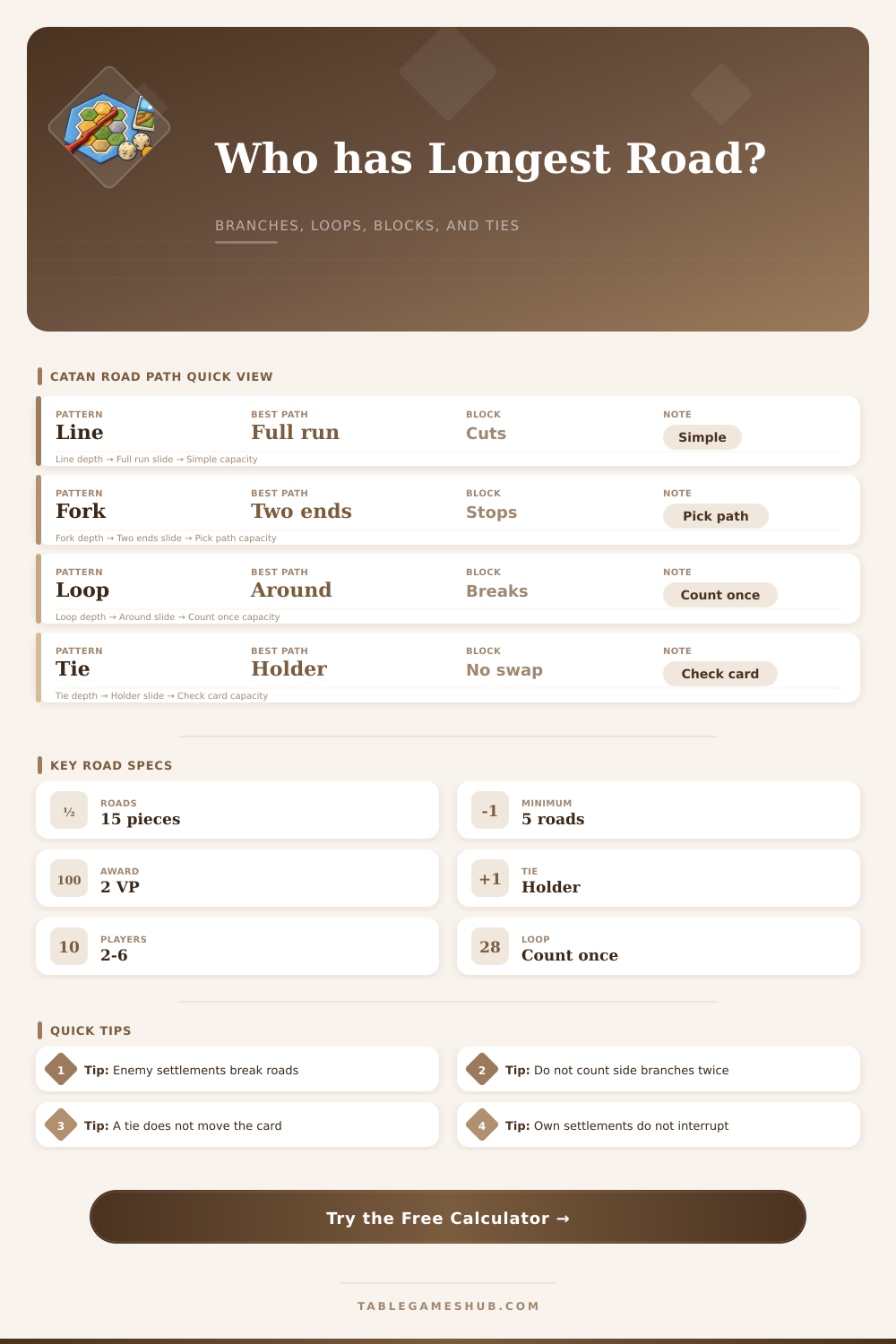
| Enemy settlement | Breaks your road at that vertex | Enemy interruptions | Own settlement does not break it |
| Equal longest road | Tie does not transfer the card | Current holder and opponent length | Must exceed the holder |
🗺Board format reference
| Board format | Typical players | Road piece limit | Route pressure |
|---|---|---|---|
| Base Catan board | 3-4 players | 15 per player | Central chokepoints matter |
| 5-6 player extension | 5-6 players | 15 per player | More blockers and longer edges |
| Seafarers island board | 3-4 players | 15 roads plus ships if used | Confirm road and ship continuity |
| Cities & Knights board | 3-4 players | 15 per player | Rules stay familiar |
| Large custom scenario | 2-6 players | Scenario dependent | Use strict vertex checks |
🔀Branch pattern guide
| Pattern | Best legal path | Risk | Suggested check |
|---|---|---|---|
| Mostly straight line | Main spine plus verified connectors | Low | Count connected roads end to end |
| Single fork | Main spine plus longer branch, or branch to branch | Medium | Compare both possible endpoints |
| Double fork or Y network | Longest pair of endpoints without reuse | Medium | Test top two spokes |
| Loop with a tail | Loop once plus one tail if not interrupted | High | Verify no edge is counted twice |
| Choke point near enemy build | Longest segment after the interruption | High | Split at enemy settlements |
🧮Preset scenario table
| Scenario | Common road shape | Likely result | Why use it |
|---|---|---|---|
| Base Game 5-Road Claim | Simple line | First qualifying card | Checks the minimum threshold |
| Forked 7-Road Network | Stem plus two branches | One branch is excluded | Tests fork handling |
| Enemy Settlement Cut | Interrupted route | Shorter legal segment | Shows blocking impact |
| Loop With Tail | Cycle plus exit | Loop counted once | Audits closed paths |
| Late Game Tie Check | Equal to holder | No transfer | Confirms contest rule |
💡Two scoring tips
This calculator is a table aid for road counting. If your board has a complex graph, use the breakdown to identify which endpoint pair needs a manual final check.
Every Catan game hits this tension point when the table falls silent. Someone has constructed yet another road, and players stare at the board, wondering who’s got longest road card. It’s a seemingly straightforward question, except the colored wooden pieces criss-crossed on the hexes make for some visual noise. You spot a long line and think, “that’s gotta win,” but then what if the path is blocked by one of your enemy settlement three intersections back? What if someone counted a loop twice, making their total illegal? Then the arguments start so you should of provided a solution before people get frustrated. That’s where the workhorse comes in (the tool above).
What it does is force you to break down components of your road network. That’s the mistake most players make, they thinks of their road network as a single blob of length rather than a series of entry/exits that connect to other parts of a graph. The calculator requires you enter your main continuous spine, the central artery of your build, and then makes you go through each fork separately. Why? Because rules say you can’t count all branches coming off a junction. Pick the longest route from one end point to the other without retracing your steps. Sounds counterintuitive if you’ve invested in three different directions, but only two of those paths will ever matter for the final score.
How to Use the Longest Road Calculator
Most people lose their points here because they don’t understand what counts as a loop. Your loop doesn’t look like a giant O on the map, it’s got all these roads coming off it. And you don’t actualy get extra points for looping back around, right? Yes! …But here’s where people trip up: According to the rules, you can only count the edges of your loop one time. So tracing around a triangle then coming back out one side to head down a tail is fine. But if you try to trace the loop again to add more length, that’s no good. Want to trace it again to make it longer? Now you’re cheating math. To avoid this, the calculator prompts separate inputs for loop edges from the rest of line so you don’t accidently double-count any of those parts. It is a small technicality, but it matters when first and second place differ by one or two road pieces.
Blocking is also a matter of human consideration. Counting road length includes an enemy settlement as a dead end. You are free to snake your roads around any of your own settlements without issue. However, that enemy town in the center of your network cut your maximum possible length in half. The calculator allows you to enter how many enemy settlement there are so it can deduct length of any segment that is broken up. This avoids mistake of glossing over a block because you haven’t studied the board close enough lately to remember what was where on previous turn.
Confusion also arises when there are ties. Beginners assume that if they build a road equal in length to current holder, they automatically claim the card. Nope. Unless you literally surpass them in length, the card remains with its previous owner. This favors the incumbent (and makes the end game tense). You could be neck-and-neck with your opponent, yet still remain stationary without that final segment. The calculator will tells you the difference between being ahead and merely even.
But there’s also the matter of resource distribution, which goes beyond math. Building roads is expensive. Where do you get grain? Where do you get bricks? How many pieces of road could you make with all this? Every time you extend your road by a single segment, you’re passing up an opportunity to build something else. This could be a city upgrade or another building that could change the outcome. Is that extra two victory points worth the resources? Do you really gain anything by extending your road at the expense of upgrading a city? In some cases, no. In other cases, you’ll find yourself already ahead, or perhaps still behind even after you build out that road.
While there’s no need to recreate the wheel with this tool, it does let you simulate some typical situations right away. It handles basic Catan, Seafarers, Cities and Knights, etc., so once you understand how pathfinding works for one, it works the same way for the others. You can play around with their scenarios until you’re confident you know how blocks and forks work together before committing them to your physical gameboard.
To win the longest road award, you need detail. While it may favor those who go off the beaten path, the true victor is the one who plans his network with defined endpoints and avoids aimless meandering around the board. Want a road? Get a road. But make sure it’s efficient, and remember that even if you build loops, you have to count them correctly, don’t let extra twists and turns confuse your final tally.
Next time you’re playing, check your competitors’ roads. Pick out their endpoints; find their blocks. And when someone challenges you for the longest road, you’ll already be prepared for the question. You’ll see exactly how they connected the dots and count them out. This will spare everyone else at the table the long discussion of “well, I think mine is longer.” There’s a winner and a loser, and this is how we tell which is which.