Archery Score Calculator
Track ring totals, Xs, end pace, and projected round score across target, field, and 3D sessions.
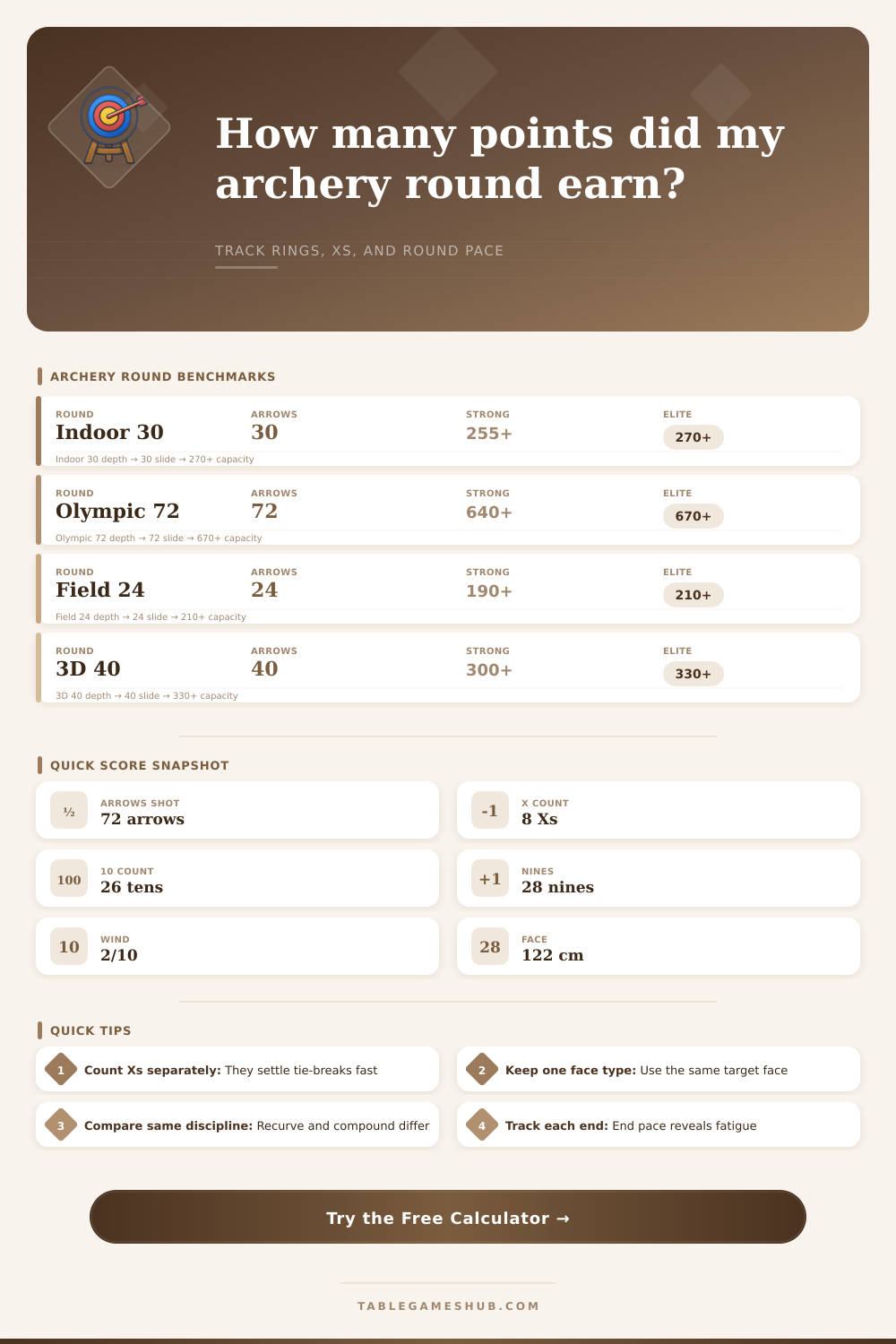
| Round | Arrows | Strong | Elite |
|---|---|---|---|
| Olympic Recurve 70m | 72 | 640+ | 670+ |
| Indoor Vegas 300 | 30 | 255+ | 270+ |
| Field 24-Target | 24 | 190+ | 210+ |
| 3D Hunter 40 | 40 | 300+ | 330+ |
| Ring | Target Mode | Field Mode | 3D Mode |
|---|---|---|---|
| X / Inner | 10 | 5 | 11 |
| 10 / Gold | 10 | 5 | 10 |
| 9 / Near | 9 | 4 | 8 |
| 8 / Mid | 8 | 3 | 5 |
| Face | Best Use | Typical Distance | Notes |
|---|---|---|---|
| 122 cm face | 70m round | Outdoor | Full-size target |
| 40 cm face | Indoor | 18m | Vegas or 3-spot |
| 80 cm face | Youth | 18m to 30m | Club scoring |
| 3D / Field | Unmarked | Mixed | Course rounds |
| Style | Bias | Stability | Projection Note |
|---|---|---|---|
| Recurve | Neutral | Balanced | Baseline line |
| Compound | Positive | High | Higher ceiling |
| Barebow | Negative | Variable | More drift |
| Longbow | Lower | Wide spread | Range sensitive |
An archery score tracker allow an archer to analyze there performance. An archery score tracker allows archers to see their performance patterns because it display more information then just the total score achieved during a shoot. If archers uses a score tracker, they can see how many arrows they shoot at an average score and whether fatigue impact their performance.
Scoring in archery involve more than just the total score. Scoring includes the number of ends and gold hit that an archer achieves. Many archers look at the number of gold hits they have achieved to determine the success of their performance in the match.
How to Use an Archery Score Tracker
For example, an individual using a recurve bow will have a different scoring standard than an individual using a compound bow. An individual using an Olympic recurve bow can score around 640 point for a 122cm target. However, an elite archer may aim for 670 points.
Using an archery score tracker can help individuals compare their scores to these examples to identify their performance. Individuals who hit many X-scores possesses better aiming skills because they have maintained their point of aim even when tired. Tens are the most importance as they will determine the bulk of an archers score.
However, this isnt sufficient for shoot-offs as X-scores is required. Nines are the next most important, as they will help an archer to even out their scores in a slump in performance. However, if an archer misses eights and below, then their aim may have drifted from the target.
If individuals input the number of ring that they hit into an archery score tracker, it will calculate the average score per arrow and the number of gold share that the individual has achieved. The size of the target and the distance that the arrow will travel will impact the scoring and the difficulty of the archery shooting session. A 122cm target will be larger and allow for more forgiveness of misses when compared to a smaller target.
A 40cm target at 18 meters are smaller than other common target distances, so it will require more precision to hit the target. Wind can play a big role in scoring on archery targets as it can push the arrows away from the center of the target. A score tracker will allow archers to account for such variable, including a conservative buffer of 10 percent to ensure that the projected scores are realistic.
Depending on the type of archery that an archer prefers, there is different ways of tracking scores. Field rounds will use five zone to score archers shots, and these targets are typicaly wider than target rounds. For 3D hunter class archery, bonus will be awarded for hitting the vitals of the target, and archers will be rewarded for estimating the distance to the target.
For clout archery, archers will need to throw their arrows at a distance, and in this case, score trackers will show archers which arrow is the most close to the center of the target. Archers of any type should use a score tracker that can adapt to these mode of scoring to keep track of their adaptability in the face of different archery disciplines. Archers can make mistake while tracking their scores.
One of the most common mistake is mixing in different types of face into the same shooting session. Mixing in a 122cm face with a 40cm face will provide inaccurate average for an archers scores. Archers can also make mistake with ignoring the quirks of the bow that they use; recurve bows need more rhythm than compound bows.
Finally, archers can get overly focused on their total score instead of their average score per arrow. If they are only focused on their total score, archers may find themselfs misled by short shooting sessions. By using the data from a score tracker, archers can determine which drill they need to focus on for practice.
If an archer finds that they are missing targets alot, they may want to practice their arrow release. If an archer find that their accuracy declines the further they shoot, they may want to practice better distance control in their practice sessions. If archers track their scores with the religion that they practice their bow skills, a score tracker will allow them to see whether their gold rate are climbing or whether their average score per arrow is increasing.
While improvements to archery skills happen in small increment, a score tracker will allow archers to identify these small improvements in their form and skill.