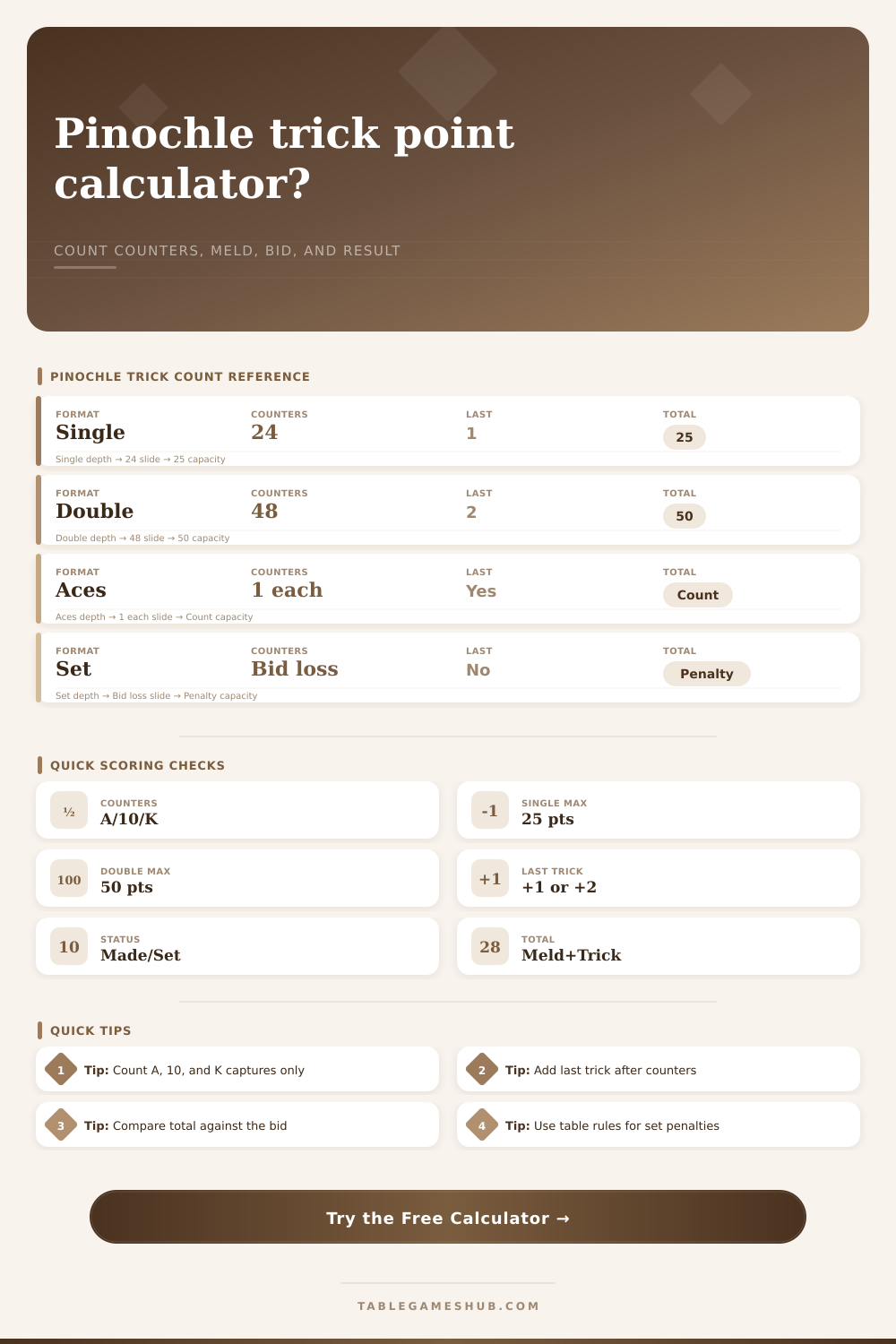
Pinochle Trick Point Calculator
Count captured A/10/K counters, add last trick, combine meld, compare the bid, and record whether the team made contract or was set.
| Scoring format | Captured counters | Last trick value | Maximum trick score |
|---|---|---|---|
| Single-deck 25 point | 24 total A/10/K counters | 1 point | 25 points |
| Double-deck 50 point | 48 total A/10/K counters | 2 points | 50 points |
| Traditional tens count | A/10/K counted as 10 each | 10 points | 250 or 500 style table total |
| Custom table note | Use the same inputs, then adjust posted score | Follow local agreement | Varies by group |
| Situation | Calculator test | Result card | Posting note |
|---|---|---|---|
| Made bid | Meld plus tricks is at least bid | Made | Post total score for the hand |
| Set contract | Meld plus tricks is below bid | Set | Apply the agreed bid penalty |
| Exact contract | Total equals bid exactly | Made | No cushion, but the bid is met |
| Last trick swing | Last trick changes total by 1 or 2 | Margin changes | Useful for close hand audits |
| Counter type | Single-deck max | Double-deck max | Why it matters |
|---|---|---|---|
| Aces captured | 8 | 16 | High-value capture count |
| Tens captured | 8 | 16 | Often swingy in trick totals |
| Kings captured | 8 | 16 | Completes the A/10/K counter set |
| Last trick | 1 point | 2 points | Added after counter cards are counted |
| Hand profile | Meld | Trick points | Bid check |
|---|---|---|---|
| Strong single-deck pull | 24 | 19 | 43 total against 35 bid |
| Close contract hand | 18 | 14 | 32 total against 31 bid |
| Double-deck trick heavy | 58 | 41 | 99 total against 85 bid |
| Short on counters | 30 | 17 | 47 total against 55 bid |
And then it’s silent at the table. Cards are turned over, and the final trick is drawn. Now you’re no longer playing cards; you’re playing accountant.
This is when pinochle stops being a game of bluffing and memory and becomes a competition in mathematical accuracy: How many kings, tens, and aces did I caught? What meld did I declare? Did I actualy make my bid, or am I donating points to my opponents? Boring stuff, sure, but the scorecard is lifeblood of this game. Unless you respect the numbers, you won’t respect the risk.
How to Score Points in Pinochle
Counting the meld is something most player are aware of. What goes unnoticed is that drama lies in scoring of tricks. There are twenty-four counting cards in play in a single deck game of pinochle. Each ace, ten, and king are worth one point. An additional point come with the last trick. Maximum points per trick are twenty-five. That is the ceiling. There are no more. Regardless of how many jacks and queens you squirrel away in your pile.
Once you punch in your counters, the calculator above do the adding for you. You won’t have to scramble for paper while your partner impatiently taps her foot. And it lets you know if you set or made your contract. After all, that is simple reality of each hand.
But first, it’s critical to know about trick points vs. Meld points. What do they do? What do they mean tactically? A meld is safe. You earn points for having the right combination of cards. Whether or not you play them well doesn’t matter. These are points-in-the-bank.
You earn trick points. You have to get your hands on high-value cards that are in play. You need to draw your partner in. You have to pull the trump suit. Most of the time, a high bid require a solid meld foundation. If you can’t snag the counters on play, it all comes tumbling down.
The table on the page is the reference. The reference table on the page shows how maximums scale between single-deck and double-deck formats. And it explains why you should adjust your expectations based off deck size.
If your running count is less than the bid, you won’t earn any points. Generally speaking, you’ll lose whatever that shortfall is. Sometimes you lose double then amount, and sometimes it goes on your opponent’s side of the score sheet. With twenty points in meld and what seems like a reasonable bid of thirty-one, now suppose you win only five trick points. That’s far from good enough. But look at that margin card in the bottom row where results is listed. How far behind are you? Take a look.
The final trick bonus gets overlooked by players. In single deck games, it’s only worth one point. That one point could be the difference between making or being set in close games. You have to plan ahead instead of playing reactively on current trick. You need to hold a card that can win the final lead, ensuring you get that extra point even if you has to sacrifice a higher counter earlier in the hand. You might of had to sacrifice something with a higher value earlier in the hand.
It’s a different size, but the logic remains the same for double-deck pinochle. You still have forty-eight counters. You get a two-point bonus for the last trick played. That takes the maximum up to fifty. But that’s just bigger numbers. Everything else is the same. You’re trying to balance the gamble on the trick play with safety of your own meld. The calculator knows that and makes sure you don’t accidentally use single-deck restrictions in a double-deck game.
There will be scoring disputes. And it’s even more common in casual groups. Who caught which ace? Did we really play a ten? A quick fix for disagreements is having some sort of written/ digital check that can quickly end arguments. It takes the emotion out of the math. Point at the numbers and move on, we want to play more hands. Arguing about arithmetic isn’t the goal.
Pinochle is as much about resource management as it is about luck. But it’s also a game of managing resources. You must manage your points (buffer), your meld, and your trump. The trick point calculator is simply there to check your management. It doesn’t play your cards for you. It makes sure that when the cards go down on the table, and it gets quiet, everybody knows exactly who won and by how much.
And the math? The math doesn’t care. But the math is fair.