Skat Game Value Calculator
Calculate suit, grand, and null game values from base value, matadors, Hand, Schneider, Schwarz, and Ouvert scoring levels.
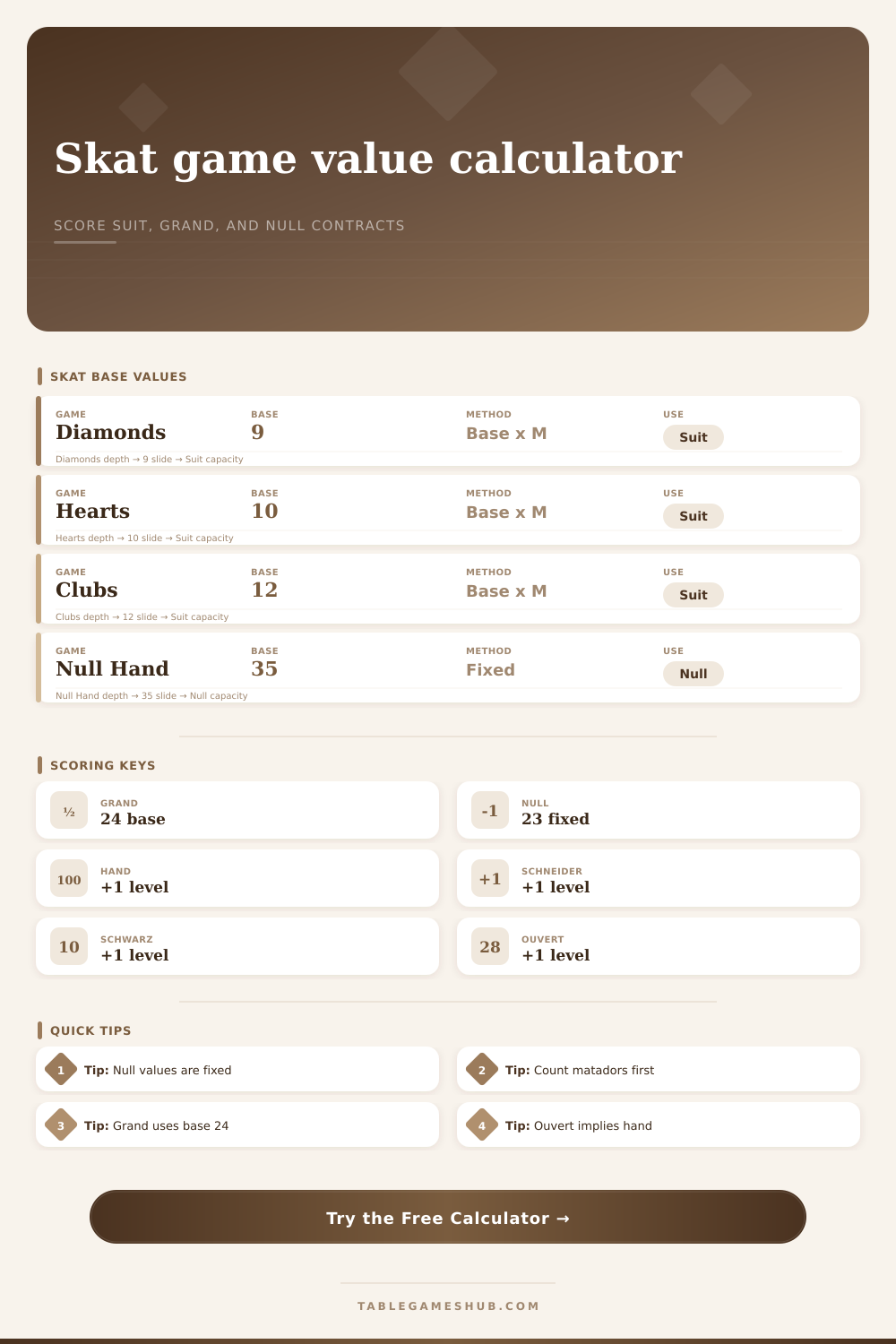
This grid highlights the ingredients the calculator uses most often: suit base value, Grand base value, the automatic game level, and fixed Null scoring.
| Contract | Base or Fixed Value | Calculation Method | Calculator Note |
|---|---|---|---|
| Diamonds / Bells | 9 | 9 × multiplier | Lowest suit base; minimum scored value is 18 with one matador level plus game. |
| Hearts / Red | 10 | 10 × multiplier | Often used for quick examples because the arithmetic is easy to inspect. |
| Spades / Leaves | 11 | 11 × multiplier | Useful when comparing a mid-base suit game against a simple Grand. |
| Clubs / Acorns | 12 | 12 × multiplier | Highest suit base; strong suit games can outscore many Grand contracts. |
| Grand | 24 | 24 × multiplier | Only the four jacks are trumps, so the practical matador count is 1 to 4. |
| Null | 23, 35, 46, or 59 | Fixed value | Null scoring ignores suit base, matadors, Schneider, and Schwarz levels. |
| Scoring Element | Adds | Requires Hand | Applies To |
|---|---|---|---|
| Matadors with or without | + matador count | No | Suit and Grand games only. |
| Game | +1 | No | Always included for a won Suit or Grand contract. |
| Hand | +1 | No | Declarer does not pick up the skat. |
| Schneider made | +1 | No | Opponents have 30 card points or fewer. |
| Schneider announced | +1 more | Yes | Counted after the Schneider made level. |
| Schwarz made | +1 | No | Opponents take no tricks; Schneider is implied. |
| Schwarz announced | +1 more | Yes | Counted after Schwarz made and announced Schneider. |
| Ouvert | +1 more | Yes | Open cards; for trump games it implies announced Schwarz. |
| Null Contract | Skat Handling | Ouvert | Final Value |
|---|---|---|---|
| Null | Skat picked up | No | 23 |
| Null Hand | Hand | No | 35 |
| Null Ouvert | Skat picked up | Yes | 46 |
| Null Ouvert Hand | Hand | Yes | 59 |
| Example | Base | Multiplier or Fixed | Game Value |
|---|---|---|---|
| Diamonds with 1, ordinary win | 9 | 1 matador + game = 2 | 18 |
| Hearts with 2, Hand, Schneider | 10 | 2 + game + Hand + Schneider = 5 | 50 |
| Spades without 2, ordinary win | 11 | 2 matadors + game = 3 | 33 |
| Clubs with 3, Schwarz made | 12 | 3 + game + Schneider + Schwarz = 6 | 72 |
| Grand with 4, ordinary win | 24 | 4 matadors + game = 5 | 120 |
| Grand with 2, Ouvert Hand | 24 | 2 + game + Hand + Schneider + Schneider announced + Schwarz + Schwarz announced + Ouvert = 9 | 216 |
You stare down at your cards. You have a Jack of Hearts and four more aces. Yeah that would be nice, but with the rules of scoring it’s hard to understand. Scoring in Skat is relatively straightforward mathematically, but then again, it can test your nerves. Most player will have picked up the fundamentals, but when you multiply it all by a higher multiplier, that’s when they falter.
Don’t worry, you won’t have to do any high-level mathematics here. Simply select your type of contract and how many Matadors is present and let the calculator do its stuff.
How to Calculate Your Score in Skat
The first thing to learn is starting value. Clubs are 12, Spades are 11, Hearts are 10, and Diamonds are 9. When you get to grand games, these are doubled (24).
Why those values? You might say they’re arbitrary, but they set the limit on what you can score. A low-value suit game can actualy outscore a weak Grand if multiplier is high enough. This is where most casual player go wrong. They assume “grand” must be worth more then a low value game. But in fact, if you have lots of matadors AND a strong diamonds game, the final score may be greater. The table below shows effect of multiplying a relatively low base value against a strong trump sequence.
The scoring are driven by matadors. It’s a count down from the top that starts with whatever trump you do (or don’t) hold. If you have the first and second trump, then you’ve got two matadors. The same applies if you don’t. So it rewards strength and also rewards weakness; which is kind of cool. And it doesn’t so much care about direction as it does about continuity. Your multiplier gets broken if there’s a break in the chain. Yes, you may have a string of three high trumps. But if they’re not next to each other, you start over. Before adding on other layers, the tool forces you to check for continuity.
That multiplier gets changed by modifiers. The score get higher if any of Hand, Schneider, Schwarz, and Ouvert are in effect. Hand is when you didn’t play the skat, adding one point. Schneider is when your opponents didn’t score more than 30 card points. Schwarz is when they scored nothing at all. Every level include the prior levels, so the score could be doubled or even tripled. Schwarz also happens to count as Schneider, which you may easy forget. The calculator knows those rules and runs them through. It doesn’t expect you to keep track of which bonuses are cumulative. Just tell it what happened and what you claimed.
But a null game is different. It’s not a multiplier game. It has a set value, depending off how you play. Twenty-three points for a simple null. Thirty-five for a hand played Null. More with an ouvert. No matador in a null. So your hand strength doesn’t increase the point value of the contract. It is just whether you make it or not. Which makes nulls feel like a different game than others. One where you’re betting on complete control and not little things that gives you an edge.
And then there’s stopping: That’s where it really gets interesting. If you don’t know when to stop you may have a good score, but lose the game and take a serious hit on your total. Getting points isn’t all about getting as many as possible. It’s about getting enough points without taking a risk. Often, winning a small suit game is worth more then nearly missing a risky Grand Slam. The app shows you that tradeoff. How much risk does Ouvert add? Exactly how many points? It gives you the data to make a cool choice rather than an ego choice.
It’s all about the numbers; they’re the language of Skat. But it’s also about the math. If we can eliminate the guessing, we gets more time to focus on the strategy, and the partnership. The numbers won’t go away. What you do with them is up to you.
You should of used a calculator sooner.