Bridge Losing Trick Count Calculator
Count losers by suit from length and A/K/Q holdings, combine with partner losers, apply fit credit, and convert the result into expected tricks.
| Suit Length | Top Holding | Loser Count | Calculation Note |
|---|---|---|---|
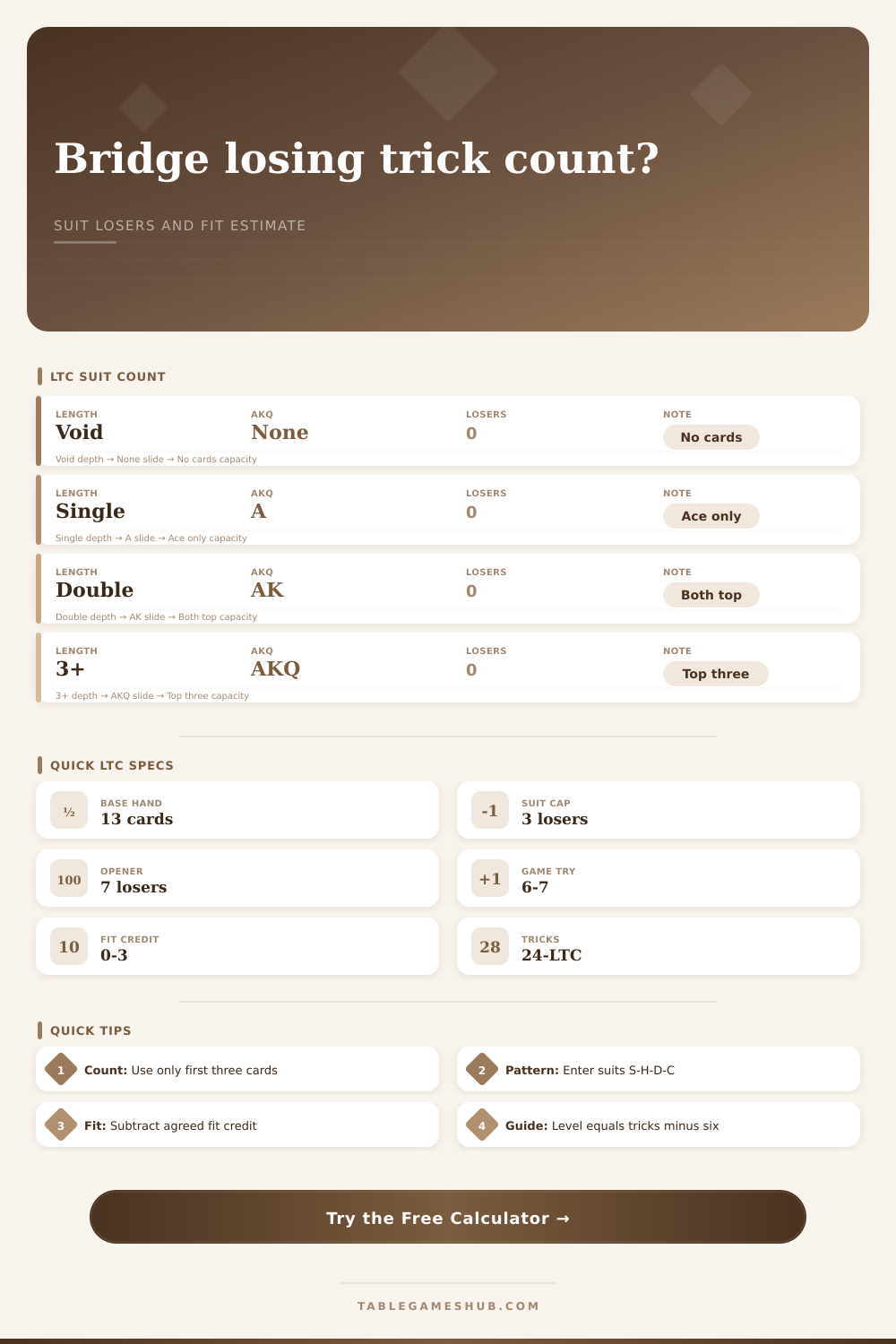
| Void | Any display selection | 0 | No cards in the suit, so no top-three losers are counted. |
| Singleton | Ace | 0 | A singleton ace covers the only counted card in that suit. |
| Singleton | K, Q, or none | 1 | A non-ace singleton has one loser under ordinary LTC arithmetic. |
| Doubleton | AK, AQ, KQ, A, or K | 0 to 1 | Two cards cap the suit at two losers; each useful top honor reduces the count. |
| Doubleton | Q only or none | 2 | The queen alone is treated cautiously in a two-card suit. |
| Three or more | A/K/Q mix | 0 to 3 | Start with three losers, then subtract A, K, and Q held in the suit. |
The calculator caps every suit by length and shows the intermediate suit values in the result breakdown.
| Adjusted Combined Losers | Expected Tricks | Level Number | Numeric Meaning |
|---|---|---|---|
| 18 | 6 | 0 | Partnership estimate is below one-level trick target. |
| 17 to 15 | 7 to 9 | 1 to 3 | Part-score range by raw trick estimate. |
| 14 to 13 | 10 to 11 | 4 to 5 | Game-zone trick estimate before strain choice. |
| 12 | 12 | 6 | Small-slam trick estimate by arithmetic. |
| 11 or fewer | 13 or more | 7+ | Grand-slam range by numeric LTC only. |
Level number is expected tricks minus six. This table is a calculation guide, not a bidding recommendation.
| Your Losers | Partner 9 | Partner 8 | Partner 7 | Partner 6 |
|---|---|---|---|---|
| 8 losers | 7 tricks | 8 tricks | 9 tricks | 10 tricks |
| 7 losers | 8 tricks | 9 tricks | 10 tricks | 11 tricks |
| 6 losers | 9 tricks | 10 tricks | 11 tricks | 12 tricks |
| 5 losers | 10 tricks | 11 tricks | 12 tricks | 13 tricks |
The grid assumes no fit credit. Add fit credit by subtracting it from combined losers, which raises the expected trick estimate by the same amount.
| Preset | Pattern | Main Input | Partner LTC | Fit Credit |
|---|---|---|---|---|
| Balanced opener | 4-4-3-2 | Broad top honors | 8 | 1 |
| Major fit invitation | 5-4-2-2 | Concentrated majors | 8 | 2 |
| Shortness fit hand | 6-5-1-1 | Two suits plus controls | 7 | 3 |
| Slam range probe | 6-4-3-0 | Top controls and void | 6 | 2 |
Here is my situation: My hand is unclear but not bad; I have some high cards and some short suits. Should I make game? Or will I be happy to play for a part score?
One way to count your hand would be the old-fashioned way (high card points). But that doesnt always reflect shape of the hand or the way two or more suit in partnership work well together.
Why Losing Trick Count Is Better Than Points
Here’s a more direct route to guessing trick-taking ability in a particular suit contract: Focus less on what you have, and more on what you don’t have.
Lose trick count does just that: It takes care of the arithmetic. It’s a straightforward calculation: Figure the number of losers in your own hand; guess at the number of losers in partner’s hand; subtract both numbers from 24. What’s left is your expected number of tricks.
Why? If you assume all winners in one hand can trump a loser in the other (assuming you have a fit), then you only need to subtract losers in both hands.
For a reference, look at the table below based off this page, it explains how top honors affect your loser count. A single king is worth one loser, but an ace-king-queen in a three-card suit are counted as no losers at all.
Why does it matter? Losing trick count show immediate playing strength, not more distant defensive values.
The most common error new players make is to count losers in all four suits as equals. Count only those in the agreed trump suit and the other two that you expect your partner to draw or ruff into.
A void in one suit does not matter, unless your partner hold honor cards in it that cannot help you. That’s where folks go off track. They penalize themselves for having no cards in a suit, but a void is actualy pure playing strength as long as they can ruff it. The calculator automaticly accounts for that when you input your suit length pattern, so you don’t overcount losses in empty suits.
The evaluation becomes dynamic at this point, credit for the fit. With an eight card fit between you and your partner you can generally discount one loser from total tally. If you’re fairly short in the minors with a good fit you may be able to deduct two or three from the total. The deduction is made because you can use trumps to win losing tricks in your short suits. You judge shape of combined hands and then pick the fit deduction from the tool. The deduction is a number added directy to the trick estimate.
Fourteen in combined losers typically points toward a game contract; twelve toward the slam zone. But these are guidelines rather than strict rules. They’re helpful just as a decision-making baseline.
Also, keep in mind how you treat unsupported queens. By default, if a queen has a king or ace backing her up, she’s a winner. In strict mode, she gets downgraded if she’s all alone and can be easily captured. So this option comes into play at the edge of passing vs raising. The strict option provides you with a more cautious number if you’re uncertain whether a queen is safe. No worries about bidding too high on honors that won’t stand up. You should of worried about it before.
In the tool, you can see some example bidding hands that have been set up as presets. The first is a typical hand with a balanced seven-loser opener. The second is a hand with a short suit that illustrates what happens when you get singletons and voids in certain suits, the number of losers drop, making it easier to make game.
That allows you to adjust your intuition. You begin to see where tricks trump points, particularly on Distributional hands where shape determines the outcome.
In the end, bid according to your true ability to take tricks. Wealth = points. Work = losers. When you grasp the subtraction method, you’ll find many hands that seem weak based off points but are actually very strong against losers. It’s simple math, but it’s the judgement calls where the game resides. Always consider the bidding flow and trust your numbers when they feel right.
And remember: you are not just counting cards. This is an estimation of partnership strength. That perspective is what separates a good bridge player from a great one.