Cribbage Muggins Calculator
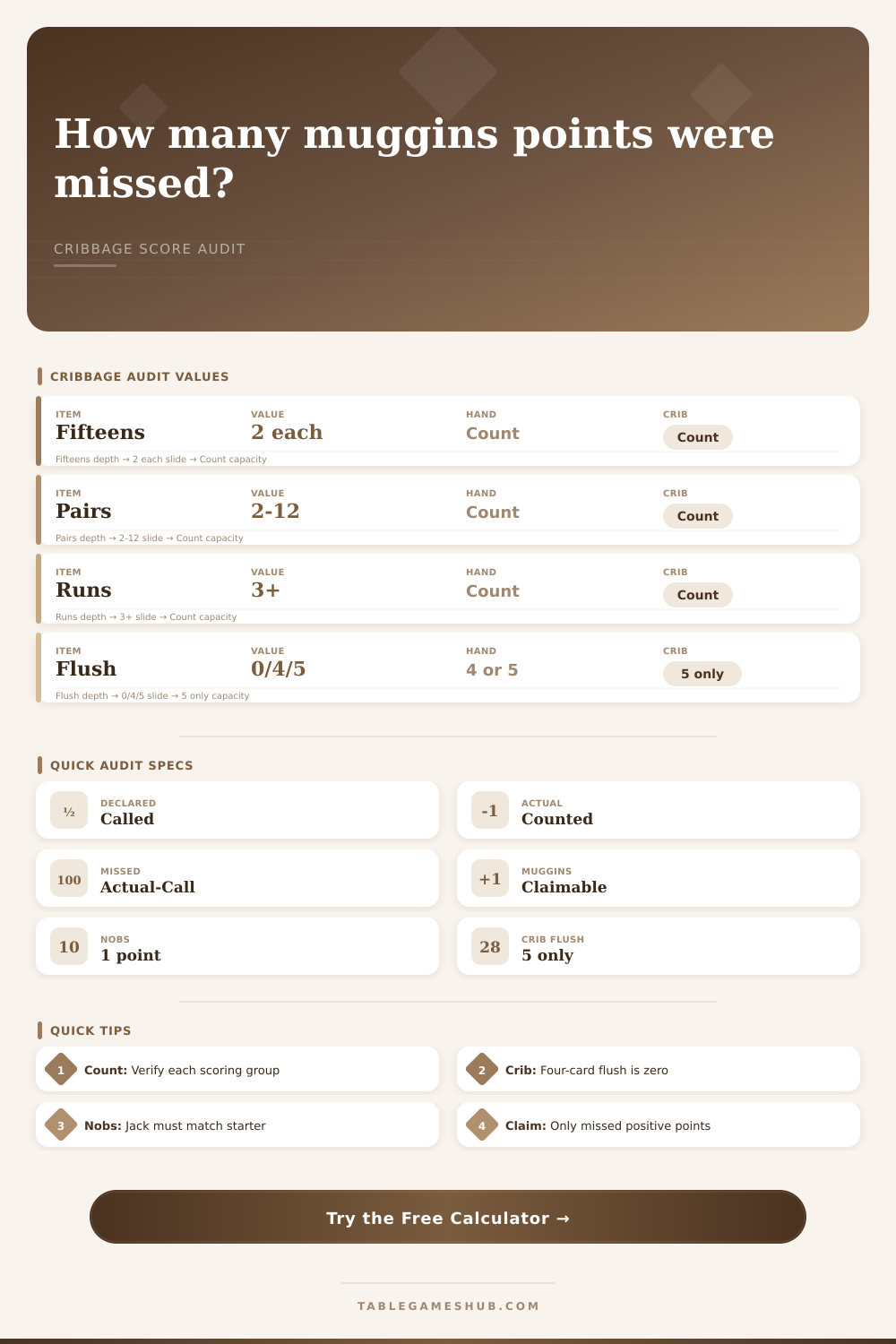
Audit a declared hand or crib count against actual fifteens, pairs, runs, flush, and nobs to find missed and claimable muggins points.
Missed-Score Audit
The announced value is compared directly to the audited component total.
Fifteens, pairs, runs, valid flush, and nobs are added as the audit score.
Hand and crib use different flush validation for four-card flush entries.
Positive missed points can become claimable when muggins is active.
| Scoring item | Point value | Audit entry | Counting note |
|---|---|---|---|
| Fifteens | 2 points each | Number of combinations | Count every distinct card group that totals fifteen. |
| Pairs | 2, 6, or 12 common totals | Actual pair subtotal | A three-of-a-kind is 6 because it contains three pairs; four-of-a-kind is 12. |
| Runs | Length of each run | Actual run subtotal | Enter the combined value after duplicate-card run multiplication is resolved. |
| Flush | 4 or 5 in hand, 5 in crib | Flush points before context check | The calculator removes a four-card crib flush because it is not valid. |
| Nobs | 1 point | 0 or 1 | Only the jack in hand or crib that matches the starter suit counts. |
| Context | Four-card flush | Five-card flush | Audit effect |
|---|---|---|---|
| Player hand | Valid for 4 | Valid for 5 | Use the entered flush value as long as it is 0, 4, or 5. |
| Crib | Not valid | Valid for 5 | A selected 4-point flush is adjusted to 0 before the actual score is totaled. |
| Review only | Still audited | Still audited | The missed-score math is shown, but claimable points are set to 0. |
| Teaching audit | Still audited | Still audited | Claimable value is displayed as half of the positive missed score. |
| Missed item | Typical amount | Where it appears | Audit checklist cue |
|---|---|---|---|
| One fifteen | 2 points | Any hand or crib | Re-scan all two-card and multi-card groups that total fifteen. |
| Nobs | 1 point | Any hand or crib with matching jack | Compare every jack suit to the starter suit before closing the count. |
| Pair inside a run | 2 points or more | Double-run shapes | Separate the pair score from the multiplied run score in the audit. |
| Pair royal | 6 points | Three cards of one rank | Count all three embedded pairs, not just one visible pair. |
| Hand flush | 4 or 5 points | Player hand only for four-card flush | Check whether the starter extends the hand flush from four to five. |
| Crib flush error | Usually 4 overcalled | Crib only | Remove a four-card crib flush unless the starter also matches suit. |
| Audit step | Component checked | Entry field | Pass condition |
|---|---|---|---|
| 1 | Declared score | Declared score | The announced count is entered exactly, with no later correction included. |
| 2 | Fifteens | Actual fifteens found | Every distinct fifteen is counted once and multiplied by 2. |
| 3 | Pairs and runs | Pair points and run points | Pairs are not lost inside double, triple, or quadruple run structures. |
| 4 | Flush context | Hand or crib plus flush points | Four-card flush is allowed in hand and rejected in crib. |
| 5 | Nobs | Actual nobs | The matching jack point is added only when suit matches the starter. |
| 6 | Muggins difference | Audit rule | Claimable points use only actual score above declared score. |
No wonder: The pegboard is merciless because it shows your errors in reverse order. In fact, cribbage is perhaps the only card game in which everyone can see the score at any moment. There’s no hiding if you count wrong, you have to move the pegs into place right then or never.
That transparency increase the pressure on the table. A player counts eighteen points. Another thinks he sees two more, for a total of twenty. Too late. The first guy already pushed his peg ahead. The second guy pushed beyond that peg. Strategy doesn’t matter anymore; now it is simply a question of who is right.
How to Count Cribbage Correctly
That’s when the muggins rule come into play. Muggins is payback for sloppy math. It’s a reward for paying attention.
So after you declare your score and list the actual components you have reviewed, the calculator handles the math for you (see example above). No more debates about if a fifteen was missed or if there was another run hiding somewhere in that hand. The calculator break out the actual score from the declared score so it can figure out the difference. That difference matter. The difference is the points owed to the person who caught the mistake.
Simple enough right? But that’s where most player fall short…in execution.
It’s difficult to count Cribbage because your human brain does not handle multiple tasks well. To count, you look at one starter card plus four in your hand. You have to find: Fifteens, Pairs, Runs, Flushes and Nob. Five tasks goes on at the same time. Keeping track of the total makes your brain get overwhelmed. Most people just count by category, starting with fifteens, and moving on to pairs, etc. But categories overlap. What happens if your pair was also part of a run? What happens if your pair shared cards with a fifteen? So you make an error (double counting) or you forget what you’ve already counted when you switch categories.
That’s where the calculator come in, helping you check the process, force yourself to break down the hand piece-by-piece before summing it up.
A crib flush is one of the most common mistakes. In your hand, if you have a four-card flush, that’s worth four points; a five-card flush is worth five. However, when the crib is involved, things are different than before. Your four-card flush in the crib won’t count if there isn’t another card matching the suit in the starter so you can complete a five-card flush. Many people assume the crib flush is treated just like the hand flush, but it isn’t. That’s why the calculator take into account the situation automatically. If you choose crib and then input a four-card flush, the calculator will rightfuly zero it out. It’s a little rule, but it catches even seasoned players off guard when they’re playing quick.
Another common victim of the count is nobs. If you have a jack matching the suit of your starter card, you get a nob, which is worth one point. That doesn’t sound like much, one point, but it’s enough to send someone out on the wrong side of first place. That small point isn’t easily lost amid bigger ones.
That’s why we audit. As you run through each hand and review what happened, look at where the holes are in the reasoning. Did you fail to notice three cards made a 15? Did you overlook that a triple card scores as a pair with a value of six points, not two? Each mistake add up.
A muggins audit tool will teach your eyes what cards do to the other ones in your hand. It’s not so much cheating as it is learning. It teaches your eye to see the structure of the hand instead of guessing how many points might be in there. You start recognizing those hands that score high and those that have an impressive shape but turn out to be empty. You’ll learn to rely on the count. The idea is to get to a place where you don’t use the calculator at all. You just know.
Until then, the math is the referee. It’s who breaks up the fights when you argue over something, and raises no voices. Math lets you move on and learn. That is realy what it is.
The pegboard doesn’t care if you meant to or not. All it sees are numbers and it only wants those numbers to be right. If they aren’t, you don’t move along in the game.
Next time you’re sitting down to play, think about this. Every card makes the score change. And checking that score is part of the rhythm. You count, check, and peg. That’s how you win.