Upwords Stack Scoring Calculator
Count one turn by word length, stacked tile heights, unstacked tile appearances, all-one-level bonuses, extra words, and rack tiles remaining.
| Score Piece | What To Count | Calculator Input | Points Added |
|---|---|---|---|
| Main word length | The primary word made this turn | Main word length | Used to audit total word tiles |
| Extra words | Every additional word created | Additional words and tile count | Each counted word adds its tiles |
| Unstacked tiles | Level-one tile appearances | Unstacked tiles counted | 1 point per appearance |
| Stacked tiles | Tile appearances above level one | Stack count and height total | Final height for each stack |
| All-one-level words | Words with no stacked letters | Bonus letters | Adds 1 more per letter |
| Final Height | Tile Type | Single Appearance | Example Use |
|---|---|---|---|
| 1 high | Unstacked | 1 point | Ground-level letter in a mixed word |
| 2 high | Stacked | 2 points | One tile placed on another tile |
| 3 high | Stacked | 3 points | Third tile in a stack |
| 4 high | Stacked | 4 points | High-value stack in a word |
| 5 high | Stacked cap | 5 points | Maximum stack height to count |
| Words Formed | Main Length | Extra Tile Count | Total Tile Appearances |
|---|---|---|---|
| 1 word | 5 letters | 0 tiles | 5 counted appearances |
| 2 words | 5 letters | 3 tiles | 8 counted appearances |
| 3 words | 6 letters | 7 tiles | 13 counted appearances |
| 4 words | 7 letters | 11 tiles | 18 counted appearances |
| Rack Tiles Left | End Adjustment | Turn Score Example | Net Shown |
|---|---|---|---|
| 0 tiles | 0 points | 18 | 18 |
| 1 tile | -5 points | 18 | 13 |
| 3 tiles | -15 points | 18 | 3 |
| 7 tiles | -35 points | 18 | -17 |
Ground Word
Five letters, no stacks, all one level.
10 ptsMixed Stack
Five letters with stack heights 2 and 3.
8 ptsCross Word
Main word plus a three-letter cross word.
11 ptsEnd Rack
An 18-point turn with two tiles left.
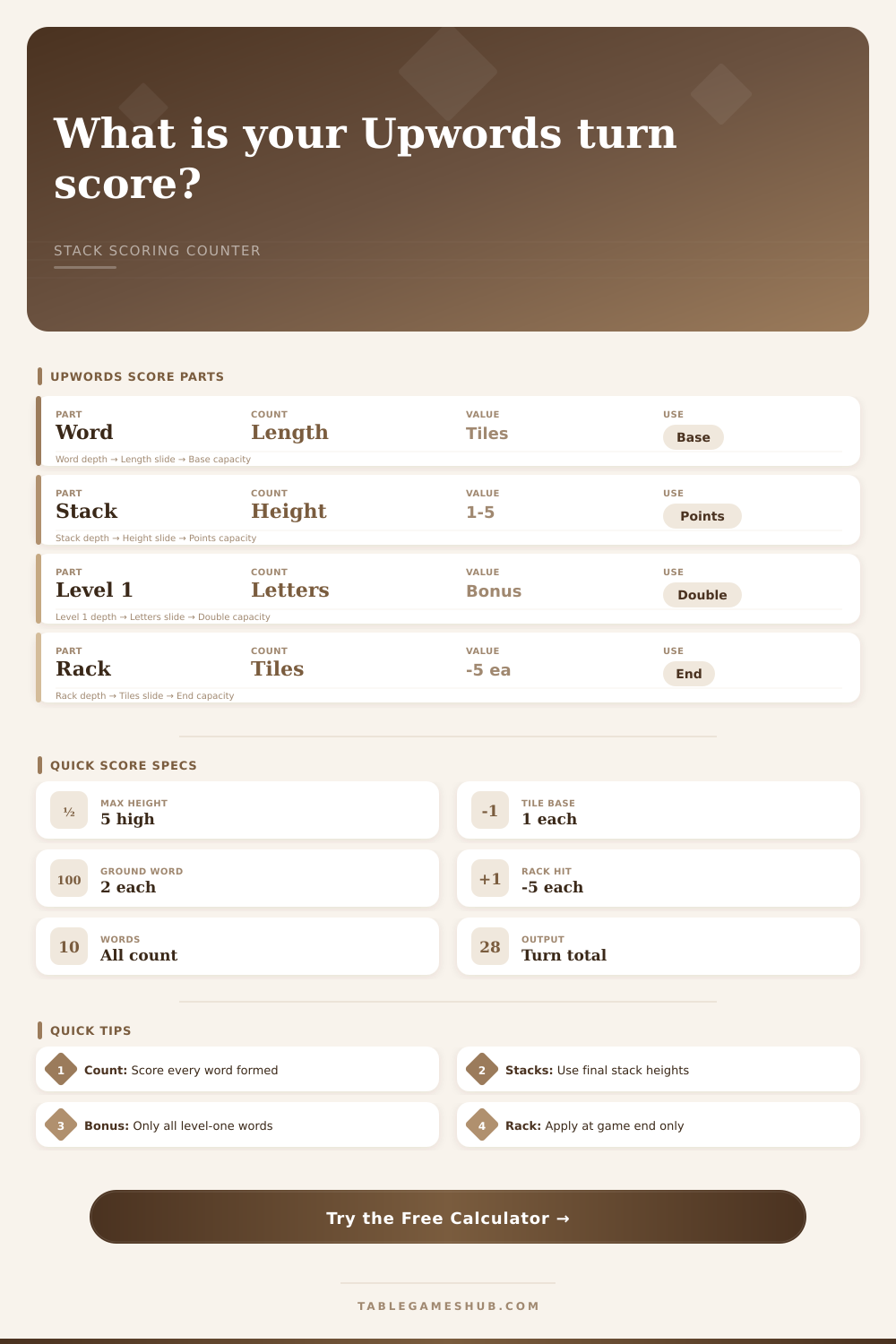
8 netThis is a very visual game that require your brain to do some math, which makes it hard. It’s easy to think you’ve made a good move only to have your score fall short. That’s because the game doesn’t reward how long a word is; it rewards how high it goes and how much space it take up on board. That means there are two part to this game: The mathematics of scoring (which I’ll leave to the calculator) and the geometry of placing tiles on the board.
How many did you put down? What was highest stack? Each tile earns a point, with a base value of one. And then you add height. A tile on level two are worth two points. Five points if it lands on a tile that’s already in place on level five.
How to Score Points
A common mistake people make is forgetting to count cross words. Any new word created that cross the main play adds to your score. The calculator has an input for cross words and their total tile count. All you have to do is figure out what you made. The reference table show the main word length and extra tile counts to show how many times each appear. Cross words left uncounted represent points left on the board, simple enough, just check letters where they intersect.
That brings us to our first bonus. And it’s a sneaky rule that will trick people. It’s called level-one. For every word where all tiles are on level one, there’s an additional point per letter. That’s basically doubling your word value. The calculator highlights this separately. There’s no mixing it with stack points. Either a word is completely on the ground or it isn’t. Identify the ones that is fully on the ground. That gets you the bonus.
There’s also end-of-game scoring, which complicate things further. For each tile remaining on your rack at the end of the game, you lose five points. That can negate an otherwise good turn. This is accounted for based off the calculator too. It will display both your raw turn score as well as what you gained (or lost) after accounting for those remaining tiles. With three tile on your rack, for example, that’s worth losing fifteen points and it’ll help determine if you should of be playing safely or gambling with a large stack.
This translates into a tidy set of rules that transform a jumbled board into an understandable equation. There’s no need to keep track of whole state of the game. Break it down: Count the stacks, now count the crosses. Subtract the rack penalty, add the level one bonus.
The key isn’t that you’re a mathematical genius. It’s that you’re organized. When you stop trying to guess and instead start counting, something happen in the game. You start seeing the value in height rather than just length. You go from playing with words to playing with shapes.