Dominoes Pip Total Calculator
Total a double-n domino set, confirm the tile-count and pip-sum formulas, estimate dealt hand tiles, count the boneyard, and track remaining pip value.
🎲Presets
⚙Pip Accounting Inputs
Domino Pip Results
🧮Set Snapshot
📊Set Comparison Grid
📋Domino Pip Reference Tables
| Domino set | Maximum double n | Tile count formula | Total pip formula |
|---|---|---|---|
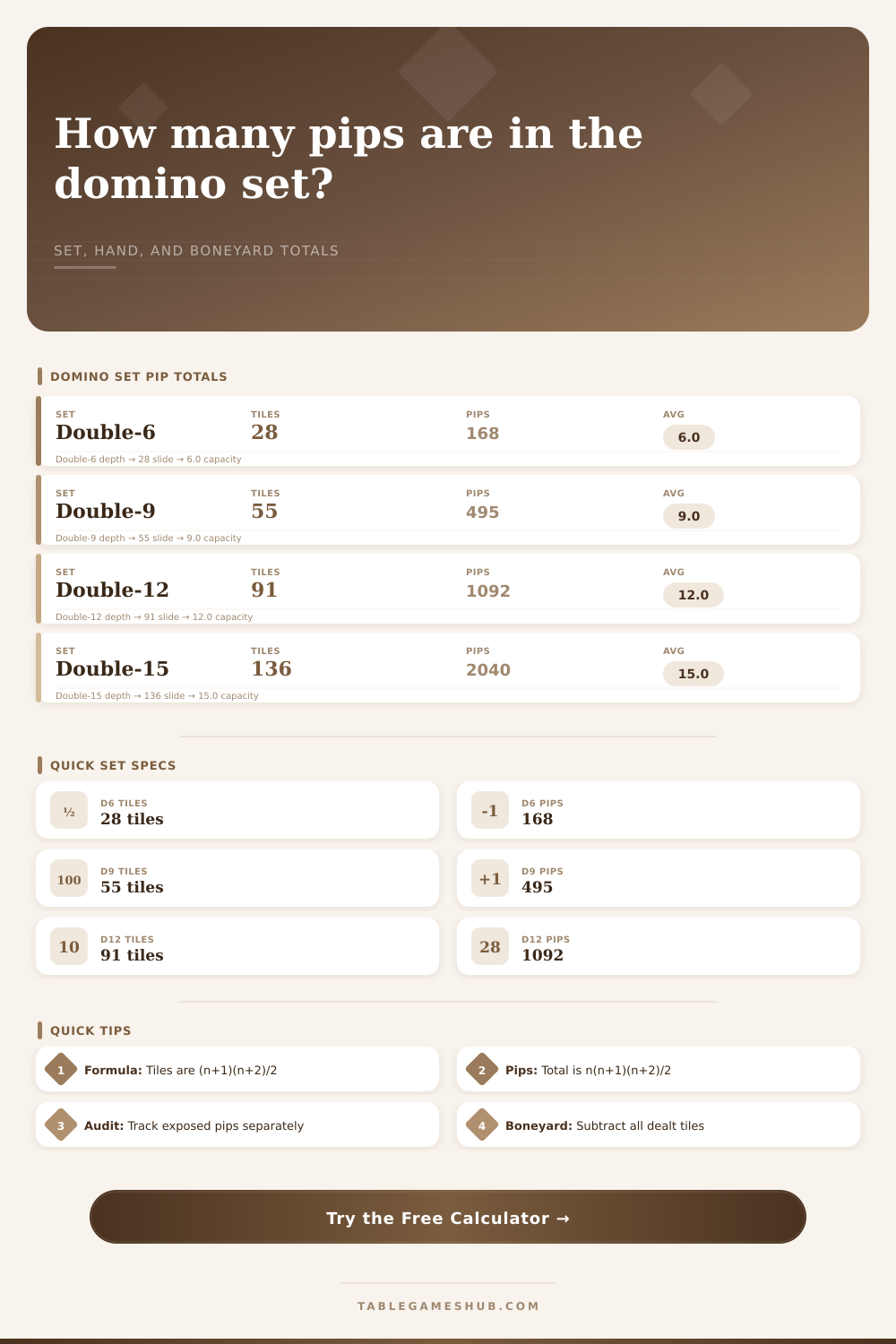
| Double-six | 6 | (6+1)(6+2)/2 = 28 | 6(6+1)(6+2)/2 = 168 |
| Double-nine | 9 | (9+1)(9+2)/2 = 55 | 9(9+1)(9+2)/2 = 495 |
| Double-twelve | 12 | (12+1)(12+2)/2 = 91 | 12(12+1)(12+2)/2 = 1092 |
| Double-fifteen | 15 | (15+1)(15+2)/2 = 136 | 15(15+1)(15+2)/2 = 2040 |
| Double-eighteen | 18 | (18+1)(18+2)/2 = 190 | 18(18+1)(18+2)/2 = 3420 |
| Common deal | Players | Tiles each | Boneyard after deal |
|---|---|---|---|
| Double-six draw | 2 | 7 | 14 tiles remain from 28 |
| Double-six four-player block | 4 | 7 | 0 tiles remain from 28 |
| Double-nine train table | 4 | 10 | 15 tiles remain from 55 |
| Double-twelve large train table | 8 | 12 | Use fewer tiles; 96 exceeds 91 |
| Double-twelve six-player deal | 6 | 12 | 19 tiles remain from 91 |
| Formula piece | Meaning | Why it works | Calculator use |
|---|---|---|---|
| n | Highest pip rank in the set | Ranks run from 0 through n, giving n+1 ranks | Selected by maximum double |
| (n+1)(n+2)/2 | Full set tile count | Counts unordered pairs with repetition | Base tile inventory |
| n(n+1)(n+2)/2 | Full set pip sum | Each rank appears n+2 times across the set | Base pip inventory |
| players x hand size | Total hand tiles | Every player receives the same starting count | Subtract from full set tiles |
| Pip bucket | What to enter | Result effect | Audit note |
|---|---|---|---|
| Exposed table pips | Visible played tiles or layout pips | Subtracted from remaining pip value | Count both ends of each visible tile |
| Scored or removed pips | Pips already credited, boxed, or missing | Subtracted from remaining pip value | Keep this separate from exposed pips |
| Hand pips | Usually hidden during play | Estimated from average pip density | Exact only if every hand is counted |
| Boneyard pips | Tiles left after the deal | Estimated from boneyard tile count | Override count if players have drawn tiles |
💡Calculation Tips
Chances are you’ve seen this debate unfold already. There’s a jumbled heap of dominoes with two individuals standing nearby; one claims that the set is intact while the other claims something is amiss. This could occur in a bar or at family reunion. They begin by counting all the tiles, but they conclude by arguing over pips. Knowing how many spots are in a set can help. When the physical evidence fails, it will only resolve the debate.
There are exactly one hundred sixty-eight pips on a standard double-six set with its twenty-eight tiles. Until you examine math, it’s an arbitrary number. It’s actualy a simple equation where the number of times each rank appears add up to total. If you have a bigger double-twelve set, that figure soars to one thousand ninety-two pips.
How to Count Pips in Dominoes
Select the type of set you’re using and input deal size into calculator above. It does all the hard work for you. You no longer has to crunch numbers during game. Being able to run the numbers doesn’t make you a mathematician. You just need to know which variables to use.
Understanding what that means, though, is main part of trick. A pip is a value; a tile is a physical object. You might capture enough pips to gain all of them even though you lost all your tiles. Or, you might box away all your tiles so they’re worth nothing while keeping all there value. By separating those two ideas, the tool knows what to ask for.
How many players are playing? How many tiles does everyone have? What’s the highest double in your set? From there it makes a guess about boneyard. And then it asks you how many pips is showing on the table.
This is where most people mess up. They tally the tiles on the table but don’t subtract out pips that’ve been scored so far. Remove that and things change.
Let’s consider a double-nine game. There are four hundred ninety-five pips. There are fifty-five tiles in set. Six players take ten tiles apiece. There are sixty tiles in hands. Fifteen are in boneyard. Where is the value hidden? Is it on the table or in hand?
That’s where the calculator come in to tell you how many pips are left. It tells you how much you haven’t accounted for. And if that number is big, somebody’s got a tile with high value hidden. If that number is negative, you messed up somewhere in your tracking. It turns a vague feeling of something being wrong into hard data.
The math backs up the rhythm of dominoes. For block games, it’s about who has heavy ones in their hand (i.e., which tiles has the most pips). For draw games, it’s about running out of bones in the boneyard. This also connects to the number of pips per tile. For any given hand, knowing the average pips per tile lets you size things up: if you’re holding mostly singles but the average is twelve pips, you know the big money lies somewhere else.
That informs strategy. Do you go for broke? Or do you play it conservative? The reference tables on page spell it out for each of the more commonly used set sizes. You’ll note that as the set size increases, the number of pips grows cubically. The number of tiles grow quadratically. This difference becomes important as the sets gets bigger.
This creates the most friction: The missing tiles. “Where’s my double-blank?” They freak out. But more often than not, just count pips that show. Sometimes you can figure it out quicker by counting the exposed pips than by shaking bag. When it all adds up, then one of those tiles must be in someone’s hand. If there’s no pips showing, then you know exactly what tile is missing.
It is a small thing. It makes a big difference. It turns chaos into logic. Guessing becomes knowledge.
This way of thinking forces you to look at game differently. Not only are dominoes a rectangle made off wood and/or plastic, but they carry value which needs to be balanced. From the second the deal begins, there is a set amount. There’s no creating or destroying pips. You are only moving them. Keeping that in mind makes it easier to follow the game in your head. You don’t have to scribble down each move. You simply need to know where weight lies.
Ultimately, if you perform an audit early on, then the “lost tile” debate never occurs. First you set your baseline. Before playing any tiles, you make sure that it adds up, you verify pips, and you double-check your count. Then you play confidently knowing the math could of helped settle disputes about missing tiles. When the mechanics become obvious, game runs smoother. Instead of tracking your inventory, you focus on strategy.
Next time somebody accuses you of losing a tile, there’s no need for arguing; you’ll simply refer them to the numbers.