Mahjong Point Transfer Calculator
Calculate riichi mahjong ron or tsumo payments from han, fu, dealer seat, honba sticks, riichi deposits, and the point delta for each of four players.
| Hand Class | Trigger | Base Points | Dealer Ron | Child Ron |
|---|---|---|---|---|
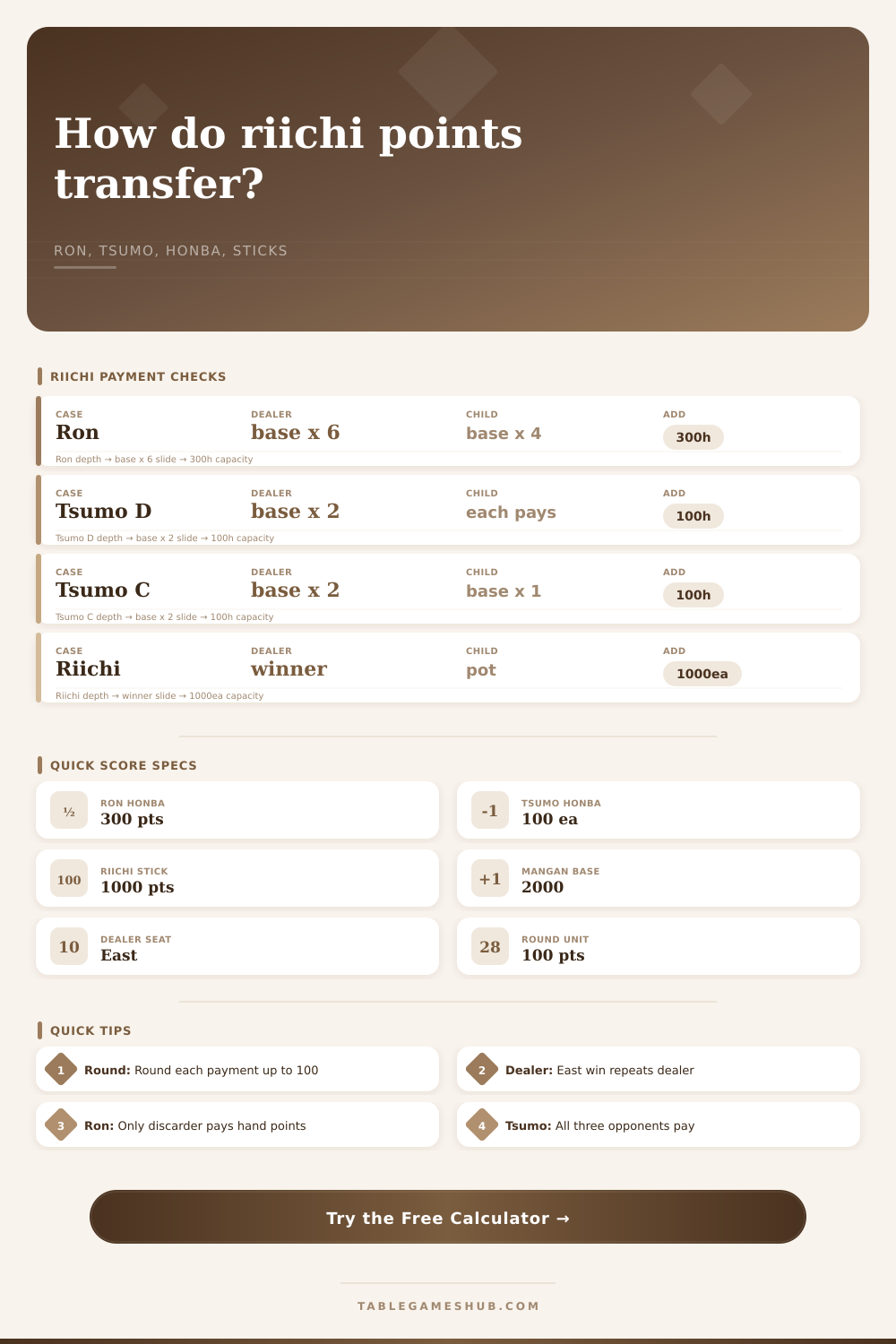
| Calculated hand | Below mangan | Fu × 2^(han+2) | Base × 6 | Base × 4 |
| Mangan | 5 han, 4 han 40+ fu, 3 han 70+ fu | 2000 | 12000 | 8000 |
| Haneman | 6 to 7 han | 3000 | 18000 | 12000 |
| Baiman | 8 to 10 han | 4000 | 24000 | 16000 |
| Sanbaiman | 11 to 12 han | 6000 | 36000 | 24000 |
| Kazoe yakuman | 13+ han in counted-yakuman rules | 8000 | 48000 | 32000 |
| Han / Fu | Class | Dealer Ron | Child Ron | Child Tsumo |
|---|---|---|---|---|
| 1 han 30 fu | Calculated | 1500 | 1000 | 500 / 300 |
| 2 han 30 fu | Calculated | 2900 | 2000 | 1000 / 500 |
| 3 han 40 fu | Calculated | 7700 | 5200 | 2600 / 1300 |
| 4 han 30 fu | Calculated | 11600 | 7700 | 3900 / 2000 |
| 3 han 70 fu | Mangan | 12000 | 8000 | 4000 / 2000 |
| Item | Ron Effect | Tsumo Effect | Delta Treatment |
|---|---|---|---|
| 1 honba | Discarder pays +300 | Each opponent pays +100 | Winner receives +300 total |
| 2 honba | Discarder pays +600 | Each opponent pays +200 | Winner receives +600 total |
| 1 riichi stick | Winner receives +1000 | Winner receives +1000 | Deposit pool transfer |
| Dealer win | East remains dealer | East remains dealer | Repeat dealer |
| Input Case | Calculator Handling | Why It Matters | Payment Step |
|---|---|---|---|
| 20 fu | Kept as 20 | Common for closed pinfu tsumo | Then multiply by han |
| 25 fu | Kept as 25 | Seven pairs scoring line | Then multiply by han |
| 31 to 39 fu | Rounded to 40 | Fu rounds before payment | Then round payment to 100 |
| Base above 2000 | Capped as mangan | Limit threshold reached | Use limit table amount |
There’s a certain kind of tension that Mahjong plays out, one unrelated to the tiles themselves: the math anxiety experienced when you call out that you’re tenpai. Yes, you’ve got a winning hand, but how much will it cost? What are the points in question? How will they change total score for everyone else at the table? The calculator takes care of that. It replaces uncertainty, which trips up even intermediate players, with clarity. It translates the han and fu numbers into precise point differentials for each player.
But realy, the problem lies in how scores is calculated in mahjong. Scoring isn’t linear. It’s exponential. It has a cap to keep someone from taking everything if they get too lucky. And it rounds it out at the end. Give me your han count plus your fu value and I’ll tell you what the base score should be. Every additional han double the previous amount. Add in some seat multiplier based off who wins, such as whether the dealer wins. Is it a child?) and you’re set. However, continuation of the dealer is even more important than most newbies know. This is all distilled down for you by the tool.
Why You Should Use a Mahjong Scoring Calculator
What was the base payment for the main hand? How much do the seats split? What bonus did the riichi stick add? What about the continuation if the dealer won? It’s important because of seat continuation; the seat is the largest part of the multiplier in the game. A dealer will lose a lot less and win a lot more (twelve-thousand points if a dealer wins, eight-thousand if a child does), but they’ll also pay out heavily. For example, with a mangan ron: If East wins, he take twelve thousand points away from an opponent. If South wins, he takes eight-thousand. That’s a four-thousand-point difference. That’s what keeps you in the game or wins it. It’s important to know: The seat isn’t just a position; it’s a way to multiply your money.
The calculator shows this visually. It shows exactly who gains or loses points, so you can see at a glance where you gain (or lose) ground. It makes things more complicated since the cost is shared. You don’t pay the whole thing yourself just because you discarded the tile. All players pays part of it. For example, the dealer would pay more then the kids. But that’s where the rounding rules come in. Every player’s contribution gets rounded to the next highest hundred points and then the honba is applied. This little bit of detail makes a difference.
If you drop a tsumo when there are honba sticks on the table, what do you pay? You pay the hand value (rounded) + the honba increment. The tool breaks those down for you so you know how each round adds to the pot. Limit hands is also tricky: From one hand to the next, the player goes from calculating to playing. They jump from a high-fu calculated win to a mangan, which can be jarring. In order to accommodate that jump, the calculator has another safeguard, limiting the base points when it hits the mangan threshold. What’s neat about that is that you don’t have to memorize exactly how many fu in a hand will push it over the edge into mangan territory. You only have to know that as soon as it reaches the ceiling, all bets are off and you recieve a set amount.
For beginners, this is an especially useful feature because it’s easy for them to over-estimate their hand’s worth if they think it’s going to get them a higher fu than it actualy does. Keeping the game fluid, it stops any individual hand from getting out of control. The sticks themselves are commonly neglected in the mental math game. They’re given away at the end of the win. They don’t come off the other players’ debts; instead, they serve as a bonus awarded to the winning player. The calculation device notes them as distinct. Their value is added to the winning score but not subtracted from anyone else’s pending balance.
This may seem like a small detail, but it is true. Sticks represent currency that has already been taken out of circulation and awaits someone to scoop up and call their own. Knowing this will help you better plan how much you want to risk going after that tenpai. You can give up points to the table but not necessarily points to another player’s hand. For most cases, the page has reference tables so you can quickly look up typical situations and their likely results. For example, what would I expect to get paid if someone played chiitoi? What about pinfu?
But the strength is in how it lets you know where points are going to flow at the table. Because mahjong is ultimately a game of resource management. If you lose points, then you have to recover those points. The tool makes those abstract probabilities come alive with concrete numbers. It helps you understand visually how one decision might affect your hand prior to making it. The rules are important, but so is knowing the economics of the game: that the dealer always has the edge, but faces heavier penalties; that kids have a lower ceiling for wins, but opponents split the cost when they lose to a tsumo; and that honba sticks raise the stakes (raising the variance) and make each hand worth more.
You don’t get to pick your cards, but you do get to understand all this, and use it to your advantage. Once you know what each hand’s worth, you play with greater assurance. Math isn’t something to fight against anymore; it’s something you use to help you win. And ultimately it’s about making good decisions at the table. Knowing how much a hand is worth so you can make informed decisions. You need to know when to push for a big point hand or when to take the easy win. Knowing what happens in the end game with honba. The calculator provides that clarity.
The messy nature of the game becomes a structured environment. Every decision has a known result. You are still responsible for your decisions, but you’ll know the cost of those decisions. This is the difference between playing and guessing.