Mahjong Furiten Calculator
Check riichi mahjong furiten logistics from your current wait list, own river, same-turn status, riichi lock, and visible tile counts.
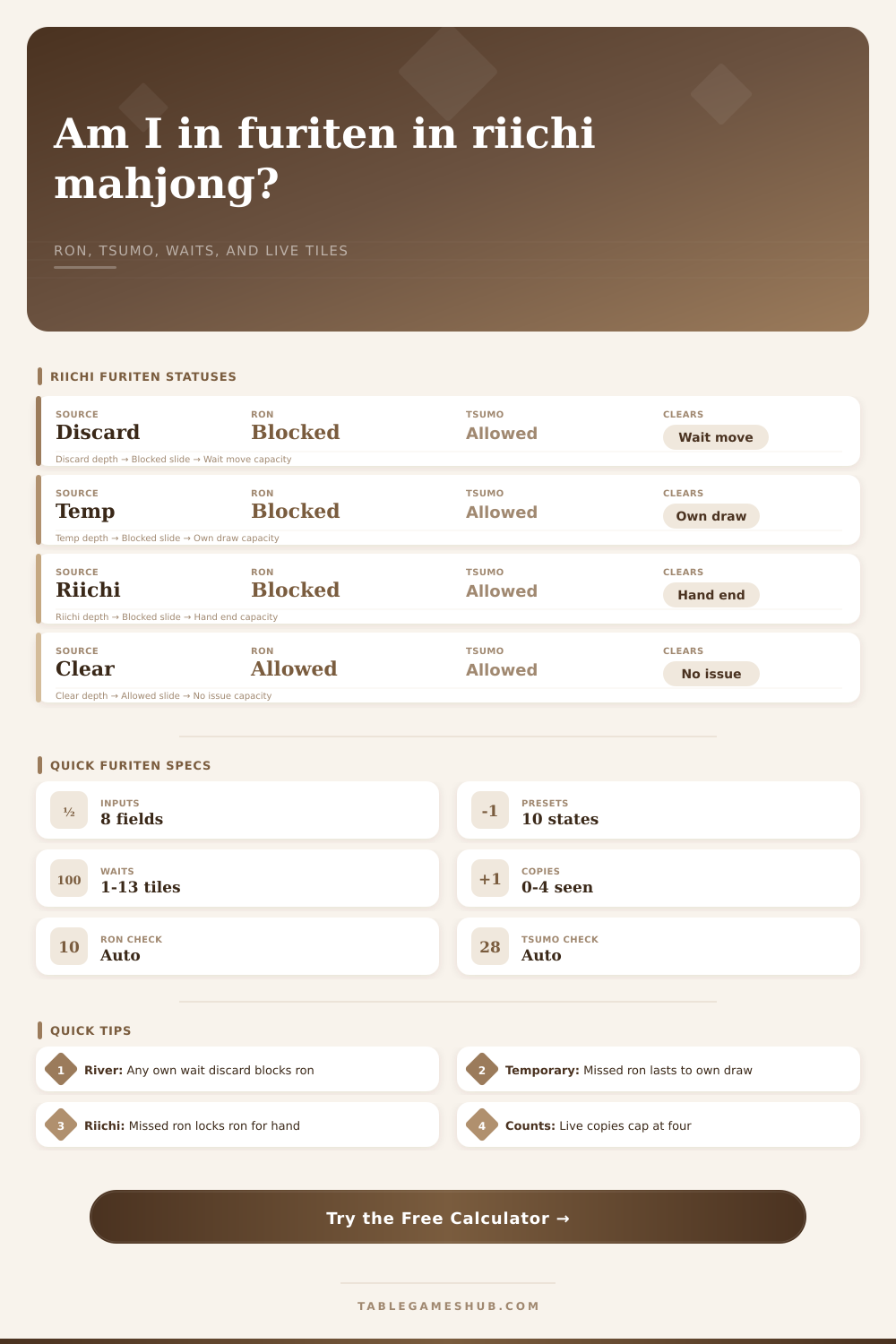
| Source | How calculator detects it | Ron result | Tsumo result |
|---|---|---|---|
| Own discard furiten | Any current wait tile is also in your own discard list. | Blocked for all waits while true. | Allowed by furiten rules. |
| Temporary furiten | Temporary turn state is set to passed ron before own draw. | Blocked until the turn state clears. | Allowed by furiten rules. |
| Riichi furiten | Riichi is declared and the riichi furiten flag is active. | Blocked for the rest of the hand. | Allowed by furiten rules. |
| Clear state | No current wait is in your river and no temporary or riichi flag is active. | Available if the table accepts the call. | Allowed if the self-drawn tile completes the hand. |
| Rule state | Can ron? | Can tsumo? | Logistics note |
|---|---|---|---|
| No furiten, live wait | Yes | Yes | The furiten checklist does not block either route. |
| Discard furiten only | No | Yes | Every discard win is blocked, not just the matching discarded tile. |
| Temporary furiten only | No | Yes | The block is tied to the current turn timing. |
| Riichi furiten only | No | Yes | The ron block is locked after the missed riichi ron chance. |
| Multiple furiten sources | No | Yes | The strictest active source controls ron status. |
| No live wait copies | Rule may allow, no copy shown | Rule may allow, no copy shown | Tile count availability is separate from furiten legality. |
| Entry type | Example | Calculator treatment | Use case |
|---|---|---|---|
| Suit tile | 5m:2 | Two visible copies, two live copies remain. | Manzu, pinzu, or souzu waits. |
| Honor alias | E:1 | Converted to 1z with at least one visible copy. | Wind and dragon waits. |
| Omitted wait | No entry | Assumes zero visible copies unless it is in your own river. | Fast checklist when only furiten matters. |
| Over-entered count | 7p:6 | Clamped to four visible copies and zero live copies. | Prevents impossible live counts. |
| Checklist item | Yes means | No means | Calculator field |
|---|---|---|---|
| Is a winning tile in your own river? | Discard furiten is active. | No own-river furiten from current waits. | Wait list plus discard river. |
| Did you pass a ron this turn? | Temporary furiten is active before your own draw. | No same-turn ron block from that pass. | Temporary furiten turn state. |
| Did you miss ron after riichi? | Riichi furiten is active for the hand. | Riichi alone does not block ron. | Riichi declaration plus riichi flag. |
| Are live copies left? | The wait still has known unaccounted copies. | The listed wait copies are exhausted by visible count. | Visible count map. |
Check the whole wait list
In riichi mahjong, one current winning tile in your own river makes ron unavailable on the whole wait, not only on that tile.
Separate rule status from tile count
Furiten answers whether ron is legal. Live count only shows whether known copies of the listed winners remain unaccounted for.
Track temporary timing exactly
If a ron chance was passed, mark temporary furiten active only until your next own draw timing clears that same-turn block.
Riichi flag is hand-long
After riichi, a missed winning discard keeps ron blocked for the hand. Tsumo remains the available furiten-safe route.
You are waiting for one tile in your full hand on the table. Your opponent then discards it… And you don’t know if you should play or not.
Do you? If you choose not to call a winning discard, you’ll probably lose out on the opportunity to win on any discard until you draw another tile yourself. That’s called furiten, and it’s an unforgiving rule that prevents you from being able to grab a discard win even though you may have plenty of other ways to win on that same tile.
What is Furiten and How to Avoid It
Knowing about furiten is what makes a player go up a rank while someone else stay back as a casual. It sounds straightforward enough. If you throw away a tile that wins your hand, then you cannot win it with ron.
Except it’s not so clear cut. Under normal conditions in riichi mahjong, even one of your current waits appearing in your discard river will prevent you from winning on any of your waits via ron. It doesn’t matter how many tiles you’re waiting on, or which ones they are, if you threw one down earlier, you’re blocked from taking it off someone else.
That’s what catches most new players out. They think they can take the other two because they don’t have those tiles in their discard river, but they do. The rule applies to all of your waits.
That’s where the calculator comes into play and removes the guesswork in a tight spot at the table: you’ll see instantly that whatever might be waiting for you, none of them match your discard history.
Also consider temporary furiten timing. If you don’t call out someone who discards winning tile, then you are temporarily blocked. This means you will lose on next discard, and the next, until you finally draw for yourself. Doesn’t matter if it’s a tile you’ve never seen before. That turn-based lock remains active until game clears it with your own self-draw timing.
So there’s this rhythm established by temporary furiten, where players has to strategize their draws to restore their ability to go offensive again. When do you pass? Every time you pass, you give up the chance to immediately score, but maybe calling is riskier or more profitable based off how much the two hands differ in points.
Finally, there’s the riichi declaration. This creates an added layer of permanence to your hand. After declaring riichi, your hand can’t change. You have to make a winning discard from then on or else the furiten status will lock-in for the rest of the hand. Your only way out is by winning with a tsumo draw.
Passing a riichi ron is therefore an incredibly high stakes decision. Basically, you’re placing a bet that the wall won’t run out before you get a self-draw. Use this tool on this page to simulate those scenarios, showing you where you’ll be blocked from ron and forced into a tsumo-only route. This helps illustrate the difference between a temporary block and a permanent one.
That matters for planning strategy. These mechanical considerations often get overlooked by a lot of player who spend too much time thinking about point calculations. Points mean nothing if the furiten logic is stacked against you, even with a high-point hand waiting on multiple tiles.
Live tile counts are relevant here as well. How many copies of your wait tiles is still left in the wall? This will let you judge the chance of winning a tsumo should ron be blocked. And if most of their copies are already dead from what you see, then staying in the hand will eventually become a liability.
That’s why the reference tables does an excellent job at outlining these scenarios for you, which will help you decide if you should ride out the temporary furiten hoping for a lucky draw, or cut your losses and fold. It’s all about managing risk as much as anything else.
Mahjong is a game of both timing and information. Furiten rules keep people on their toes. They compel you to pay attention to all the waits and discards. And they reward those who get it and read the river.
If you’re new to the game, just learning the ropes, or if you’ve played a long time and want to fine tune your defense, you have to always be mindful of your own furiten situation. A quick glance at calculator will tell you what you need, but mastering this means learning the rules so well that you know them without having to stop and think.
You should of mastered it earlier. Know immediately if you can call or must wait. This knowledge is the difference between a good hand and a winning hand.