Aggregate Score Calculator
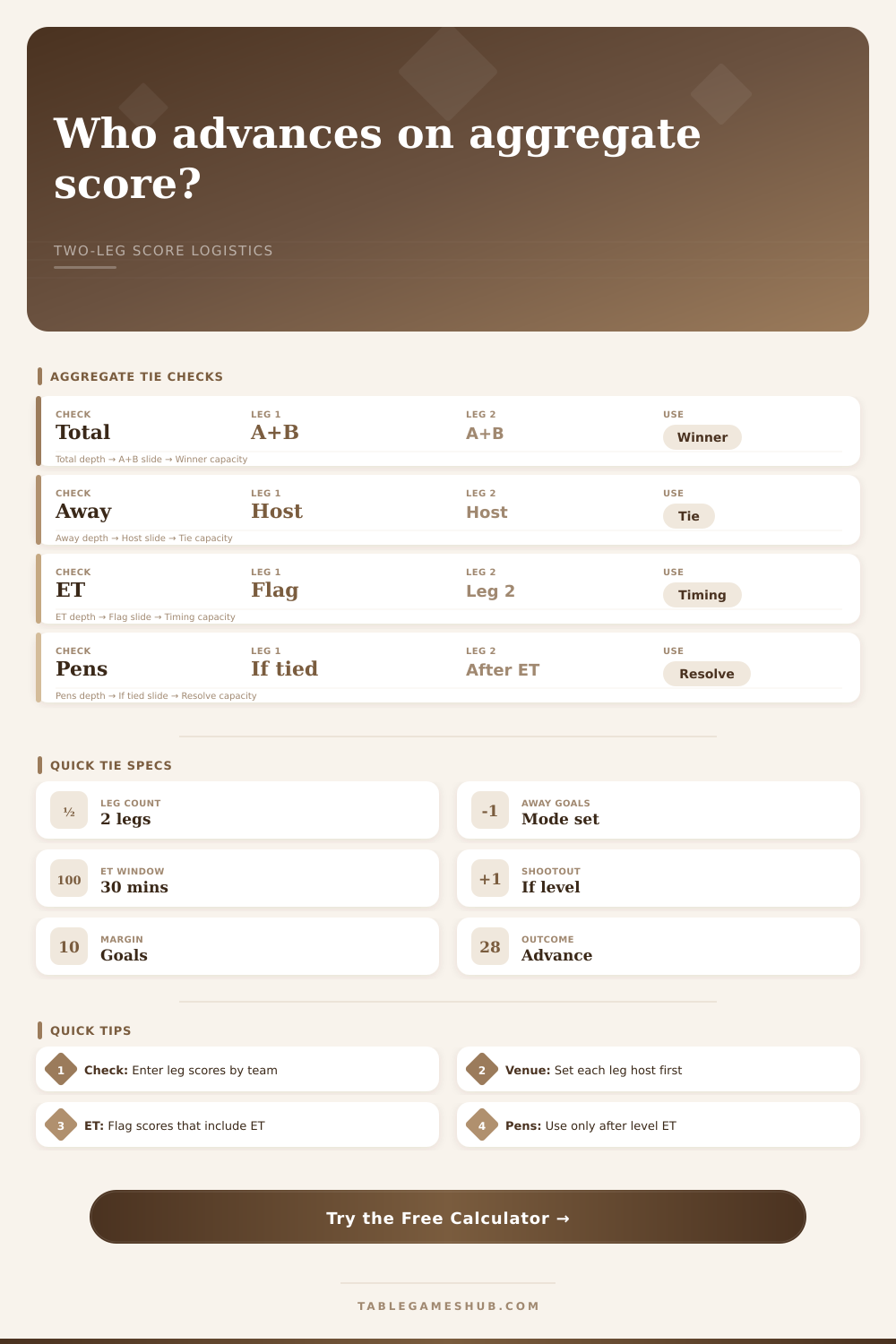
Resolve a two-leg fixture by leg score, home and away split, extra-time flag, tiebreak mode, aggregate margin, and final advancement status.
| Mode | First check | If aggregate level | Calculator handling |
|---|---|---|---|
| Aggregate only | Total goals across both legs | Unresolved or separate rules | Shows tied fixture when totals match. |
| Away goals after 90 | Aggregate total | More away goals wins | Counts only the entered home and away split. |
| Away goals after extra time | Aggregate total | Away goals may include extra-time goals | Uses entered leg 2 total when ET is flagged. |
| Extra time then penalties | Aggregate total after leg 2 | Penalty winner resolves level tie | Uses the selected penalty-winner mode. |
| Neutral venue | Aggregate total | No away credit for neutral leg | Neutral legs add zero away goals for both teams. |
| Host setting | Team A away goals | Team B away goals | Use case |
|---|---|---|---|
| Team A hosted leg 1 | Team A goals from leg 2 | Team B goals from leg 1 | Standard reversed two-leg draw. |
| Team B hosted leg 1 | Team A goals from leg 1 | Team B goals from leg 2 | Reverse order with Team A away first. |
| Team A hosted both legs | Zero unless leg marked neutral | Team B goals from both legs | Rare administrative venue arrangement. |
| Team B hosted both legs | Team A goals from both legs | Zero unless leg marked neutral | Rare administrative venue arrangement. |
| Neutral venue leg | No away-goal credit | No away-goal credit | Useful for single-site or relocated fixtures. |
| Timing flag | Score meaning | Common sequence | Breakdown note |
|---|---|---|---|
| No extra time | Both leg scores are 90-minute totals | Aggregate decides, then selected tie rule | Displays 90-minute basis. |
| Score includes extra time | Leg 2 score is a 120-minute total | Second leg level after 90, goals added in ET | Marks total as including extra time. |
| Scoreless extra time | Leg 2 final stayed unchanged in ET | Level after 90, no ET goals | Shows ET played without changing goals. |
| Penalty shootout | Aggregate stayed level after ET | Shootout selects advancing side | Requires penalty-winner tiebreak mode. |
| Preset | Competition-style rule | Logistics focus | Watch item |
|---|---|---|---|
| UEFA comeback | No away-goals rule | Aggregate margin after a home second leg | Away goals do not override total. |
| Legacy away goals | Away goals after 90 | Level aggregate with uneven away split | Venue entries decide the tiebreak. |
| EFL penalty finish | Extra time then shootout | Level total resolved after ET | Penalty mode must name a winner. |
| AFC legacy ET | Away goals after ET | Second-leg away goals can matter late | Flag if leg 2 includes extra time. |
| Neutral first leg | Mixed venue treatment | One leg has no away-goal credit | Neutral host removes away count. |
Fans were confused by the away-goals rule. For decades, it made two-leg games fair. The rule was a mathematical backup for away teams. Under this scenario, if the away team had enough goals on the board, a draw would of been a win. That meant you could go into another team’s home ground and get beat yet still advance. The logic was all about home advantage and crowd pressure. But in execution, it seemed unfair to the fans. They may watches their team lose a game they should’ve won. And the math didn’t care about anything but numbers.
These are all solved by the calculator, above. It is a combination of number of goals plus the context of the venues. In other words: no need to remember who was home and who was visiting. Enter both legs’ scores. Then mark down who hosted each game. Pick the applicable tiebreak protocol. And the calculator does its work. It calculates away-goal differential, goal margin, and total.
How to Use the Away Goals Calculator
Why? Because that outcome depends on the tiebreak rules of respective leagues. For example, one league might resolve it with penalties; another might have an automatic winner with an identical scoreline.
The away-goals rule was recently eliminated by UEFA. That means that the visiting team no longer gets an automatic advantage. In other words, if the aggregate score is tied, it’s simply a tie. (That levelled the field for the hosts). They no longer had to worry about scoring first in the second game. Because of this, the second leg has become more entertaining and open.
Under old rule, games could get conservative. Away teams was happy with a slim margin and would play not to lose. Now they are free to attack, knowing that only total count matters. It’s all about goals scored, period.
Be sure your inputs mirror how the game actualy went. Did they play extra time? Flag that. That’s an important one from some of these older comps. There are some comps where away goals scored in extra time count. If you enter the score on the second leg and flag that it includes extra time, then the calculator will include those goals. If not, then it treats the score as a 90-minute result. For a tie aggregate, that can change who wins. It’s a small detail, but it matters when games is close.
You then pick your tiebreak mode. Select between different protocols. You can also simulate the old away-goals rule. You can also use the new aggregate-only rule. You can also go half-and-half by having extra time followed by penalties. That’s useful when trying to figure out previous games or even as a trivia feature.
There are tables of references that help make sense of it all, including how neutral sites work. For example, there’s no away-goal credit if the match is at a neutral venue. This makes sense if it’s a relocated fixture or a cup final held domestically. In those instances, neither side enjoy home advantage. When you look at that tie, focus on the total margin. A one-goal margin means there’s wiggle room. There’s potential for a late comeback. A two-goal margin seems safer. The tool makes it obvious. It tells you how safe or unsafe things are. It differentiates between home and away splits. You know just how many goals each side has scored on the road. That gives you the tactical story. It tells you if a team dominated at home or had trouble on the road.
Momentum is a factor, and aggregate scoring is how you manage it across two separate events. You need a clear head and patience here. Don’t panic in the first leg. Don’t get comfortabley in the second leg. Know the rules. Understand the math. That’s where the calculator takes over. You don’t have to worry about the arithmetic; just the drama.
Any match is the same. Advance or go home. A goal is a goal, unless it’s scored on neutral ground. Pay attention to the host settings. That’s where it goes sideways most often.