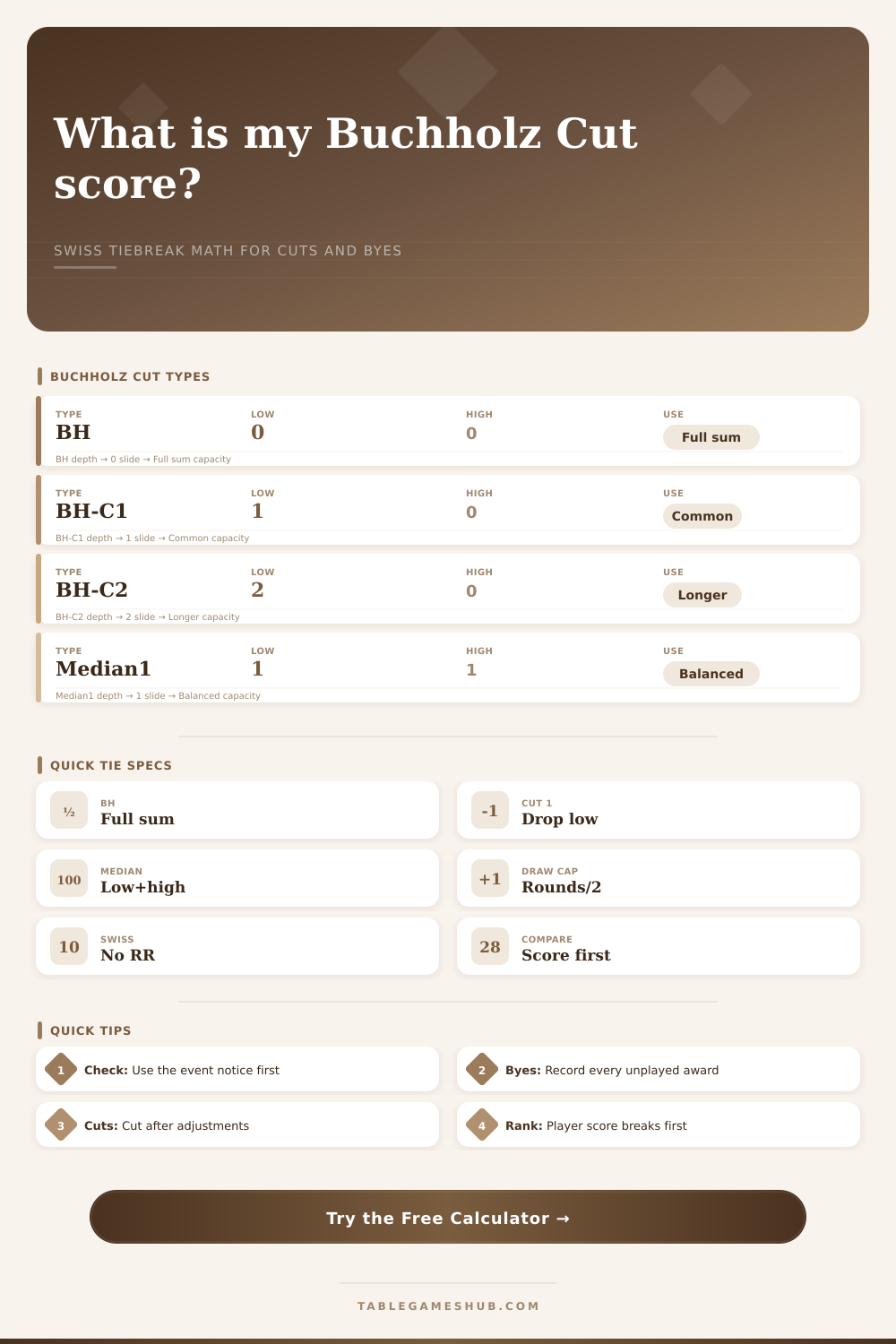
Buchholz Cut Calculator
Compute Swiss tournament Buchholz, Buchholz Cut, Median Buchholz, unplayed-round treatment, and same-score ranking comparisons for chess and board-game events.
| Tie-break label | Calculator cut setting | Formula used | When it appears |
|---|---|---|---|
| Buchholz (BH) | 0 lowest, 0 highest | Sum of every opponent contribution. | Strength-of-schedule baseline in Swiss events. |
| Buchholz Cut-1 (BH-C1) | 1 lowest, 0 highest | Raw Buchholz minus the least significant value. | Common first Swiss tiebreak in FIDE-style lists. |
| Buchholz Cut-2 (BH-C2) | 2 lowest, 0 highest | Raw Buchholz minus the two least significant values. | Longer events or secondary resistance checks. |
| Median Buchholz 1 | 1 lowest, 1 highest | Cut the least value, then the most value. | Events that dampen both soft and elite pairings. |
| Median Buchholz 2 | 2 lowest, 2 highest | Cut two least values, then two most values. | Nine-round style events with enough opponent data. |
| Unplayed case | Current FIDE-style model | Calculator input | Practical check |
|---|---|---|---|
| Pairing-allocated bye | Dummy contribution based on player score, capped by draw value times rounds. | Enter the awarded point in unplayed awards. | Usually not marked as a voluntary unplayed round. |
| Requested half-point bye | Dummy contribution, draw-capped; late-only requested byes may be evaluated as draws for opponents. | Enter 0.5, or equivalent in the scoring scale. | Check whether the event treats it as voluntary. |
| Forfeit win | Dummy contribution may be capped by scheduled opponent adjusted score. | Enter award plus optional cap score. | Cap prevents the dummy from exceeding the paired opponent. |
| Forfeit loss or zero bye | Dummy contribution may be capped and may affect Cut-1 exception logic. | Enter 0 for the unplayed award. | Voluntary zeroes are candidates for the low-cut exception. |
| Opponent list after adjustment | Low cuts | High cuts | Resulting sum |
|---|---|---|---|
| 1.5, 2.5, 3, 3.5, 4 | 1 | 0 | 13.0 after removing 1.5. |
| 2, 2.5, 3, 4, 4.5, 5 | 1 | 1 | 12.0 after removing 2 and 5. |
| 4, 5, 6, 6, 7, 8, 8 | 2 | 0 | 40.0 after removing 4 and 5. |
| 6, 7, 7, 8, 9 | 0 | 0 | 37.0 with no cuts applied. |
| Ranking layer | What is compared | Calculator support | Organizer action |
|---|---|---|---|
| Primary score | Final tournament points. | Player score is compared before tie-breaks. | Only equal-score players need Buchholz separation. |
| Selected Buchholz cut | The event's named Buchholz variant. | Chosen low/high cut generates the main value. | Use the exact cut rule from the tournament notice. |
| Median Buchholz | Opponent sum after one low and one high cut. | Always shown as a secondary reference. | Apply only if listed in the official tiebreak order. |
| Further criteria | Direct encounter, wins, color, or other rules. | Not scored here. | Move to the next published tiebreak if still tied. |
The nature of Swiss tournaments is strange; you’ll play five good rounds, earn four points, and turn around after your final round to see your name below that of another person with four points. The reason? Often it’s the Buchholz, a tiebreaker that determines how strong the other people are, not how good you are. On paper, it seems fair enough, but in reality, it just make you feel punished for playing the best players in the event.
So what’s it do? Simple enough: It adds up final scores of everyone you faced to get your Buchholz sum. Playing four noobs who got there butts kicked in every round? Your score will be low. You beat four grandmasters who all had great final scores, your score will be huge.
How to Understand Buchholz Tiebreaks
This means that even if you win lots of games from weaker player, it’ll harm your tiebreak rank, which is a paradox that many tournament directors have trouble explaining to angry competitors. The calculator up there allows you to see just how various adjustments and cuts alter the final tally and help untie that knot.
The standard Buchholz (Buchholz Cut-0) is the sum. It’s nice, but glaringly flawed because it doesn’t consider forfeits/bye rounds well at all. A bye causes you to give your opponent credit for whatever you would of scored in that round, so it can artificially inflate tiebreak. To address this, tournaments employ cuts, with a Buchholz Cut-1 being the removal of the lowest opponent score from consideration. It is a reasonable assumption, but it changes the math entirely; your weakest opponent becomes the least important indicator of your strength.
Before even stepping up to the board, you should of had an idea of what rule your event will follow. In most cases, it’s Cut-1, as in FIDE style events. This is all spelled out on the page’s handy reference table and looking at the event notice can save you from wondering why your good performance wasn’t reflected in the standings and also keep you from having a fight over it at the awards ceremony. It is always a good call.
There’s also the complication of byes, which is another half-point if it’s a pairing bye in chess, but what about your Buchholz? The different systems does things differently here. Some will just assign whatever player got as their outcome in that round, even if they didn’t play, while others will limit the bye to only be equal to the draw point. So unless you’re aware of how your organizer deals with byes, your tiebreak calculation might be out by an entire point; which makes a difference if you’re competing for something like a title qualification or cash prize. Fortunately, the tool has a toggle to switch between these two ways of handling byes so you can see the different options.
Things become more tricky when we talk about forfeits. Do you receive credit for your opponent’s maximum possible points if they’re late and you win on forfeit? Or does it get capped? Some systems will cap the forfeit so people can’t try to game the system by skipping a round in order to increase their tiebreaks. It’s just a little thing that can change the dynamic of the tournament, and knowing these rules helps you make plans based off that. For instance, do you go looking for an actual game or take the half-point guarantee, knowing that byes are capped?
For example, you might want to use the ranking comparison function during a head-to-head situation or if you and another player tie at four points. In that case, the system will display both players’ individual Buchholz values next to each other. This shows you exactly how the tie was broken. That sort of transparency instills confidence in the outcome because you know it didn’t just get picked out of thin air, it was the result of one particular math process being applied to what actualy happened in the games.
The bottom line: Because it attempts to rank by strength in a format where there isn’t a set schedule of matches, Buchholz is ultimately a stand-in for strength. The way it ranks players gives you an appreciation for how to go about pursuing hard games vs. You might choose to take easy win, though it is a tradeoff. Sometimes you take a loss against a stronger player and that may save your ranking in terms of tiebreaks. That makes it imperfect, but it’s the best we have for Swiss systems, so understanding it is good.
Often it’s not the players with the highest number of wins at the top when the final standings are posted, but rather those that figured out the tiebreaks best. Knowing how the rankings work provides you with an advantage whether you are a player attempting to move up in the standings or someone responsible for making the rules as the tournament organizer. It’s not about running the numbers to figure out if you should of won the tiebreak. It’s about knowing what to do ahead of time so you don’t guess your way there. That is where the true benefit is.