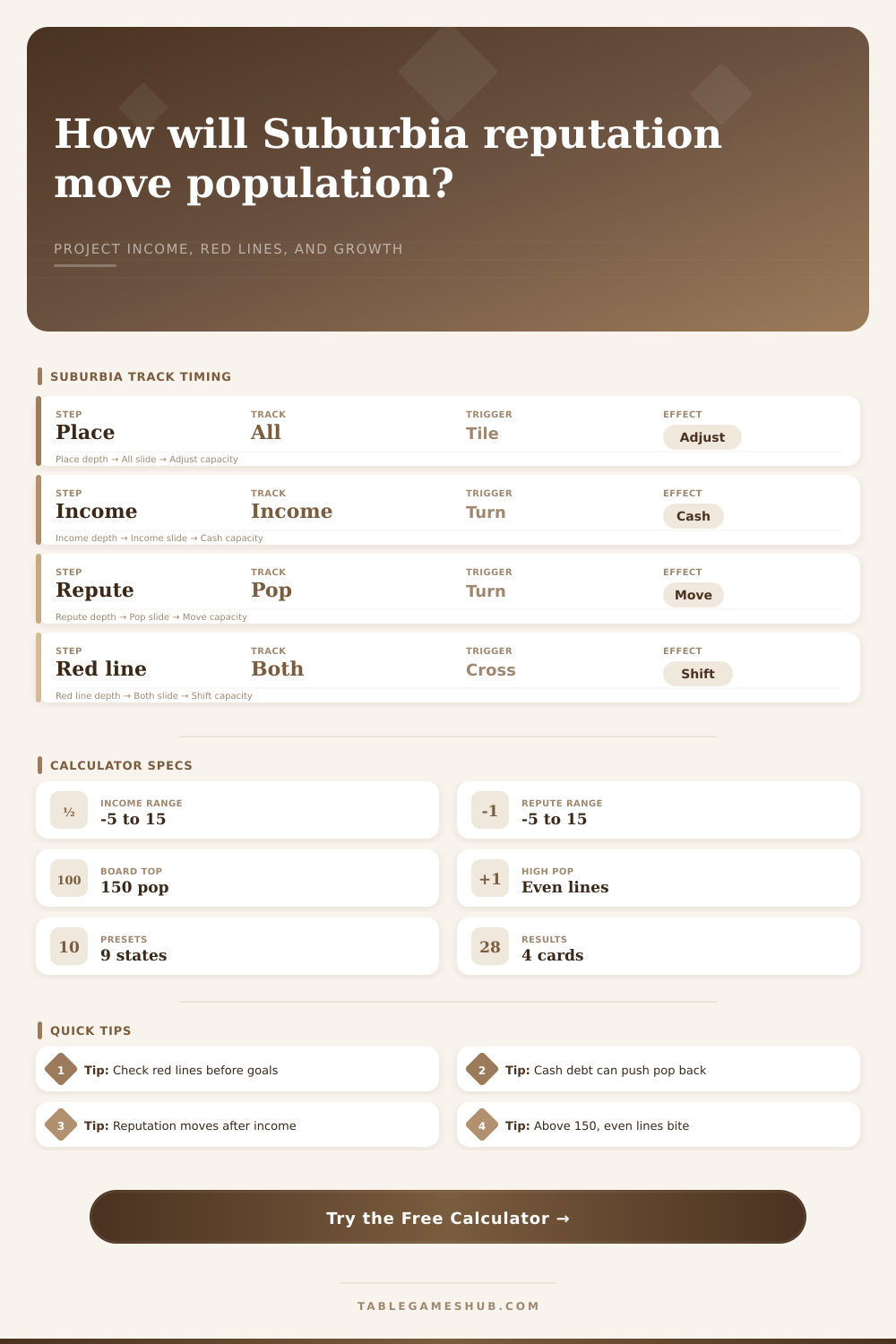
Suburbia Reputation Calculator
Project a Suburbia turn through tile effects, income collection, cash shortfalls, reputation-based population movement, and red-line track adjustments.
| Turn step | What to enter | Calculator handling | Table check |
|---|---|---|---|
| Place tile or investment | Immediate income, reputation, and population icons | Applies marker changes, then moves any immediate population shift | Resolve adjacency and all-borough icons before pressing calculate |
| Collect or pay income | Cash before the income phase | Adds positive income or pays negative income from cash first | Unpaid negative income becomes population loss one-for-one |
| Adjust population | Current reputation marker after tile and red-line changes | Moves population forward or backward by that reputation value | Negative reputation can trigger backward red-line recovery |
| Add market tile | No calculator input | Ignored because it does not change your tracks this turn | Use the projection before choosing future market timing |
| Population movement | Red-line result | Income marker | Reputation marker |
|---|---|---|---|
| Population moves forward past printed red line | Borough maintenance pressure increases | Move 1 space left per line crossed | Move 1 space left per line crossed |
| Population moves backward below printed red line | Earlier penalty is unwound | Move 1 space right per line crossed | Move 1 space right per line crossed |
| Population is greater than 150 | Use high-population overflow logic | Even-number red lines can stack quickly | High reputation may immediately reduce itself |
| Population cannot fall below zero | Extra negative movement is converted to cash pressure | Income still obeys the -5 floor | Reputation still obeys the -5 floor |
| Track state | Typical feel | Calculator warning | Action at table |
|---|---|---|---|
| High income, low reputation | Cash engine with slow population growth | Population may stall without a reputation tile | Check whether a park, school, or restaurant swing pays off |
| High reputation, low income | Fast growth with red-line drag | Red-line crossings can eat both markers | Project several turns before taking another growth burst |
| Negative income, positive reputation | Growth can hide an approaching cash crunch | Cash shortfall may reverse population progress | Count debt before celebrating the population gain |
| Negative reputation, low population | Backslide risk with possible marker recovery | Backward red lines can restore income and reputation | Watch for zero-population cash conversion |
| Tile family | Common track role | Population logistics | Calculator use |
|---|---|---|---|
| Residential green tiles | Direct population or reputation growth | Can jump into red-line penalties before income | Enter printed population and net reputation |
| Commercial blue tiles | Income and conditional cash effects | Often helps pay debt before population moves | Enter the income marker swing and starting cash |
| Civic gray tiles | Reputation boosts from adjacency or sets | High reputation can cross multiple red lines later | Use the projection turns field for timing |
| Industrial yellow tiles | Income gains with reputation costs | May improve money while slowing population | Enter both the income gain and reputation penalty |
In Suburbia, you put down a pretty tile. Income goes down. Population growth halt. That tile looks great on the board but the math doesn’t work.
Your turn determines what happens next. See penalties coming so predicting the turn is important. Understand why they are moving. The math move. The winner understand the reason behind the math.
How to Balance Growth and Money
Suburbia’s bread and butter is the conflict between growth and cash flow. The way you get ahead of your rivals is by moving people around faster. If you focus on either at the expense of the other, game will slap you down.
A safe place is one where you have lots of income but not much reputation. That means you’re falling behind compared to rivals moving people more quickly. Risk comes from chasing population without first balancing income. You take on debt before counting on reputation growth. Players gets caught in this trap all the time.
A residential tile offer a large pop increase… Cool! Drop it down, and your population mark jump up. Oh yeah, you crossed a red line. Borough maintenance penalties cause your income and rep markers to move left. Income phase hits. Your income is negative and you have no money. That debt shrinks your population. You gain population only to lose it on the same turn. The rules are working exactly how they’re supposed to.
How can I prevent this? You should of audit the chain reaction. First, apply tile effects, which have an immediate impact on income and reputation. 2nd, Check Cash vs New Income Total. If insufficient, convert short to Population Loss. Remember: This occurs prior to the Reputation step. 3rd, Move Pop based off Existing Rep. The order is strict: you cannot move people until you pay the debt.
The Calculator shows the chain reaction: Does Residential tile cause a crash in Income/Reputation? See the red line crashing income? Then tile is a Liability.
And then there’s the zone that has a hundred and fifty plus population. This is when the game gets punishing. Your red lines are tight and often have a line on every even number. These lines reduces both reputation and income markers. For high-reputation players, this means you’ll keep crossing these lines. You may leave the turn with higher numbers yet less capacity to grow in the future. It is a choice between long-term stability and short-term gain. Players push to get to the goal but gets themselves stranded because their reputation crumbles beneath weight of penalties.
The tool lets you simulate. Plug in a restaurant reputation bump and see what happens on subsequent turns. Or a factory income push. Does this move take your income down to negative two? Can you afford that? If not, then any gains from the tile will be cancelled out by population losses. It’s all about managing variance.
Some turns require you to spend money to get momentum going. Others are to harvest some cash so you can come back up. Know what mode you’re in. Suburbia is a rhythm game. Income and reputation are two sides of the same coin. One goes up, the other tends to go down. The art is balancing the two to avoid a red-line.
Test your instincts with the projection tool. Does it show a shortage? Reconsider. Does it cross a red line? Weigh that cost carefully before moving. Growth shows on the board; survival shows in the tracks. Listen to both, and your borough will do well.