Tapestry Civilization Advance Calculator
Estimate how many civilization track spaces you can take, where your resource pressure sits, and which landmark tiers are realistically in reach.
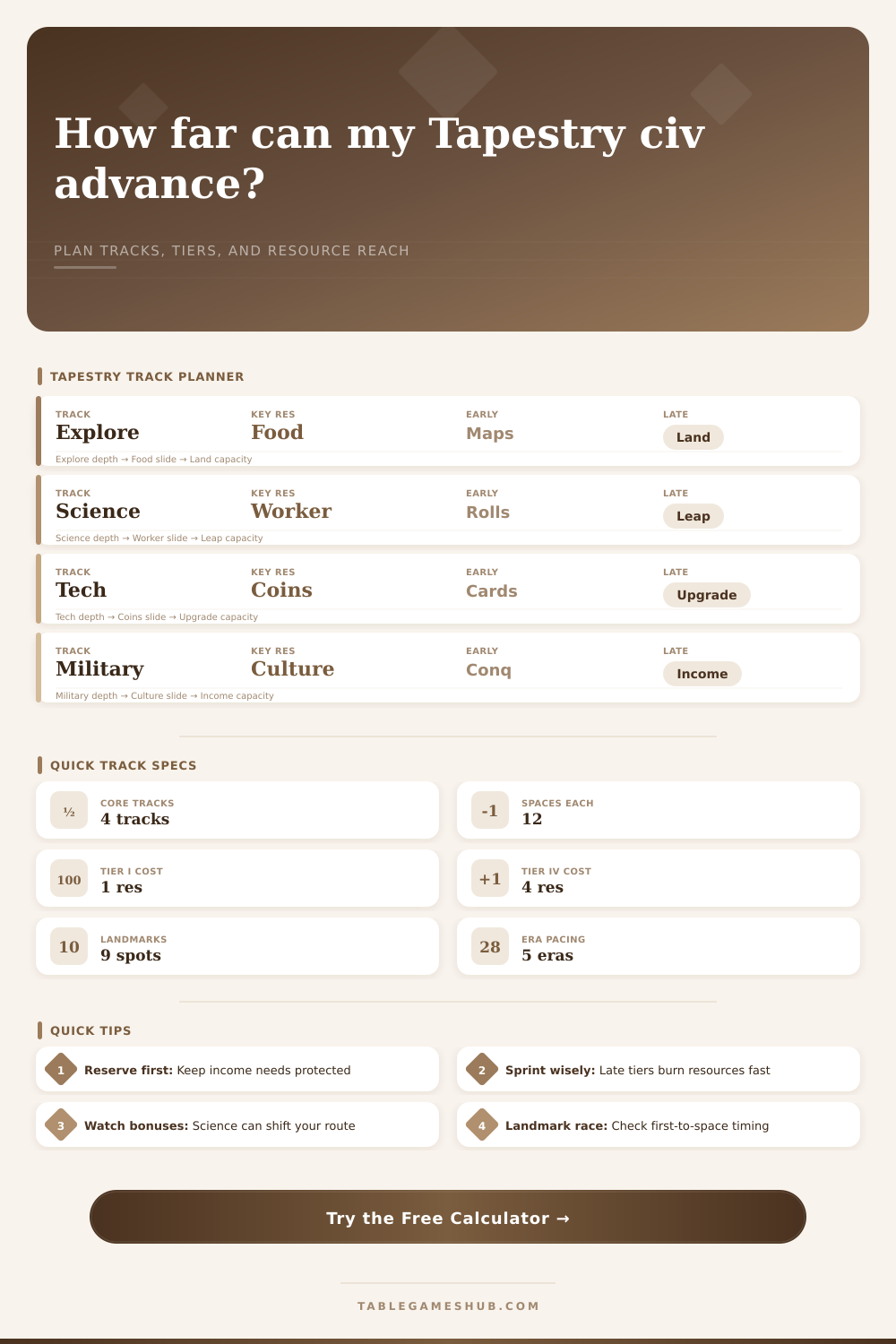
| Destination Spaces | Track Tier | Resource Cost Per Advance | Planning Meaning |
|---|---|---|---|
| 1 to 3 | Tier I | 1 | Early tempo; broad track starts are inexpensive. |
| 4 to 6 | Tier II | 2 | Mid-game commitment begins; spare resources matter. |
| 7 to 9 | Tier III | 3 | Landmark race and income timing become tighter. |
| 10 to 12 | Tier IV | 4 | Late sprint; final spaces demand a deep resource bank. |
| Track | Primary Resource | Typical Board Pressure | Calculator Signal |
|---|---|---|---|
| Exploration | Food | Territory tiles, map reach, and first-to-space landmarks. | Strong when food is ahead of the other three resources. |
| Science | Workers | Science rolls, cross-track jumps, and flexible tempo. | Strong when worker supply can absorb an uncertain leap. |
| Technology | Coins | Tech cards, upgrade timing, and income row alignment. | Strong when coins support repeated upgrade turns. |
| Military | Culture | Conquest timing, territory control, and pressure landmarks. | Strong when culture can push through an expensive tier. |
| Current Space | Next Tier Gate | Risk Level | Action Check |
|---|---|---|---|
| 0 to 2 | Space 3 | Low | Use cheap advances to open options before committing. |
| 3 to 5 | Space 6 | Medium | Compare landmark timing against neighbors on the same track. |
| 6 to 8 | Space 9 | High | Reserve enough resources for the last advance in the tier. |
| 9 to 11 | Space 12 | Very High | Commit only when the final space is worth the income delay. |
| Preset Family | Favored Track | Planning Boost | Best Use |
|---|---|---|---|
| Futurists / Inventors | Technology | Earlier high-space reach | Testing whether a tech sprint still leaves income room. |
| Militants / Nomads | Military or Exploration | Focused track pressure | Checking if map or conquest tempo can cross a tier gate. |
| Mystics / Historians | Science or Wide | Flexible advance value | Estimating how much uncertainty to leave in reserve. |
| Craftsmen / Leaders / Architects | Balanced or Landmark | Income or landmark bias | Finding a practical route across two tracks. |
The room falls silent. You sit at the table with your hand hovering above your resources. Other players appear to have their next move already decided. Do you take a landmark? Will you save your coins for income? The tension is in Tapestry’s moments like this, one where it isn’t just about who can gather more resources but who can do so within the right tempo.
The game doesn’t end once your resources is exhausted. Instead, it finishes when the track fills up, which means you can’t necessarily generate enough to outpace your opponents. This leads to the pressure of the price tiers.
Managing Your Resources in Tapestry
Early civ advancement is inexpensive: it often costs just a single resource to move your civilization marker forward, and this encourages people to take first-to-space bonus and generally be aggressive about starting their civilizations quickly. But the price for moving up past that triples. Every step from seven through nine will use up a large part of your economy, which means a lot of food and resources. Is it worth it? Most people also forget to ask themselves: What will I be able to do in the future once I spend these coins? Spending 4 coins to reach space ten while leaving yourself no coins to spend on your income round stalls engine of your game. Use this to see where you might fall into this trap.
Enter your current resource amounts, and it will deduct enough coin to keep you alive through one more round. What’s more, I think the inputs look more important than they actualy are. When you pick a civ, it changes assumptions of what that civ does in terms of pressure generation (technology goes up for futurists, exploration goes up for nomads, etc). It reflects effectiveness of each faction’s engine. The calculator lets you see the raw math as a player, but it improves reality of your board as a specialist or a more well-rounded civ. The Craftsmen is balanced; the calculator tells you the raw math).
The overlooked piece of data in all this, the landmark pressure output, isn’t so much about winner-take-all, but rather who’s most likely to be outpaced/blocked. If it’s high, you’re near enough to a tier gate to worry, but not far enough back to nail it (i.e., a warning sign). Time to spread the love, then; don’t push that track anymore.
Tapestry is kind of like that, too: You can’t win by being ahead on just one track, or behind on all four. But you also can’t afford to be behind on all four. The reference tables list standard costs, but not opportunity cost. You might think science is cheap because you’ve got workers, but your neighbor might have them, too, and if both of you want the same space, then somebody has to pay a penalty, meaning either one of you. That’s the sort of arithmetic the calculator does with your resources, but it doesn’t read opponent’s mind.
In those cases, it’s experience: you understand that the Militants is stockpiling for a military dash while the Mystics have their eye on the science track. You are allowed to spend resources using the tool, but will the target be safe? In some instances, the best play is no play; holding three resources in reserve can leave you flexible for the late eras.
Ultimately this game comes down to making many tiny decisions that hurt, and each decision that goes into your engine could of been put toward your score. You need to balance short-term gain with long-term engine building; every point you take now is a point you cannot get later as a free bonus. Once you know how much reserve you have left and what spaces you’ve got, the calculator up top does the math for you (so you don’t get tired of doing it in your head on turns) and lets you know if you’re pushing too hard.
The lower this number is, the more you’re livig on the edge, and I think you should trust the cushion metric. One bad dice roll/missed paycheck and you’ll slide into a deficit that’s difficult to crawl out of. You need a buffer, which feels wasteful in the moment but will buy you breathing room to react to what your opponents throw at you.
Remember, Tapestry is a game of risk management: You’re balancing speed vs. Stability. Your choices determine whether it’s a race or not, the calculator shows you what that race costs, but ultimately you must decide whether it’s worth running. Maintain your reserves and mind your competitors; slow and steady wins the race. Better to be slow and steady than fast and empty.
Don’t worry about who’s ahead. The board will fill up eventually no matter who leads the way. Your task is to ensure you’re standing on the right spots when the last bell rings.