Talisman Strength Combat Calculator
Estimate your attack score, enemy spread, fate reroll value, trophy turn-in timing, and life-loss risk before choosing the fight.
| Preset | Strength setup | Enemy target | Use case |
|---|---|---|---|
| Strength 5 Bandit | 5 base, no gear | Strength 5 | Even early-game fight |
| Weapon Boost | 4 base plus weapon | Strength 6 | Object-supported attack |
| Dragon Fight | 8 plus support | Strength 9 | Late board encounter |
| One Life Gamble | 6 with penalty | Strength 7 | Check whether to retreat |
| Net edge before dice | Base win | Base stand-off | Read |
|---|---|---|---|
| -3 | 16.7% | 8.3% | Needs fate or another bonus |
| 0 | 41.7% | 16.7% | Fair fight, loss still common |
| +2 | 66.7% | 11.1% | Good attack if life is stable |
| +5 | 97.2% | 2.8% | Only snake eyes style danger |
| Trophy value | Strength gain | Remainder | Combat impact |
|---|---|---|---|
| 0-6 | +0 | Same value | No pre-fight strength change |
| 7-13 | +1 | 0-6 | Moves many fights one band |
| 14-20 | +2 | 0-6 | Strong boss preparation |
| 21+ | +3 or more | 0-6 | Often better than saving trophies |
| Life state | Loss result | Practical pressure | Recommended margin |
|---|---|---|---|
| 4+ life | Lose 1 life | Recoverable | 50%+ win chance |
| 2-3 life | Lose 1 life | Guard resources | 60%+ win chance |
| 1 life | Lose 1 life | Potential defeat | 75%+ win chance |
| Inner Region | Loss can cascade | High pressure | Fate plus spare life |
A strength five bandit stares back at you on the border of the Outer Realm. Your character sheet inform you that so are you. Tension hangs in the air like electricity about to discharge into the roll of a pair of dice. A sword that increases your attacks by a point rests in your hand. Seven points worth of trophy waits in your inventory ready to be turned into an increase in your strength if only you would of do it now. Do you fight as-is and trust to the gods of good luck to come through, or spend some of your resources now in order to nudge the odds in your favor?
It’s those moments when your intuition falters, when probability enters the picture. With this calculator, we take all of your fate points and gear and turn them into a concrete chance of winning instead of relying on your gut. Strength is a variable, but most players considers it as a fixed quantity on the character sheet. It’s not. It’s a collection of factors (pool) that change based off the decisions made during play. What spells do you cast? Who joins your party? Which items do you pick up? This tool shows how those choices impact strength before rolling any dice.
How to Win Fights
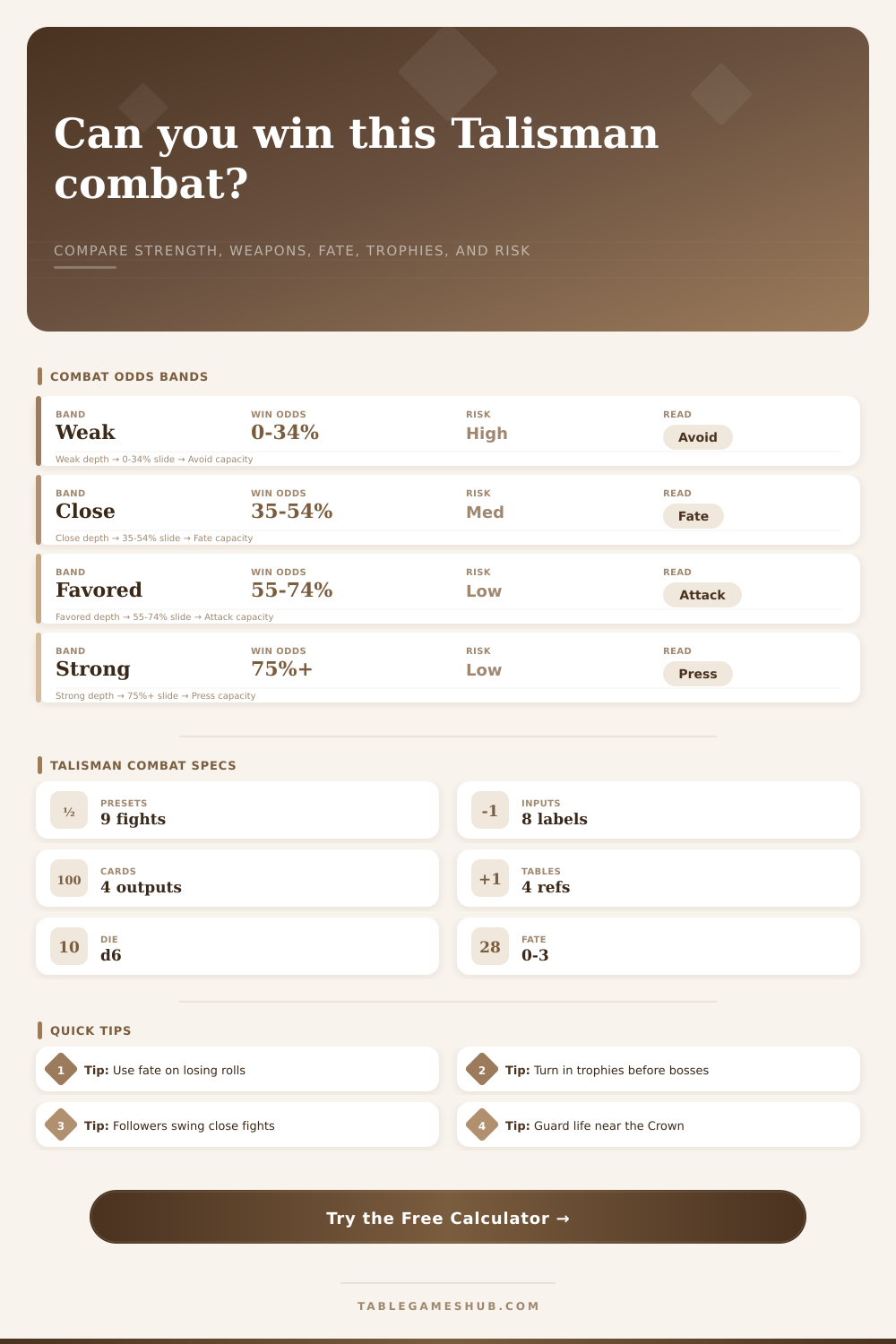
After entering the starting Strength for your character, you can add bonuses from weapons, assistance from followers, and modifiers from terrain. Every time you add something to your strength, it alter the likelihood of success. One more point doesn’t mean you will win. It merely moves the odds slightly in your favor by expanding the set of dice combinations that produce a succesful outcome. The difference between a forty percent chance and a fifty percent chance feels small until you are standing there with two lives left. At that point, it is the line between continuing your quest and returning to the start.
A fifty percent chance seems like a close margin, until both sides have only two cards left. Then it becomes the difference between moving forward or having to restart. This is explained by banding on the page’s reference table. Weak positions are where you’re probably going to get your ass kicked, so retreat or try something else. Favored positions mean that the odds is stacked in your favor. It would be a good use of energy and time to go ahead and duke it out.
These bands help explain why you shouldn’t fight everything. Some monsters aren’t worth your time. And sometimes, you should walk around the goblin camp instead of straight into it. Patience is as rewarding than aggression in this game. And knowing how to disengage is part of mastering it.
The system adds another layer of strategic depth that many new players miss: fate rerolls. That’s no simple die. It is a bit of fate insurance. The calculator defaults to spending fate only on subsequent rolls after an unlucky result. This represent a conservative strategy. However, you could choose to save fate for future encounters. Or, if your life count is dwindling, then the stakes of failure rise to life-or-death levels. Only one life left? Lose and your adventure ends there. Then fate isn’t merely careful, it’s required.
You might spend fate to reroll a three into a six. The calculator helps weigh the trade-off of risking your life against the odds of victory. There’s also an interesting tradeoff around trophies. Do you convert them into strength now? Or do you save them for the end of the game and hoard them for score? Typically, if you’re up against something nasty, it makes more sense to convert.
The math works out like this: If you get a seven-point trophy, which adds seven points permanently to everything going forward, including all future fights… That’s often better than carrying a single valuable card around in your inventory. It means you’ll tend to live longer as a player, since people who know how this mechanic works will keep shifting their power base based on whatever the immediate threat is.
That’s where the d6 roll comes into play. There are 36 ways for two dice to fall. Ideally, you want a good percentage of all of those results on your side. You cannot control the dice. What you do control, however, is what exists behind the dice, the static numbers. Ideally, you’d want your Strength + Weapon + Bonus to be two or more points higher than the enemy’s strength. One point? That’s shaky. Three points? That feels comfy. With the calculator, you know right where you are along that scale.
At heart, then, Talisman is a game about managing uncertainty, about managing your resources and information and probabilities. Those all come together in the combat phase, which is why that phase feel so important. This tool lets you take the guesswork out of do-or-die scenarios. Every time you go into battle, you’ll know whether you have an edge or not. That makes all the difference in the way you play. It transforms panic into planning. When the bandit raises his sword at last, you’ll already know whether you’re prepared to meet him.