Viticulture Wine Value Calculator
Estimate whether a red, white, blush, or sparkling wine line is worth the worker, cellar timing, order rewards, and residual lira.
Wine value results
Use the net value to compare this order line against planting, touring, building, training, or holding grapes for a better contract.
| Wine type | Grape recipe | Cellar access | Calculator value note |
|---|---|---|---|
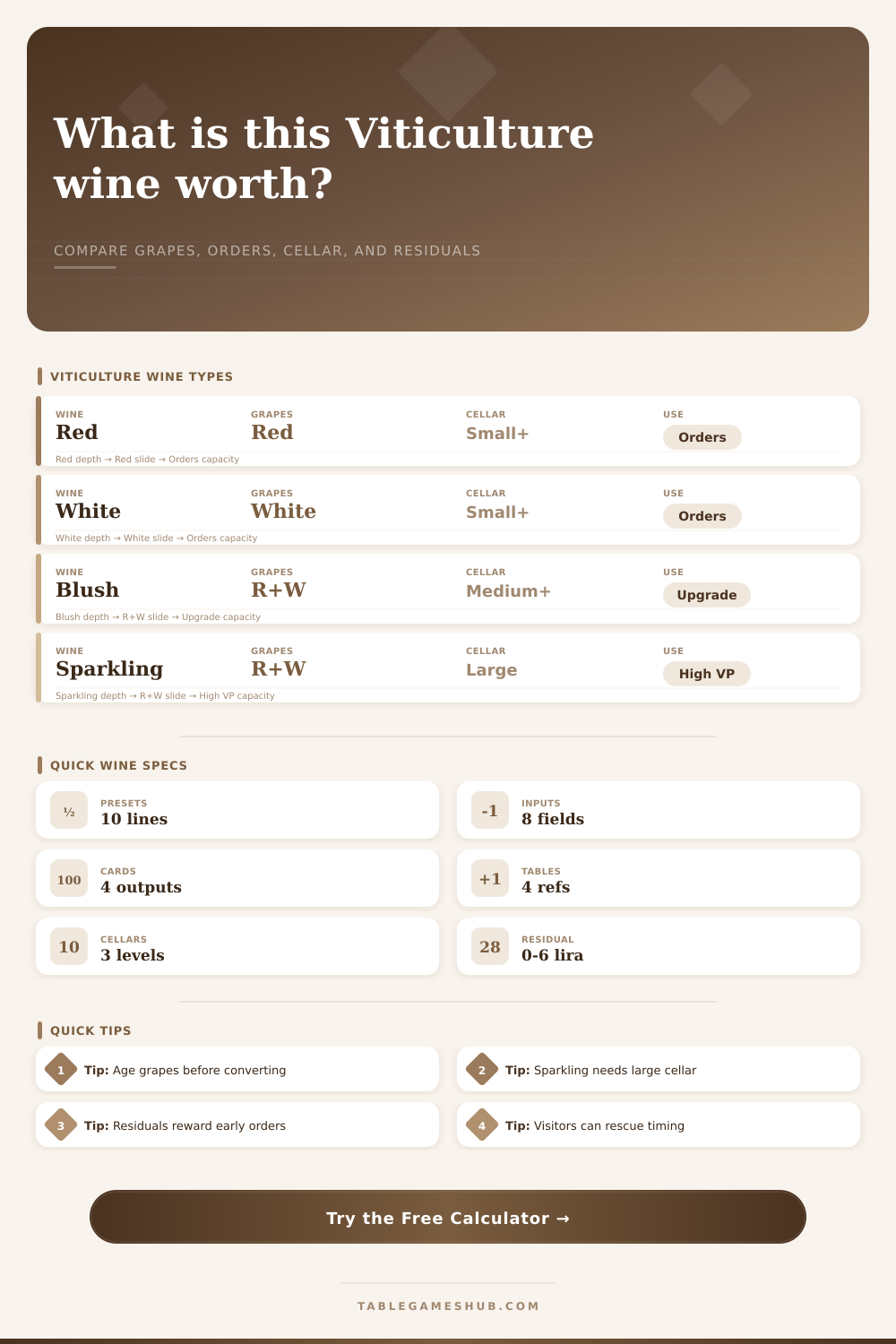
| Red wine | One red grape | Small cellar and up | Good for low and mid orders when red grape value is already aged. |
| White wine | One white grape | Small cellar and up | Often fills early orders with less cellar pressure than blush or sparkling. |
| Blush wine | One red plus one white | Medium cellar and up | Combines both colors and receives an upgrade bonus for order flexibility. |
| Sparkling wine | Two red plus one white | Large cellar | Consumes more grapes but can justify high VP orders and late cellar investment. |
| Cellar | Wine cap | Unlocks | Planning read |
|---|---|---|---|
| Small | 3 value | Basic red and white | Great for low orders, weak for premium contracts. |
| Medium | 6 value | Blush access | Best pivot level for mixed grape orders. |
| Large | 9 value | Sparkling access | Needed when late orders demand high wine values. |
| Blocked | Penalty | No valid make-wine line | The calculator subtracts pressure if the type is unreachable. |
| Timing | Factor | Best use | Risk |
|---|---|---|---|
| Summer detour | 0.85x | When a visitor shifts the action early | May cost a planting or touring tempo. |
| Winter worker | 1.00x | Normal make wine or fill order plan | Can be blocked by worker placement. |
| Grande worker | 1.08x | Reliable late conversion or order fill | Uses your most flexible worker. |
| Visitor line | 1.14x+ | Compressing make wine and order value | Depends on card timing and hand quality. |
| Order profile | Typical reward | Residual fit | Value read |
|---|---|---|---|
| Starter order | 3 VP / 2 lira | 0-1 residual | Playable when the wine is already made and the worker is not contested. |
| Mid order | 4-5 VP / 2-4 lira | 1-2 residual | Strong when it builds income before the final few years. |
| Premium order | 6 VP / 3 lira | 2-3 residual | Needs aged wine or a visitor boost to beat alternative scoring. |
| Top sparkling order | 7 VP / 4 lira | 3+ residual | Excellent if large cellar is online and grape cost is already sunk. |
It’s harvest season, and it’s time for the reds. What will you do with them? Sell them immediately as wine? Wait for an order, hoping for higher prices? Store them until they’re ready to age? In Viticulture, how you answer these questions defines you as not only a winemaker, but also as most successful one, or merely someone who couldn’t keep up. Here’s where the issue isn’t scarcity of choices… It’s abundance.
There are orders whose values shifts each round; there’s cellar space to manage; there are workers to place. You try to keep track of everything in your mind, which result in some really costly errors. You’ll enter your specific scenario into the calculator above and it spits out the math for you, no guesswork required to determine if potential payout is worth the sacrifice of time. In other words: it converts the various game mechanics into a unified number that lets you compare apples to oranges.
How to Use the Calculator for Better Strategy
For instance, how does ordering blush wine stack up next to getting a red wine upgrade? What do you have, and how much will it cost to deliver it? On that front, you begin with those grapes. Each grape has a value (which isn’t set). An older grape is more valuable than a younger grape. It becomes something people will pay good money for). Most players will rush this step. When they spot an order offering them little, they’ll go ahead and fill it. But just one or two rounds later that very same grape might be in a higher category which open the door to far greater rewards down the line.
Another tough constraint is ceiling on your cellar: regardless of the value of any grapes you may have lying about, unless you possess a good cellar, you’re not making sparkling wine. This is one of those constraints where it’s easy to get excited about your impressive order card and forget that your cellar isn’t big enough to handle what it require from you. It’s something the tool will check for you, if you have a tiny cellar, then your highest possible wine quality score is 3, which means you’ll be completely shut out of premium contracts. In the long run, you’ll pay much more by bottling yourself into a dead-end.
It might feel wasteful upgrading so early when your cellars could otherwise be filled with workers. Yet this shortsightedness ruins long-term strategy. And then there’s the question of outside assistance, and when to get it. Compressing time brings a lot of actions into one turn; it allows you to complete multiple actions in a single turn. This modifier reduces the workload of making wine, which completely changes everything. When a visitor assists you in filling an order, the effective cost goes down, but the reward stay the same. In other words, if you’re receiving help from guests, the multipliers used in the calculation will adjust to match that. The calculator considers difference between working solo during a typical winter worker round and having someone else do half the work during a fortunate summer detour.
It gets trickier when we add in residual income. Some orders increase your passive income over time, and the longer into the game you get, the more important this is. Sure, you’ll get a higher VP reward here and now, but maybe next round will also be lower, so you could still end up ahead by letting it compound. This tool balances out those future rewards vs. The short-term satisfaction. And it lets you know that while taking a slightly lower score right now might mean less VP, it can build a solid foundation for a stronger ending round down the road.
In the end: find balance. Get the most points per worker action without letting your residual income stop growing or your cellar fall behind. This is where the calculator doesn’t tell you what to do, it simply highlights the tradeoffs. It translates fuzzy intuition into hard numbers. When you know how all the pieces interact, then it’s no longer a crapshoot; it’s strategy. It’s not about acting on every card as it comes up, it’s about playing the long game. Last, but certainly not least: Patience is yet one more ingredient in a fine vintage. You should of waited for better wine.