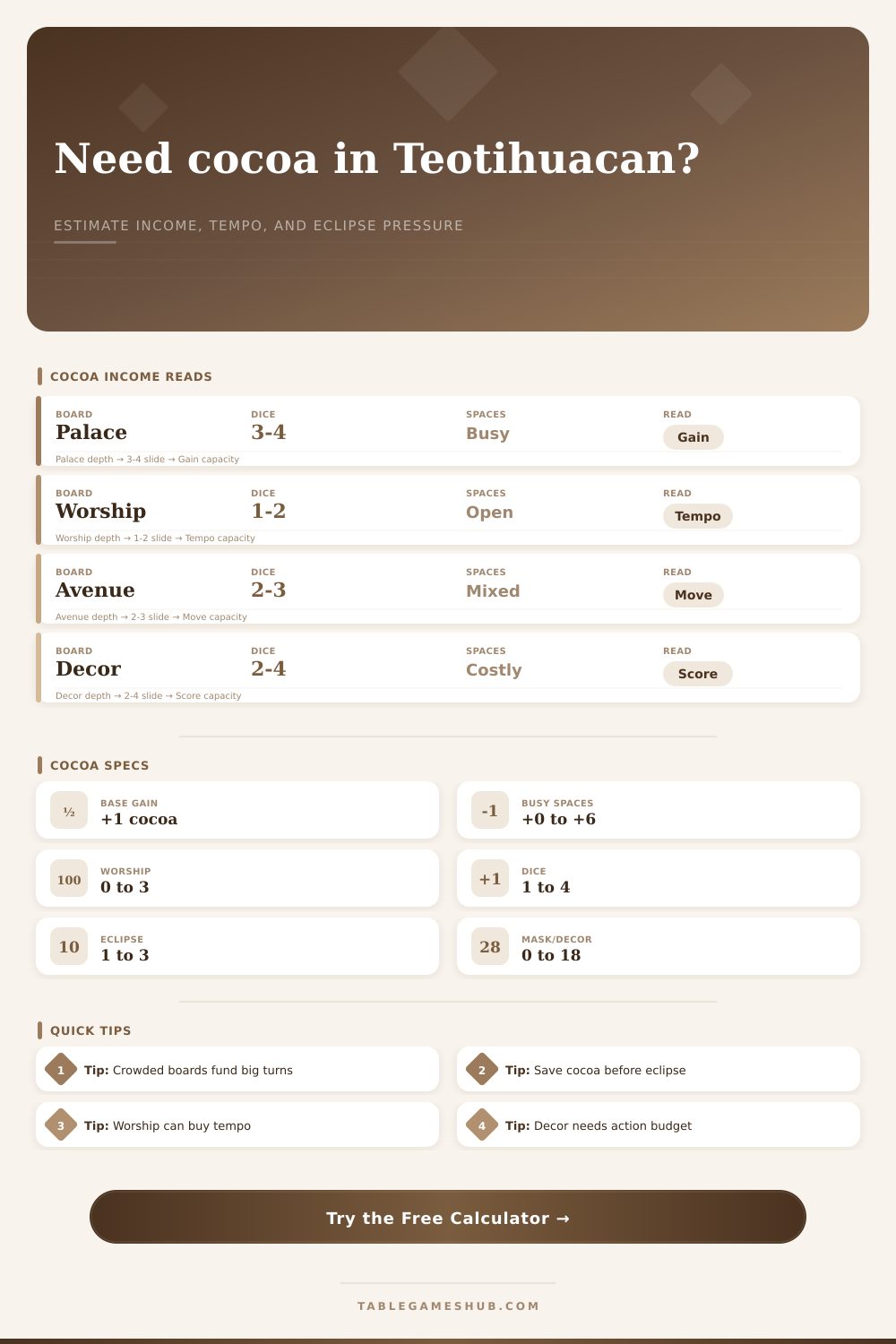
Teotihuacan Cocoa Income Calculator
Estimate whether a cocoa pickup, worship stop, or scoring setup leaves enough cocoa for your next Teotihuacan action and eclipse pressure.
Use this table aid for Teotihuacan: City of Gods planning. It models cocoa gained from crowded action boards, then compares the stockpile against expected next-action costs and scoring tempo.
| Occupied spaces | Base cocoa read | Best use | Risk if skipped |
|---|---|---|---|
| 0-1 | 1-2 cocoa | Only if starved | Low tempo gain |
| 2-3 | 3-4 cocoa | Fund medium action | Can still stall |
| 4-5 | 5-6 cocoa | Set up big board | Good income missed |
| 6+ | 7+ cocoa | Reset economy | Other players profit |
The calculator treats a cocoa pickup as 1 plus occupied action spaces, then adds selected technology and temple help.
| Plan type | Dice workers | Worship spaces | Expected cocoa pressure |
|---|---|---|---|
| Palace cocoa | 1-2 | 0-1 | Low cost, high refill |
| Avenue tempo | 2-3 | 0-1 | Medium move pressure |
| Decoration setup | 2-4 | 0-2 | High scoring pressure |
| Worship chain | 1-3 | 2-3 | Tempo over raw stock |
| Scoring focus | Point band | Cocoa need | Calculator meaning |
|---|---|---|---|
| No scoring setup | 0 VP | Save only | Economy turn |
| Small setup | 4 VP | 1-2 spare | One useful step |
| Useful setup | 8 VP | 2-3 spare | Solid conversion |
| Eclipse swing | 12-18 VP | 4+ spare | Protect scoring |
| Eclipse phase | Stock target | Tempo target | Read |
|---|---|---|---|
| Early | 2-4 cocoa | Build engine | Spend freely |
| Mid | 4-7 cocoa | Fund scoring | Balance stock |
| Late | 7+ cocoa | Secure payout | Hold reserve |
| Final push | Enough only | Convert VP | Avoid excess |
So there’s that moment. You’re in Teotihuacan with some dice in hand, a full board to look at, and nearly nothing but cocoa left over. It’s nerve-wracking. Should I use my resources here and hope I have enough time to get some serious work done?
It’s where many player go wrong: they freak out and pick up random cocoa beans, “just in case.” But then they find themselves spending three turns crouched over their beans, only to see someone else construct a temple. With the calculator above, you can understand your risk level prior to committing your workers, transforming your “gut instinct” into a solid economic prediction.
How to Play Teotihuacan Well
Tempo = Cocoa, and it’s more than just money. When you take up space on the board, other players is blocked from taking those spaces. But they’re also producing income for you! This is reflected in the tool: every occupied space brings both profit and pressure, is it worth detouring to a crowded Avenue or Palace?
Look at the math, if it indicates a lot of gain in income but little future funding, then maybe you’ve set yourself up to stall out. The longer you wait for funds, the longer you wait to score, but there’s no promise that you’ll make it.
The last wrinkle most players underestimate are the worship spaces. These create tempo instead of raw stock, which means there’s a bonus that improves efficiency for next few turns or a change in order of operations. If you can delay accumulating cocoa now to get into position to take an even sweeter action later in the turn, do it.
Do you want to know exactly what those trade-offs are? The reference table on this page lays out how different board configurations impact your capacity to purchase large and/or medium actions. Casual players differ then those who set the tempo of play by not accounting for these tempo gains. Therefore, it makes sense to consider them relative to pure income.
How does the time-to-eclipse affect the value of your cocoa stock? In the early part of the game, there’s plenty of time to replenish and you can spend freely without worrying. In the late part of the game, each individual cocoa bean protects points. The calculator takes this into account, weighting having some extra cocoa on hand (for scoring opportunities) more heavily as you get closer to the eclipse.
Don’t want to find yourself starving at exactly the moment the last few points is going to fall? Can’t afford that if you’re hoping for a decoration/mask swing at the business-end. You’ll need some reserve to help cover your bases AND pay off those all-important last-second moves.
But these numbers can change drastically depending on technology and temple bonuses (which act as boosters). What seems like a small efficiency tech by itself may not look like much, but could be the margin of difference between making a high-value move vs retreating into lower-yielding space. You should of seen this coming.
These bonuses’ inputs also provides insight on what’s working about your engine at this moment, so you can play around with different variables to see if it can support aggressive moves, or whether it’s still playing catch-up with its economy. In Teotihuacan, compounding benefits outstrip chasing raw amounts, so knowing this matter.
One common error is over-estimating the liquidity of your cocoa positions. Players often assume that having ten beans means they can affords a five-bean action and still have plenty left over, forgetting to account for next player interference or the opportunity cost of not taking a better action elsewhere. The tool makes you consider what’s happening net, at the end of the turn, so you have a more realistic idea of where you stand.
You can easily get seduced into taking immediate gain and missing the strategic hole you’re digging yourself into. Teotihuacan’s cocoa management comes down to this: maximize your score over time while aiming for immediate results. Don’t be so rich that you’re wasting turns counting beans, but don’t be so poor that you can’t jump into those high-value actions.
By quantifying how risky each potential action is, the calculator allows you to identify that sweet spot, turning a gut feeling into a clear economic projection, and you just need to go with it. Trust the math. Make the move that keeps your engine humming along during the eclipse.
You’ll recieve better results. It is naturaly more efficient. A luxurius amount of cocoa helps too. You should steer the game based off this. One might feel more comfortabley doing so, but you must act.
Actually, the moddern way to play is different than before. Making a mistake with furnitures can be hard. The player’s goes where they want. He go towards the temple. The board sits on the table. I saw him take it. It was better then he thought.