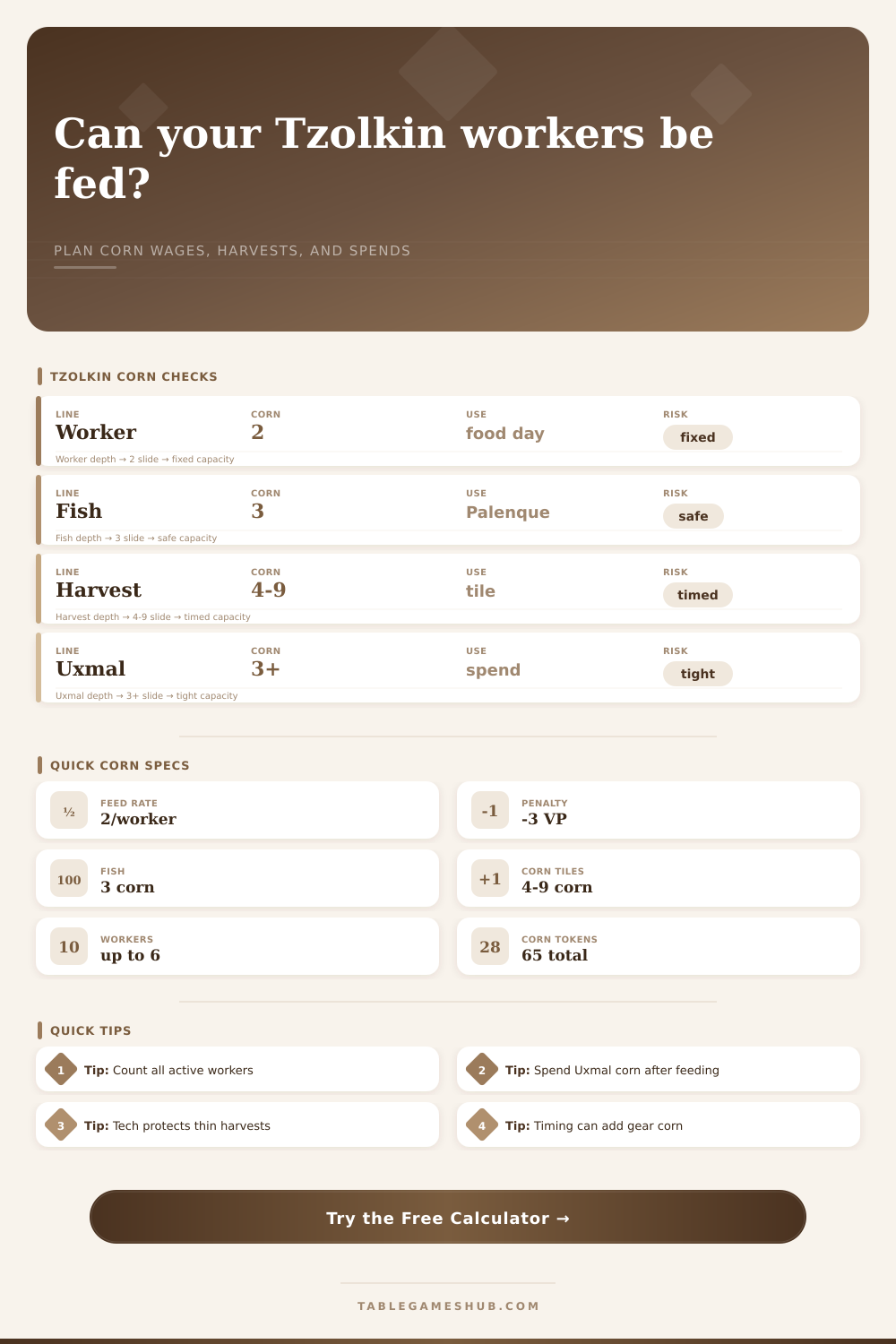
Tzolkin Corn Wage Calculator
Check whether your active workers can eat through upcoming food days after Palenque harvests, Uxmal corn spends, temple rewards, skull choices, and starting-player timing.
This tool treats corn as a worker wage reserve: it adds likely corn income, subtracts fixed food-day demand, then shows whether an Uxmal or skull line leaves enough corn to avoid hungry-worker penalties.
| Workers in play | One food day | Two food days | Hungry penalty each | Planning read |
|---|---|---|---|---|
| 3 workers | 6 corn | 12 corn | -3 VP per worker | Starter tribe baseline |
| 4 workers | 8 corn | 16 corn | -3 VP per worker | First expansion pressure |
| 5 workers | 10 corn | 20 corn | -3 VP per worker | Needs steady Palenque income |
| 6 workers | 12 corn | 24 corn | -3 VP per worker | High action power, high wages |
| Palenque action | Corn before tech | Tile pressure | Best wage use | Calculator cue |
|---|---|---|---|---|
| Fishing | 3 corn | No tile depletion | Patch a one-worker gap | Pick 3 corn harvest |
| Action 2 | 4 corn | Corn tile only | Half of a 4-worker food day | Pick 4 corn harvest |
| Action 3 | 5 corn | May need wood cleared | Stabilize a small Uxmal spend | Pick 5 corn harvest |
| Action 4 | 7 corn | Wood or burn choice | Cover most of a 4-worker day | Pick 7 corn harvest |
| Action 5 | 9 corn | Deep timing reward | Feed 4 workers with cushion | Pick 9 corn harvest |
| Opportunity | Corn swing | VP or board value | Feeding risk | When to test |
|---|---|---|---|---|
| Hold corn | 0 | Preserves food day | Lowest | Any tight round |
| Uxmal temple climb | -3 corn | Temple step | Medium | Before scoring rewards |
| Uxmal small build | -4 corn | Age 1 building line | Medium | After a secure harvest |
| Uxmal big build | -6 corn | Heavy corn construction | High | Only with wage cushion |
| Place skull | -1 corn | 8+ VP action tempo | Low to medium | When skull supply matters |
| Timing state | Modeled corn | Reason | Use case | Warning sign |
|---|---|---|---|---|
| Neutral timing | 0 corn | No turn-order boost | Normal wage estimate | None |
| Before food day | +1 corn | One tempo action remains | Small harvest patch | Worker cannot reach harvest |
| Take start player | +3 corn | Gear corn pickup estimate | Converting turn order into food | Space already taken |
| Late seat squeeze | -1 corn | Pay-before-harvest friction | Opponent blocks expected spot | Need corn to step down |
| Double-turn setup | +2 corn | Better harvest timing | Claim food before spending | Calendar advances past worker |
So there you are, sitting down to play Tzolkin. You look around your board, seeing the four workers you have out and active, and seeing pile of corn you just collected at Palenque. And you want to use up that corn! Right now. You spot a building at Uxmal that give you points, or perhaps a temple step that seem like forward movement. Your mouse is hovering over the corn tokens.
Then you look at the calendar. Is this the food day? Because if it’s the food day, it may have come and gone alredy. That’s the moment. That’s when games gets won or lost. It is not by who places more worker. But it is about who keeps them fed longer, in hopes they’ll pay their way.
Why Feeding Your Workers Matters
That’s where the calculator comes in (above). It eliminates emotional impact of that looming hand by forcing you to face cold math of survival before you reach for victory points. Just plug in how many workers are still actively growing food, what’s in your corn stock now, and number of days ahead that it will need to be fed. Then take away two corn tokens for each worker for every day in your time horizon. Subtract out any corn you intend to spend on one of the Uxmal buildings.
What’s left? It is a barebones ledger. Does it leave something for the penalty? Because the penalty are severe: Lose three victory points per hungry worker, and your good situation quickly becomes a disaster.
I also suspect many underestimate load of the feeding day. Thinking in terms of individual turns, people see a harvest and assume they’re good to go. But Tzolkin spans multiple week. If you’ve got five workers, you need ten corn for a single food day. And that’s only half what the tile is usually worth! That’s half the standard tile value right there.
And then the demand scales up real fast based off how many workers you have. The reference table on the page makes it clear; four workers don’t seem like much until suddenly you’re feeding sixteen corn worth of labor every other day. Then all that work on that Uxmal building doesn’t seem cheap after all.
And that’s where the technology shifts the feel of the game. An extra corn isn’t just an extra corn; it’s insurance. When you buy into agricultural technology, you’re purchasing some kind of reliability against bad luck and depleted tiles. That’s why the calculator values it as a cushion. Higher levels of tech means more reliable yields when they’re needed most. Otherwise, you’re simply rolling the dice with whatever tile comes out of the deck. You have to protect yourself somewhere.
This way, you might decide to pass up harvesting to place a skull instead, knowing that your tech will cover your bottom line.
There is another factor beyond just math: time. Playing first isn’t just a matter of going first but also tempo; did you get an extra action between the food day check and now? If so, maybe you blocked someone with piece of corn. Maybe you got them one more action that produced corn. Those benefits of time can be modeled using the calculator. Give yourself a boost for getting start player token or penalize yourself for opponents squeezing you on their side of the table. Turn order becomes something material rather than abstract. Do you save enough corn through your spot in the rotation to make your strategy worth it?
Most players will pay for progress at the expense of their food supply. They build a building/temple because they look good on paper. Unfortunately, if that spend leaves one worker without food, you take a penalty. The building gains you five points. The penalty costs you three. This results in a net loss of two points, plus the opportunity cost of corn used elsewhere.
Why does the game punish inefficiency with your most important resource? Because it works. The corn tokens has limited supply. Sixty-five of them are in the box, and they run out faster then you’d expect. This is especially true since all those players want to hoard their corn so they can make big spends. Hard decisions come from watching that pool evaporate.
Should you take a harvest action when your corn count isn’t high but you’re sure you won’t find more? Sometimes it’s better to hang on just because you don’t know where else it will come from. That’s when you’ll notice the shortage. That’s when the calculator would of shown you the shortfall.
Tzolkin is all about balance. Points. It is about expansion. You must ensure survival of your people. The calculator doesn’t dictate how you do that. The calculator says what you can do with what you’ve got. Everything comes second to feeding the tribe.