Puerto Rico Shipping Calculator
Estimate Captain phase barrels, public ship space, wharf overflow, warehouse saves, Harbor bonus points, and VP chip pressure.
Enter goods as five counts in this order: corn, indigo, sugar, tobacco, coffee. The calculator models one Captain phase from your seat and reports practical shipping pressure without changing any game state.
Shipping Result
| Good type | Common pressure | Shipping read | Storage read |
|---|---|---|---|
| Corn | High barrel count | Often fills the largest public opening | Can overwhelm small storage |
| Indigo | Medium count | Useful filler when corn lane is blocked | Often safe with one-kind storage |
| Sugar | Medium-low count | Good second ship target with Harbor | Worth saving if it denies spill |
| Tobacco | Low count | Protects VP in tight endgame turns | Good large warehouse candidate |
| Coffee | Low count | Can be blocked by one narrow lane | Priority save when public space is gone |
| Bonus setup | Modeled effect | Best use | Risk note |
|---|---|---|---|
| No bonus | 1 VP per loaded barrel | Maximize public space first | Spills punish wide production |
| Harbor only | +1 VP per public load group | Split across several goods | Bonus may exceed VP chip supply |
| Wharf only | Private ship for one good type | Clear the largest leftover stack | Does not create public space |
| Harbor and Wharf | Public bonus plus private overflow | Score public loads, then wharf bulk | Endgame chip cap matters |
| Warehouse | Modeled save | Good target | Captain implication |
|---|---|---|---|
| None | No complete type saved | Ship the biggest exposed stack | Captain timing is urgent |
| Small warehouse | One leftover good type | Highest leftover count | One spill lane can be neutralized |
| Large warehouse | Two leftover good types | Two highest leftovers | Can wait if VP chips are plentiful |
| Wharf plus storage | Ship one stack, save another | Largest stack to wharf | Great for uneven production |
| Preset | Core pattern | Pressure point | Calculator read |
|---|---|---|---|
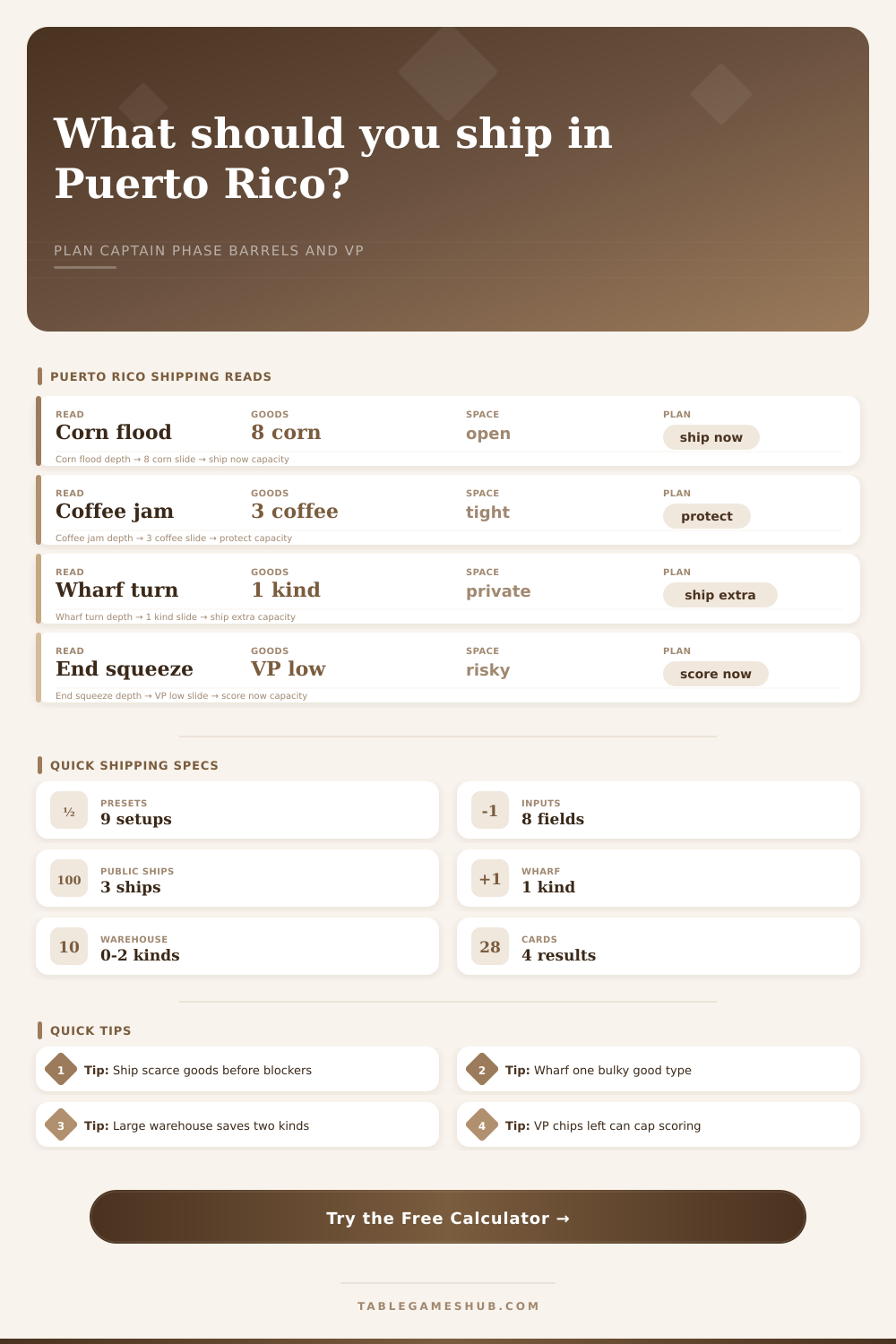
| Captain Corn Flood | Large corn stack | Public cargo space | Compare ship-now VP to spill |
| Harbor Bonus | Several good types | Load group count | Find bonus VP ceiling |
| Large Warehouse Save | Wide leftovers | Two storage types | Measure saved barrels |
| Wharf Private Ship | One bulky leftover | Private ship value | Score extra barrels after public loading |
| Final VP Squeeze | Low chip supply | Point cap | Favor immediate points |
With the Captain phase, you have to handle five kinds of goods that vary in size and value. You’ve got three public ships, each of which varies in capacity over time. They can be blocked on the lanes you desire by opponents making timing a big part of it. By using the calculator (above), all the guesswork goes away.
You see exactly how many barrels you’ll fit onto the ship, and how many will either go missing from your warehouse or spill back inside. Players think about who wants to do what first and then look at what ships. This is backwards. Look at who will do what first and what space is still open. The tool also requests “opponent block risk“, since that tends to determine profitability of a turn.
How to Use the Shipping Calculator
Go first in the turn order and you can try to get the biggest ship. But if you go last or your neighbors have been aggressive with their colonists placement, that big ship might only be half full when it’s your turn. You can tweak the chance of contestation (which affects how many VP you project from winning), and the model shows that turns depends on how much room is left when it matters most.
Until it’s too late, people misunderstand the warehouse question. A small warehouse saves one kind of good. A large warehouse saves two kinds of good. It’s easy enough. But if you can’t fit everything on a ship, then having goods spilled back in your warehouse ensures they don’t vanish.
It measures how many goods might be lost due to spillage. It takes into account your stock levels, how much room remains in public ships, and if you have private wharf access. If your spill figure is high, you’re losing money now or missing out on options later. This number is frequently worth far more than the victory point estimate: it shows the point at which your supply chain snap under stress.
Casual players don’t always consider harbor bonuses. Each different kind of good on a public ship earn more VP in the Harbor district. This rewards diversification: instead of filling up a ship with one stack of something, spread it around to get more goods on the boat. But, doing so wastes space fast which is inefficient if you’re missing diversity in your load.
That’s where the calculator comes in; it models the space versus bonus, letting you know whether you’ll be better off shipping less, but getting the bonus. It might reveal that if you fill up a ship with all corn, you’ll have a higher score than sailing fewer barrels and picking up the bonus. An intuitive guess becomes a checked answer.
But all this changes in the endgame. Each point becomes worth much more. That’s why the remaining victory point chips are so important. They limit how much you can get from them. Are you down to one or two? Maybe it’s not smart to risk it all and go after that big shipment when blocking will leave you with nothing.
In the late game, sticking to the same thing trumps going for broke. Getting something is better than getting as many points as possible. And the tool takes the chip count into account. It tells you: “You don’t need to maximize efficiency anymore; you just need to get whatever you can.”
To master Puerto Rico shipping, you have to learn to read the entire game situation. Shipping involves volume, bonuses, time, and the interaction between warehouses and ships. How much does volume get me? What are the volume requirements? Are there enough warehouses for my needs? What’s available now vs. What will I have later? It’s less about each piece and more about the relationship between them all.
The tool breaks this down into different tables: one by type of good and another by bonus set up. These provide a fast answer that covers most cases. But the true art form is learning the relationships well enough that you don’t always have to look at the numbers. When you know why coffee bottlenecks protect v.p.s. You also learn why corn floods kill small storage, so you begin to see it yourself without thinking.
You anticipate the flow of goods instead of just responding to the dice. At that point the game cease being a puzzle and becomes a conversation.