Wingspan Egg Laying Calculator
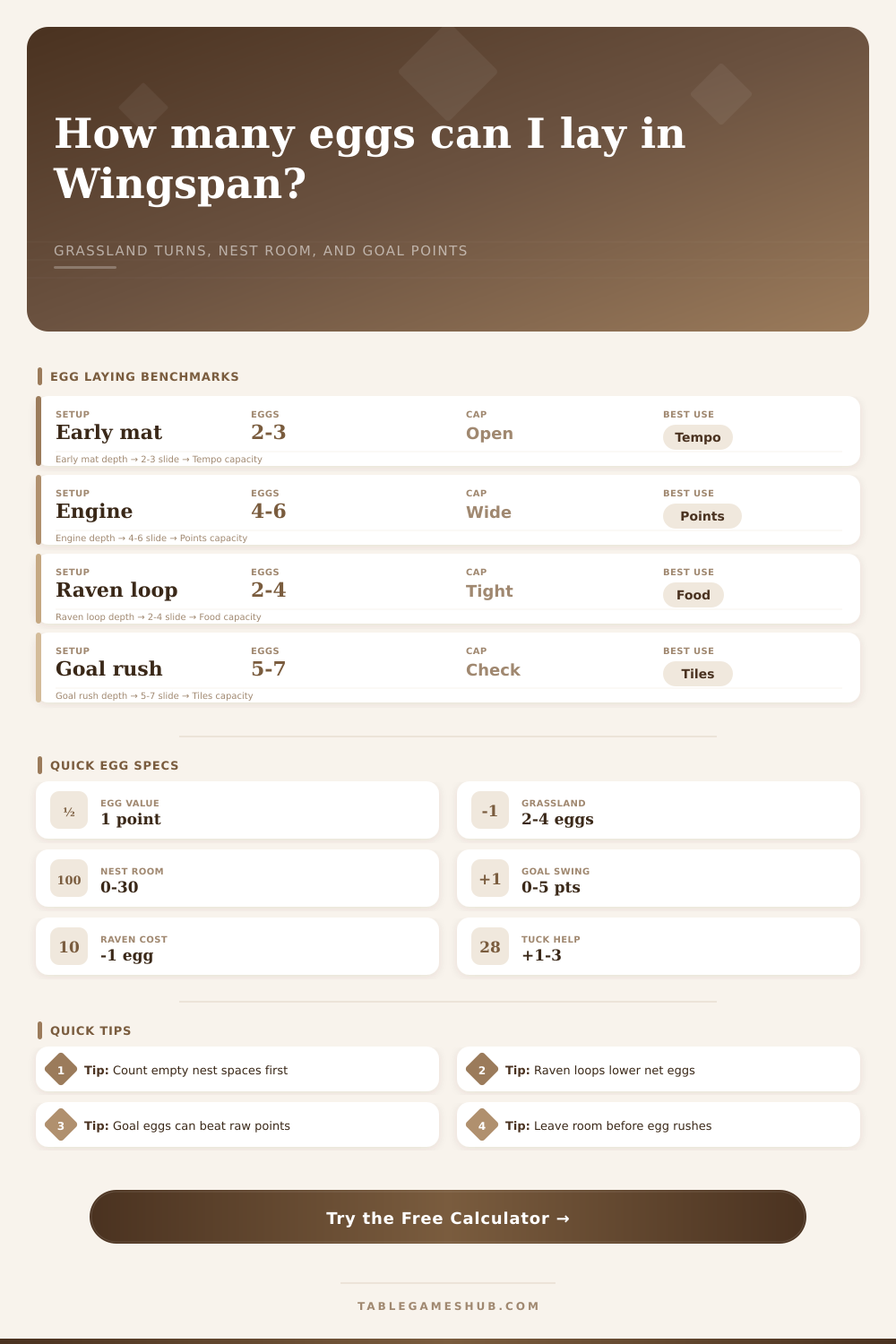
Estimate egg output, nest-cap limits, food conversion tradeoffs, end-round goal swing, and final egg points from one grassland plan.
Load a named board state or enter your own grassland numbers. The calculator caps eggs by available nest spaces, subtracts raven-style egg costs when entered, and projects the remaining turn window.
| Grassland birds | Typical base eggs | Common bonus range | Calculator note |
|---|---|---|---|
| 0 to 1 birds | 2 eggs | 0 to 1 egg | Early turns usually need broad nest room more than a high bonus stack. |
| 2 birds | 2 to 3 eggs | 0 to 2 eggs | Check whether the second grassland bird has room before counting every bonus. |
| 3 birds | 3 eggs | 1 to 3 eggs | This is where brown powers can push egg output past low nest capacity. |
| 4 to 5 birds | 4 eggs | 2 to 5 eggs | Late engines often score well only if enough open nests remain. |
| Nest type | Capacity planning range | Egg pressure signal | Use in calculator |
|---|---|---|---|
| Bowl nest | 2 to 5 eggs | Often fills quickly in grassland-heavy turns. | Add all open bowl spaces to nest capacity. |
| Platform nest | 2 to 6 eggs | Good target for final egg scoring when open. | Count remaining spaces after any existing eggs. |
| Cavity nest | 2 to 5 eggs | Reliable mid-capacity home for spare eggs. | Include only birds currently in play. |
| Ground nest | 2 to 6 eggs | Can carry goal pressure when several are active. | Use the printed capacity on each bird card. |
| Star nest | Variable | May cover multiple goal categories. | Count egg spaces normally; handle goal value separately. |
| Preset family | Input emphasis | Typical risk | Best result card to watch |
|---|---|---|---|
| Grassland engine | High base eggs plus bonus eggs | Overruns nest capacity | Capacity after action |
| Raven food loop | Negative food conversion adjustment | Food gain hides lost egg points | Goal plus egg swing |
| End-round rush | High goal value per egg | One blocked egg can cost a goal rank | Eggs this action |
| Wetland tuck support | Moderate eggs and extra bonus output | Bonus eggs may not all fit | Final egg points |
| Goal pressure | Value per egg input | When to use | Breakdown meaning |
|---|---|---|---|
| No relevant goal | 0 | Eggs only matter for final scoring or bird costs. | Swing equals raw egg points only. |
| Minor position race | 0.5 to 1 | One or two eggs may change placement slightly. | Goal swing is a conservative bonus estimate. |
| Clear tile contest | 1.5 to 2.5 | Each egg strongly affects the current tile. | Compare goal swing against alternative actions. |
| Must-win rush | 3 to 5 | A late egg burst can decide the round score. | Blocked eggs are especially costly. |
Wingspan has some great grassland action. You go to grab the cube. Wait, you look at your birds. The math say four eggs, but you only have room for two. And that moment of hesitation? It’s what makes all the difference between a wasted turn of empty bonuses and building an engine that hums along smoothly.
So many players are focused on getting cards. But no one remembers this simple fact: A bird is only valuable if you can fit its resources in your nests. High-egg-output card mean nothing unless you can put those eggs down. Once you input your board state, the rest is math. After that, you don’t have to track every possible space within a nest. Just take your opponent’s move. Then the calculator does the math for you.
Count Your Space First
It runs your possible action through constraints on your ability to play it out. You feed in your starting number of eggs from the habitat, plus any bonus they get from their powers and mark off how many spots is open. The calculator tells you what sticks and what doesn’t. What lands and what’s a waste of tempo because you can’t put it down.
Because if you can’t get it down it won’t count against your opponent’s score, and you won’t trigger any secondary objectives. Early game planning requires a different mindset different than late-game rushing. Early on, you want to get nests that has space (birds), not rush for maximum current output. Don’t buy dead weight. There’s no point in getting a high-output bird whose nest is already filled.
Capacity constraints will narrow as your engine expands. The reference tables provides breakdowns of normal outputs based off how many birds you have in your grasslands. This shows how limited capacity affects performance. Around round two or three, you might know: do I fill this goal tile, or save up my points for end-of-round scoring?
For example, with the raven loop, we see trade-offs. You’re spending an egg to get food and maybe you’ll be able to do something stronger next turn because of it. However you’ve just lost the egg permanently. With the calculator you can enter it as a negative adjustment and it will show you what your net position is. This keeps you from thinking, “oh I have so many eggs that I must be ahead.”
In reality, there is a deficit. Many people do not realize they are behind until the very last round, where each point make or breaks them on tie breakers. Losing a few egg points can equal a rank down on a goal tile, which is typically worth way more then any food you got out of it.
That’s all changed when there’s goal pressure. Maybe eggs earns a ton of points at the end of the round. Suddenly you’re willing to be less efficient in other ways in order to get those eggs. You might pass up higher-value cards. You take fewer birds. You might keep a spot open in your nests so you have room during this point-scoring period. The tool tells you how much of that swing it thinks will happen. Tells you if a push is feasible or you’ve missed the boat; run out of space and now you’re chasing points that no longer exist.
Wingspan’s not just an acquisition game; it’s a constraint-management game. There are only so many eggs to lay in their nests, so much food available, and only so many moves to make per turn. Each egg has to shares its way. The beauty of a filled-out board can tempt you into thinking that’s what matters. The excitement of playing a rare bird card can, too.
But the winner isn’t the person who fills out his board the most or plays the coolest cards; rather, it’s the one who best accounts for the real-world restrictions of his own table. Before you count your bonuses, count your empty space. Maintain that discipline all game long and those unsure choices on the grassland will appear not like lost opportunities but carefully calculated ones. You should of checked the math first. It naturaly happens when you are playing moddern games.