Seven Wonders Wonder Value Calculator
Compare a wonder board path by adding built stages, printed victory points, resource strain, coin conversion, science symbols, military tempo, and nearby card or guild synergy.
| Value source | Calculator treatment | Typical range | Best when | Risk flag |
|---|---|---|---|---|
| Printed stage VP | Added directly to gross value | 3 to 20 VP | Giza-style stage plans | Requires heavy resources |
| Coins from stages | Coins divided by three | 1 to 4 VP | Ephesos and cash-heavy turns | Can be spent before scoring |
| Science symbols | Balance bonus plus symbol count | 0 to 16 VP | Babylon with green cards | Weak if symbols are uneven |
| Military shields | Pressure-adjusted tempo value | 0 to 9 VP | Rhodes and hostile neighbors | Can overpay at quiet tables |
| Guild and card synergy | Manual VP-equivalent estimate | 0 to 18 VP | Late Age III pivots | Depends on visible seats |
| Resource burden | Subtracted from gross value | 0 to 20 VP | Low burden, high print stages | Includes lost card tempo |
| Wonder plan | Stage profile | Primary payoff | Common support cards | Calculator note |
|---|---|---|---|---|
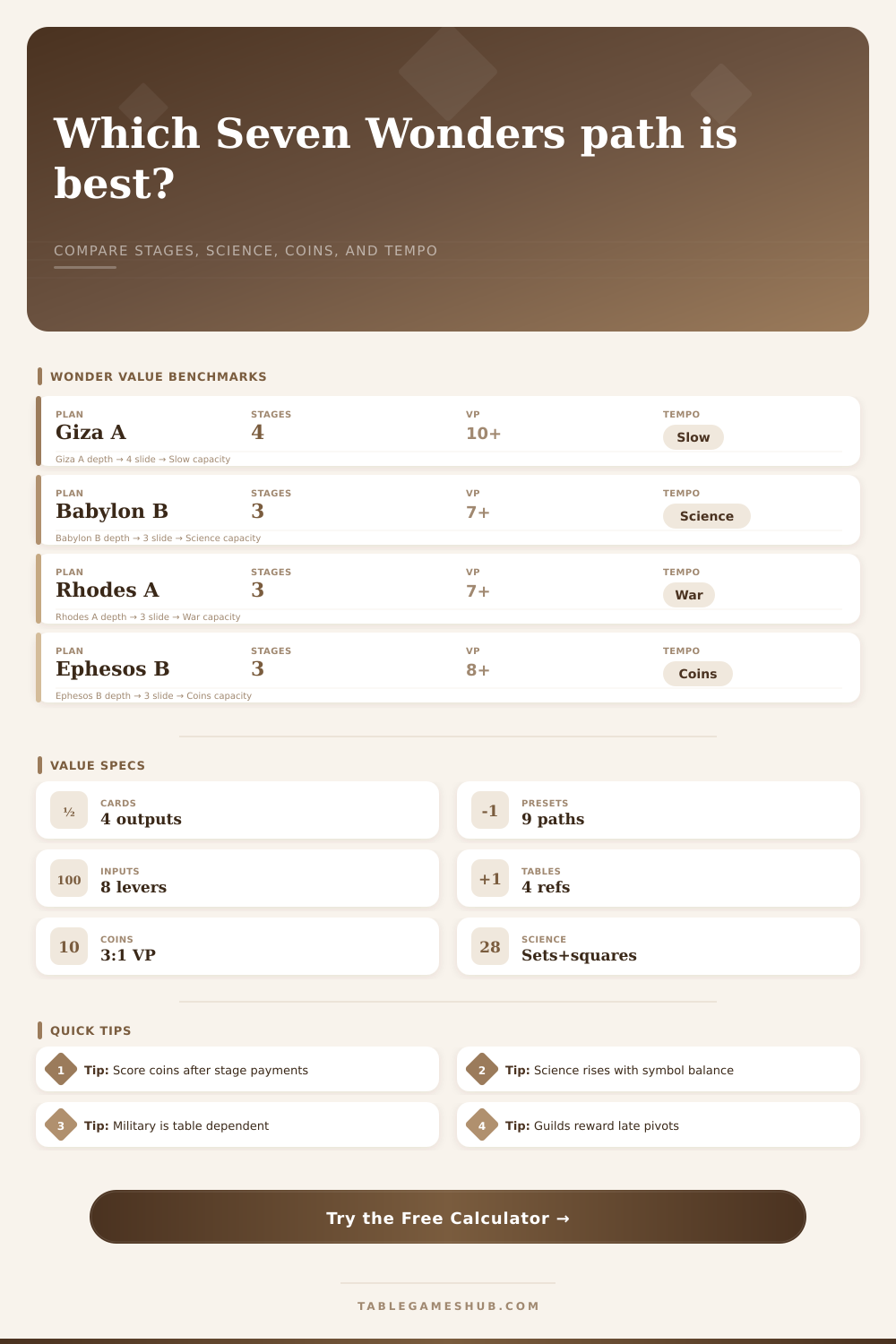
| Giza high-stage push | Three or four VP stages | Large printed VP | Stone, ore, brown economy | Keep burden honest; the VP is real but slow. |
| Babylon science side | Science symbol plus turn tricks | Green-card ceiling | Tablet, gear, compass balance | Science bonus is highest with complete sets. |
| Rhodes military tempo | Shields with direct VP | War pressure and tempo | Red cards, ore, tactical timing | Use high pressure only when neighbors compete. |
| Ephesos coin engine | Coins and VP together | Flexible build cash | Marketplaces, commerce, late blue | Coins count only if they survive to scoring. |
| Alexandria resource flex | Resource choice stages | Card access and tempo | Gray cards, multi-resource cards | Convert flexibility into synergy value. |
| Halikarnassos replay line | Discard access stages | Late card recovery | Buried guilds, science, blue cards | Synergy estimate should reflect discard quality. |
| Track | Low value | Solid value | High value | Use this input |
|---|---|---|---|---|
| Science single symbol | 1 to 2 VP | 3 to 5 VP | 6+ VP | Mostly one symbol |
| Science balanced set | 3 to 5 VP | 7 to 10 VP | 14+ VP | One full set or better |
| Military quiet table | 0 to 2 VP | 3 to 5 VP | Rare | Low or ignored pressure |
| Military active table | 2 to 4 VP | 5 to 8 VP | 9+ VP | Normal or high pressure |
| Preset | Stages | Main input | Expected posture | Watch point |
|---|---|---|---|---|
| Giza High-Stage Push | 4 | Printed VP | Commit if resources are ready | Stage burden can erase tempo |
| Babylon Science Side | 3 | Science balance | Protect symbol diversity | Single-symbol plans flatten fast |
| Rhodes Military Tempo | 3 | Shield pressure | Score wars while building VP | Low pressure lowers payoff |
| Olympia Guild Pivot | 3 | Card synergy | Stay flexible into Age III | Needs a real guild target |
| Late Hybrid Finish | 2 | Coins plus synergy | Build only efficient stages | Do not chase low-value stages |
The stack of resources sits in your hand as you gaze upon the wonder board, and the sickening sensation of analysis paralysis washes over you. On one hand, you know you win VP for every building you build. On the other hand, you’re sacrificing wood and stone to do it. That wood and stone might have been spent on a more powerfull card instead. That’s where games is won and lost, not when you count up the final number of score points.
After plugging in the synergy and stages, this calculator crunches the numbers for you so you don’t need to guess if that additional shield was worth the opportunity cost of foregoing another guild card. Vague feelings become concrete numbers you can compare between various strategy.
How to Make Good Choices in Seven Wonders
The basic idea is that each time you invest in a wonder, you are trading off another opportunity. Another investment). Did you spend three wood on a stage that gives you two shields and a victory point? What was that cost versus the alternative of something else? That’s where it gets tricky, because now you have to think about what those three woods could of been used for instead. Would it be better if I’d spent them on a blue card which will get me four points? Or maybe I could’ve paid for someone else’s shields, stopping my neighbor from winning there war against me.
The tool forces you to attach a number to this cost, since raw victory points don’t mean much out of context. A stage printing five points sounds nice until you consider that you couldn’t have gotten 10 points somewhere else because the same resources were invested there. And that’s what people often overlook when planning your wonder path.
Then there’s science bonuses, which make things even more complicated as it’s less about raw numbers and more about balance. Ten of one symbol plus one of another sounds great, but if you don’t also have all the other symbols to fill out your set or use wild cards to connect the dots between them, it doesn’t count. This is where the shapes of the symbols matter: each one tweaks the bonus value depending on whether or not you’re close enough to get that full set bonus.
It’s important to have diversity in your green engine. You should encourage diversity on your wonder instead of just stacking up one type of symbol and ignoring everything else. A little thing, but it makes every victory point feel precious in Age III.
Strategic Puzzle: The military shields represent another strategic problem in that their worth is wildly variable depending on whose side of the table they’re on. Shields from Babylon or Rhodes can be very valuable insurance if your tablemates are aggressively contesting wars and hoarding red cards. Those shields may not win the war outright, but they keep you breathing while you build up your economy. You have a slider to adjust for pressure on the table to avoid overvaluing shields at a quiet game without anyone fighting.
Shields is nothing more than art on a board at a low pressure table. At a high pressure table, they’re literally victory points waiting to happen.
Mental accounting: End-game conversion rates are changing how you perceive cash flow during the game; three coins = 1 victory point. Spending a coin early in the game on resource production or on a powerful card is more efficient than saving it up and using it for scoring later. Did you really get any return on investment with all that coin production from Ephesos (or whatever) at the end? Or would you have been better off with more cash invested in asset creation? The tool makes you realize the temptation of hoarding and forces you to see that spending is generaly wiser.
Synergy is the wildcard. Because you don’t know what other cards will be in play and which guilds you’ll get, synergy cannot be quantified until after the game is done. This input encourages you to guess how much extra value you’ll get from free builds or chained effects created by your wonder strategy. Yes, it’s subjective. But recognizing this prevents you from underestimating flexible boards like Olympia that establish several different winning condition. You’re building a machine whose parts make one another better, not simply a pile of individual victory point sources.
So the page lays it all out for you with reference tables that show you what kind of ranges to expect from each wonder side, a standard against which to compare your own games. Babylon wants you to be precise when collecting science, while Giza provides slow-but-steady points. This gives you an idea of their types. You can then decide whether you want to commit to a plan early on, or stay flexible and let the board state reveal itself.
You don’t have to have perfect information to make good decisions. Just a better means of weighing the benefits different than the costs. To play Seven Wonders well, you need to think like an accountant with taste in dramatics. Each stage is a promise of future worth; each resource is a vote for a particular strategy. It’s up to you to decide whose debt you want to pay off.
The calculator just brings the promises out in the open, so you know what you’re buying when you place that stage into position. It’s still your turn to play the game, only now you know what you’re buying.