Opponent Match Win Calculator
Estimate opponent match win percentage, floor-adjusted OMW%, opponent strength band, and tiebreak points from real tournament records, byes, drops, and current-round handling.
Opponent Match Win Results
| OMW Band | Adjusted OMW% | Typical Meaning | Tiebreak Impact |
|---|---|---|---|
| Soft pairing path | 33.0% to 44.9% | Many opponents finished near or below average after the floor. | Often weak in standings ties; needs strong match points. |
| Balanced field | 45.0% to 54.9% | Opponents collectively played close to even records. | Common middle result for Swiss tiebreak ordering. |
| Strong schedule | 55.0% to 64.9% | Opponents mostly won more matches than they lost. | Helpful against players with equal match points. |
| Elite schedule | 65.0% and up | Several opponents are likely near the top tables. | Usually a premium tiebreak profile for a cut race. |
| Input Format | Example | How It Is Read | Best Use |
|---|---|---|---|
| Match record | 3-1-0 | Wins, losses, draws become match points over available rounds. | Most accurate for card and board game Swiss pairings. |
| Percentage | 62.5 | Read directly as 62.5% before floor and exclusions. | Useful when standings already list each opponent MWP. |
| Match points | 9/12 | Numerator divided by denominator, then converted to percent. | Useful when standings show points but not percentages. |
| Decimal | 0.625 | Values at or below 1 are treated as decimal percentages. | Useful for exported spreadsheet tiebreak data. |
| Floor Rule | Minimum | Effect on Weak Records | Common Reason |
|---|---|---|---|
| No floor | 0% | Every opponent contributes exactly their actual percentage. | Raw analytics, private league reports, custom standings. |
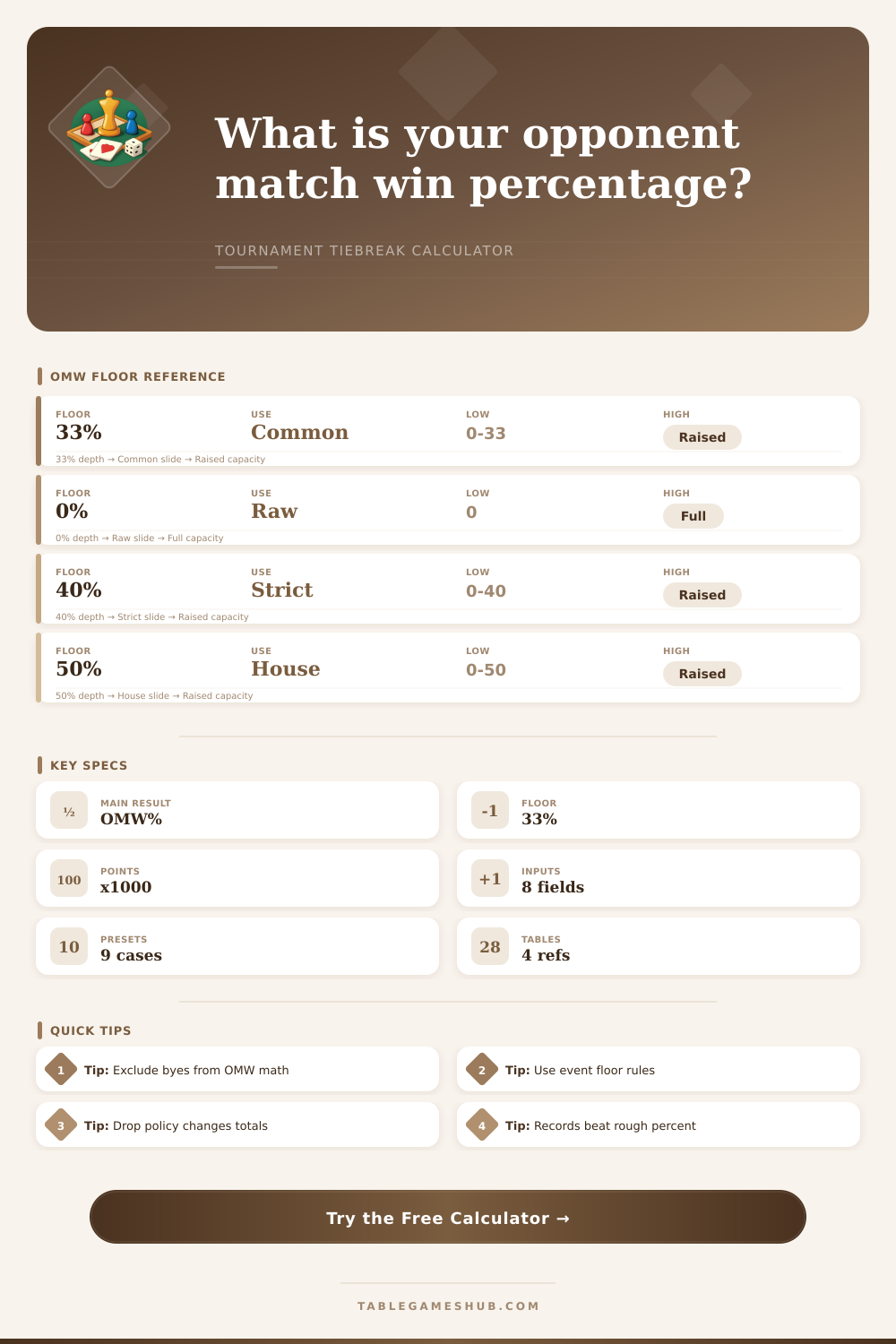
| One-third floor | 33% or 33.3% | Very low opponent records are raised near one match win per three. | Common Swiss-style opponent match win treatment. |
| Forty percent floor | 40% | Weak records have a stronger upward adjustment. | House leagues that want less damage from early drops. |
| Half-field floor | 50% | All opponents below even are counted as even records. | Small events where variance is high and pairings are sparse. |
| Exclusion Method | What It Removes | Use Case | Calculator Behavior |
|---|---|---|---|
| Use every listed opponent | No opponent rows are removed. | Official standings already include the event policy. | Byes are only reflected in the denominator note. |
| Trim lowest listed MWPs | The weakest percentages after parsing. | What-if analysis for cut-line sensitivity. | Sorts by raw MWP and removes the requested count. |
| Trim earliest listed drops | The first rows in the opponent list. | Known early drop or incorrect first-round opponent. | Removes rows from the top of the entered list. |
| Trim latest listed drops | The final rows in the opponent list. | Known late drop or final-round report mismatch. | Removes rows from the bottom of the entered list. |
| Metric | Raw OMW | Floor-Adjusted OMW | Best Decision Use |
|---|---|---|---|
| Definition | Average of opponent percentages exactly as entered or derived. | Average after each opponent is raised to the selected floor. | Use adjusted OMW when your tournament policy floors opponents. |
| Drop sensitivity | High when a weak opponent is removed. | Moderate because the floor reduces low-end damage. | Compare both when evaluating a bubble position. |
| Bye handling | Byes should not add a fake opponent result. | Byes still do not contribute an opponent percentage. | Keep byes separate from opponent rows for cleaner math. |
| Current round | Changes the final listed opponent if included. | May also change whether that opponent hits the floor. | Use for live standings before final pairings are posted. |
Calculator note: this tool models opponent match win percentage from supplied records and common Swiss tiebreak conventions. Always use the official event report for final standings.
Heart racing, you glance at the standings posted in the jammed tournament room. You’re in the hunt. You have the match points you need to make the cut. But so do three other. Now it comes down to who had the best match win percentage against whom. Until then, that seems like an arbitrary number. Then it decides your place of finish. It is not just about how many matches you won today. It’s who you played when you won them.
Roof size and rainfall are easy math saved by the calculator above (you don’t want to try and guess at the numbers). You are using the wrong calculator. Use your opponents’ record as the input to see if they was really strong enough to match your rank. Opponent match win percentage is an easy concept but that’s part of its deception.
Understanding Match Win Percentage Tiebreaks
Pairing systems like swiss attempt to group competitors based off record. Beating people with perfect records show you are better than beating people who lost every match. To award you accordingly, the system will average out how many matches all of your opponents won and give you that as a score. The higher the number, the tougher the competition. The lower the number, the easier the pairing engine probably thought your matches would be (either because they assumed you were flailing or the field was thin). So, above all, know exactly what you are measuring here. You need to measure not just where you ended up, but also quality of the road there.
This number has a floor (commonly one-third or 33%). Most events will use this value. Why? Because just because someone lost all their matches doesn’t mean they played badly. Maybe they faced three unbeatable players in a row. If there’s no floor, then any time you defeat a player with a perfect record of zero, your tiebreak goes down. That’s punishing you for defeating somebody the system put up against tough opponents early. A floor helps protect you from unlucky pairings by lifting that poor record above a base level.
For example, suppose you were matched up against a player who lost every match. But let’s say he was unlucky… Two of his losses comes against players who went on to have undefeated records. With a floor, you’re protected from that bad luck in the pairings department: instead of losing to two undefeatables, we’ve boosted his record to a baseline of three wins and five losses. Some leagues has tighter floors (or no floors at all). Check your event’s rules before doing any math; a wrong floor can move you up or down far enough to cost you a spot in the top eight.
Byes are another common snare that catches players calculating their own tiebreaks. If you get a bye, you get a win (which is reflected on your record sheet) and match points, but nobody to average against. You can’t count someone who doesn’t exist in the equation. This is where the tool says “How many byes did you have?” so it doesn’t lower your opponent strength rating with useless information. It keeps the denominator honest. That’s what most people don’t get about it. I add the bye and then wonder why my tiebreak looks lower then I thought it would be.
In addition, there are controls for dealing with dropped opponents. Sometimes people drop out of events due to travel, work, or simply feeling overwhelmed. So what do you do about someone who drops out after they’ve played two rounds? Do you erase them? Do you leave them in? With this calculator, you can adjust those records yourself and run through various what-if situations.
For example, you might be on the bubble and want to know whether leaving a weak opponent’s record in place helps or hurts you versus another player with the same number of match points. It returns both a raw percent and a floor-adjusted percent, as well as a label for what strength band it fits into. The label allows you to quicky understand the number. If your score falls into the elite band then chances are you sat at some top tables. If your schedule is labeled as a soft pairing path, it’s a warning sign that your tiebreaks may not hold up. This is because the rest of the field has equally good or better match points but tougher history.
Tiebreaks are just tiebreakers. Winning matches is what matters most. Knowing them allows you to plot out who you need to beat to win, and who losing to doesn’t hurt quite so badly. Sometimes, knowing that defeating a struggling opponent might not help your tiebreak as much as you expected can change your perspective. It frees you from worrying about the number on the paper. Instead, you are playing the person across from you and focusing on what happens at the table. Play solid matches against whomever is there. The numbers will work themselves out. You should of known it would be this way.