Root Underworld Calculator
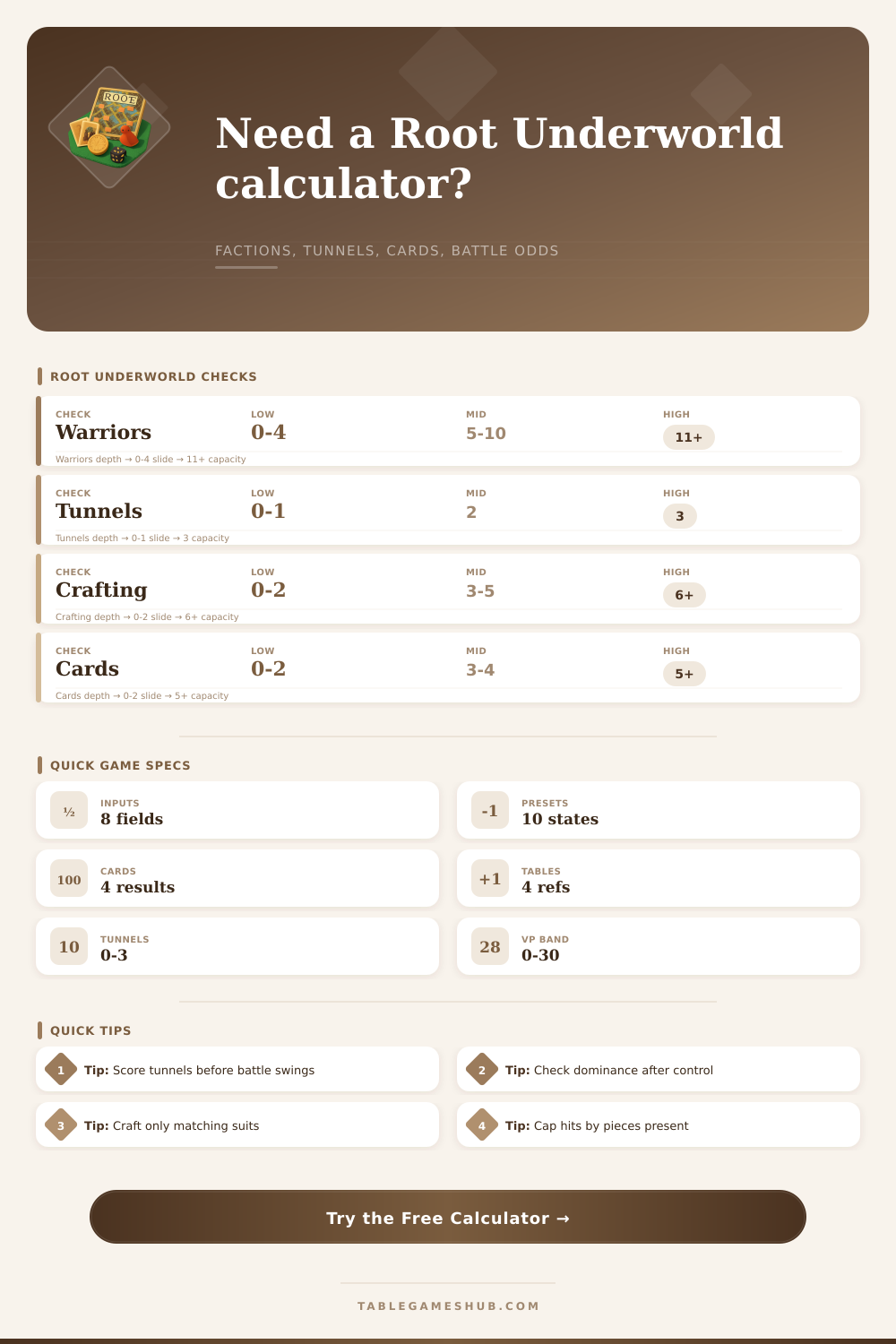
Score a Root Underworld board state with faction pressure, warriors, buildings and tokens, crafting pieces, tunnels, mountain pass control, cards, battle odds, dominance, and final VP.
1Underworld Board State Presets
Load a named Root position, then adjust the eight fields to match the clearing cluster, tunnel access, card hand, battle odds, and scoring lane being audited.
2Faction, Pieces, Tunnels, Cards, and Odds
3Underworld Spec Grid
4Reference Tables
| Faction lens | Primary score source | Underworld pressure | Calculator modifier |
|---|---|---|---|
| Marquise cats | Buildings, wood conversions, craft points | Needs roads around tunnel choke points | Piece score is steady, route score is fragile |
| Eyrie dynasties | Roost count and decree tempo | Tunnels widen recruit and move options | Warriors raise odds but turmoil risk remains |
| Woodland Alliance | Sympathy, supporters, base defense | Mountain pass opens surprise spread lanes | Cards and defensible pieces add burst value |
| Vagabond | Ruin items, quests, aid, hostile warriors | Underworld corners can speed ruin access | Cards and battle profile matter more than rule |
| Underground Duchy | Markets, citadels, ministers, sways | Burrow pieces project through tunnels | Route value and building count score high |
| Corvid Conspiracy | Plot reveals, extortion, raid threats | Tunnel ambiguity protects hidden plots | Tokens and card cover lift final call |
| Route state | Tunnels counted | Mountain pass | Score effect |
|---|---|---|---|
| No tunnel held, pass closed | 0 | Closed | No mobility bonus, dominance control is brittle |
| One tunnel held, pass closed | 1 | Closed | Small reach bonus, useful for a single battle lane |
| Two tunnels held, pass contested | 2 | Contested | Balanced reach bonus with control warning |
| Three tunnels held, pass contested | 3 | Contested | Strong route bonus, opponents can still bottleneck |
| Two tunnels held, mountain pass opened | 2 | Open | High tempo, better battle projection and card craft timing |
| Three tunnels held, pass opened | 3 | Open | Best reach profile for dominance and endgame scoring |
| Battle profile | Attacker shape | Expected hits | Practical risk |
|---|---|---|---|
| Hidden ambush risk | Attack may lose warriors before dice | Lower by one hit band | Cards in hand reduce the warning slightly |
| Even battle | Three into three | About two attacker hits | Good for clearing tokens, not always rule |
| Favored battle | Five into two | Two to three attacker hits | Best chance to swing a tunnel clearing |
| Desperate battle | Two into five | One to two attacker hits | Often needs card points or dominance cover |
| Defenseless target | No defending warriors | Extra hit applied | Excellent for removing tokens and buildings |
| Guerilla defense | Alliance defender uses high die | Attacker odds suppressed | Only attack when pieces or VP justify it |
| Check | Count to enter | Score contribution | When to trust it |
|---|---|---|---|
| Cards in hand | Cards after draw or before daylight use | Small VP and control flexibility bonus | Trust when suits match crafting pieces |
| Crafting pieces | Only active suited pieces | Direct craft VP estimate | Trust when bird cards are not required elsewhere |
| Dominance status | VP race or dominance declaration | Changes final call more than raw VP | Trust only after clearing control is checked |
| Buildings and tokens | Pieces scoring, revealing, or removable now | Main point engine for most factions | Trust after enemy battle reach is considered |
5Two Underworld Scoring Tips
Resolve reach before points: Tunnels and the mountain pass can turn a quiet scoring turn into a battle turn. Recount rule, move paths, and exposed tokens before accepting the final VP projection.
Treat dominance as a separate lane: A dominance declaration can make 24 VP stronger than 29 VP if three suited clearings are controlled and opponents cannot route through the Underworld network.
That’s why the underground level of Root is so important. While the top board is noisy and frantic… Full of threats and armies you can see. The tunnels are silent. They are subtle. That’s where you get some real leverage. Because most players thinks about moving units up top. That’s where the pressure is immediately.
And they neglect the fact that if you control the underworld, then you change the geometry of the board, even before rolling your battle dice. You shift who gets to go where and how easy. How do you know how much advantage you have in those secret places before sending your troops off to a hopeless battle? To do so, the calculator quantifies that pressure. It makes the invisible measurable by turning current state of play into a specific number.
How to Use the Tunnel Calculator
To begin with, you choose your faction lens: How do your pieces interact with tunnels? Do you need steady building placement (Marquise) or do you thrive on uncertainty (Corvids)? Not all tunnel control are created equal. Some control enables reinforcements, while others does nothing. It’s those differences that matter. And the tool weighs them.
It counts warriors, but also their access to routes. Five warriors is worthless if they’re trapped on the other side of a tunnel controlled by your opponent. The primary input is tunnel access. The reference table details how two tunnels with a contested pass provide a balanced reach bonus and how three open tunnels present an overwhelmingly strong tempo.
Movement points aren’t everything. They show the level of threat they pose. A player controlling several routes of approach force opponents to spread out defense or run the risk of being passed around completely. That configuration gets a route value from the calculator which converts mobility into potential victory points. If it’s low then it means you aren’t fully using your tunnel network. You have resources, but you aren’t using them to create pressure.
These battle odds model the chances of engaging based off the attacker and defender numbers profiled. Battle outcomes is savage in Root. Often one die roll can change everything. The calculator predicts hit chances within known probability bands. It accounts for guerrilla defense profiles and hidden ambush risks that dramatically reduce attacking force odds. Warns if it thinks there’s a small chance of hitting.
This means you don’t have enough reach with your tunnels to effectively fight, even though you might be able to get where you want. That difference can save your butt in the late game or cost you dearly. Then there’s the factor of dominance which complicates it further. Traditional wisdom says you’re winning once you hit thirty victory points, but what happens when you declare dominance? Suddenly the math flips, and the tool shifts its recommendation depending on whether you’re in a point race or whether you’re trying to secure control.
If you block up three clearings, cut your enemy’s supply lines, and take control, then having twenty-four points is better than having twenty-nine VP. And indeed the calculator accounts for that as well, shifting toward a defensive grouping plan rather than an aggressive scoring mindset when it detects dominance. After all, sometimes getting out on top of the game is just as valuable as having the highest raw number of points in the board.
The last measure includes cards and crafted pieces that round out the total. These give you some flexibility, as you can use them to switch from scoring points to providing combat support. The system calculates how valuable they will be based off amount of craft points and how well they match suits. Do you have nothing left in hand and no more crafting resources? Your situation has become brittle. You’re unable to respond to an unexpected shift in who is winning the battle.
The overall score takes all this in and projects it into one number. It determines whether you should advance for a knock-out win or fall back to strengthen your control. Run it through your board state prior to making big moves. It is quiet in the tunnels, but they never sleep. You would of seen it coming if you looked closer at the moddern strategy. Actually, most players ignores the tunnles.