Terra Mystica Fire and Ice Calculator
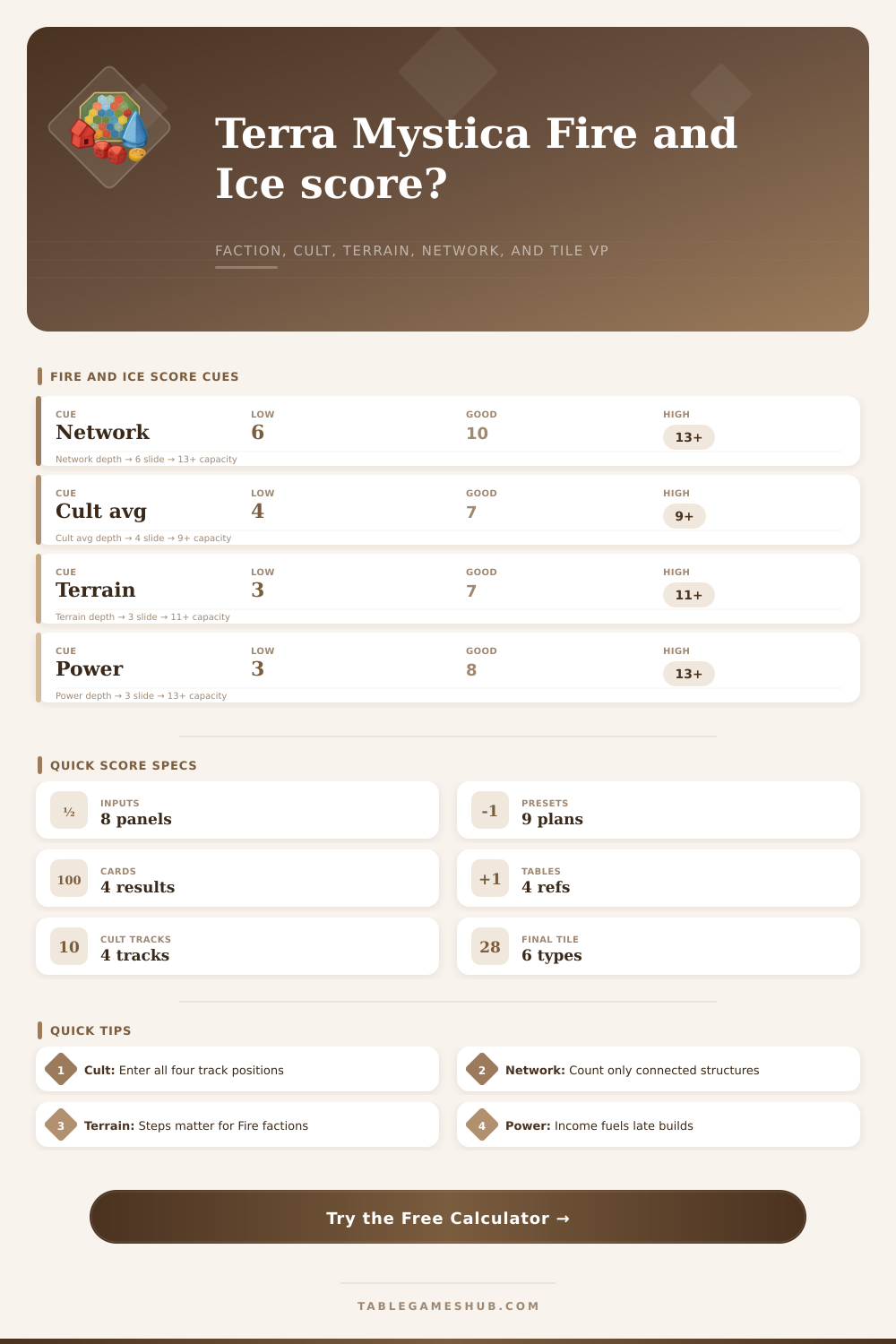
Estimate a Fire & Ice finish from faction profile, dwellings, trading posts, stronghold or sanctuary, cult track position, connected structures, terrain steps, power income, shipping or range, and final scoring tile pressure.
| Faction | Calculator emphasis | Best signal | Estimate note |
|---|---|---|---|
| Yetis | Power action access | Power income plus major building | Strong power flow improves late builds and reach. |
| Ice Maidens | Connected towns | Dwellings, towns, network | Dense ice expansion rewards wide building counts. |
| Acolytes | Cult conversion | Cult average and temples | High track pressure increases final cult award reliability. |
| Dragonlords | Volcano terrain | Terrain steps and dwellings | Terrain tempo matters more when expansion requires many changes. |
| Shapeshifters | Power bowl tempo | Power income and range | Power timing can turn one extra build into network points. |
| Riverwalkers | Color and river spread | Shipping or range value | Reach score improves when color access connects distant clusters. |
| Input | Low board | Strong board | Calculator use |
|---|---|---|---|
| Dwellings | 4 or fewer | 7 to 8 built | Drives spread, towns, and faction density. |
| Trading posts | 1 to 2 built | 3 to 4 built | Marks economic conversion into points and towns. |
| Stronghold or sanctuary | None built | One or two built | Boosts faction tempo and town pressure. |
| Connected structures | Under 8 | 12 or more | Feeds 18, 12, or 6 VP network estimate. |
| Track or tempo line | Watch range | Strong range | Scoring effect |
|---|---|---|---|
| Cult average | Below 5 | 7 or higher | Raises likely 8, 4, and 2 VP placements. |
| Terrain steps | 0 to 4 | 9 or more | Supports terrain tile and Dragonlords estimates. |
| Power income | 0 to 4 | 10 or more | Supports Yetis and Shapeshifters tempo. |
| Shipping or range | 0 to 1 | 3 or more | Boosts reach, network, and Riverwalkers spread. |
| Tile focus | Primary input | Secondary input | Estimate behavior |
|---|---|---|---|
| Network | Connected structures | Shipping or range | Awards more for large linked groups. |
| Terrain | Terrain steps | Dwellings | Awards heavy terraforming finishes. |
| Cult | Four cult tracks | Major buildings | Awards wide track pressure. |
| Balanced | All inputs | Faction fit | Smooths points across several signals. |
After three hours of shuffling pawns, settling territory disputes, and jockeying for influence over various cults, the board is a confusing maze of interlocking structures and disputed tiles. And now… it’s time for the thing we all hate: final scoring. In Terra Mystica Fire and Ice, points aren’t awarded for sheer number of buildings. Points are awarded to players who connects their buildings most effectively, dominate the cult tracks, and control the flow of power best.
The math is complicated. It involves terrain step resolution, how networks connect, faction specific bonuses, and a mix of other factors like cult track averages. Under pressure, with your opponent watching your every move, trying to do this in your head are a formula for mistakes. A single missed connection can mean falling from first to fifth place. Thankfullly, when you input the current state of your board into the calculator above, it do all that hard work for you. Freeing you up from having to do math in your head on game day.
How to Score Points Correctly
Three things form the backbone of the score: terrain control, cult influence, and network size. Network size refers to your biggest connected collection of buildings. This includes any combination of sanctuaries, strongholds, trading posts, and dwellings that is next to each other or linked via bridges or shipping routes. How do you know? Think about it as connectivity rather than just numbers, eight well-connected structures yield more points then a dozen scattered ones.
The tool accounts for the specific abilities of each faction. Note that Riverwalkers can uses their boat range to span the gap and connect what might otherwise be an incomplete network. In contrast, Yetis will tend to connect based off how efficient their power actions are. Bottom line, count every link and make sure it counts. The page’s reference tables explains how different building combos translate to network strength. This lets you check whether all the apparent sprawl really makes a cohesive network.
There’s an extra level of comparative pressure to the cult tracks, too, and markers move forward in Fire, Water, Earth, and Air depending on what you do. The point isn’t necessarily just how high up in a song you are, it’s that being first is much better than being at top of the track entirely. So if you’re ahead of the field by a big margin in three but falling way back in the fourth, you may be behind someone sitting solidly second in all of them. That’s when people fall off, really, trying to get the highest score in one and let the rest slide, only to discover that a balanced mediocrity beat single-minded excellence. Rank-based awards are calculated by comparing your submissions to what is statistically expected. This means the calculator doesn’t just show how far your markers have progressed, but how much your cult strategy has been paying off in real terms.
It’s easy to miss the scoring aspect of terrain; Fire and Ice deepens this. Dragonlords can really dominate through converting land to a valuible asset. Each turn of converting terrain score you points at the game’s end and consumes power along the way. For other factions: do you want to spend power on land now or wait until later? The tradeoff here is short term (expand fast) vs longer term (lots of points per turn). With this tool you enter in what terrain actions you’ve taken, and see the impact versus network size as you get closer to the finish line. If you’re taking lots of turns for terrain, but don’t have much of a network, it’ll show up right away.
Everything is tied together through power management… Running out early means you lose all of your potential score, while the power income inputs can helps determine if your late-game engine was fueled sufficiently to achieve its goal. This is further refined by shipping and range values, which account for ease of access to distant areas of the board; and these details do matter, as they factor into sustainability. High-potential-on-paper players who were low on power probably took some risks that didn’t pay off.
So in conclusion: Terra Mystica favors adaptability over any set plan of attack. The board shifts. Your enemies will block you. Opportunities will pop up. That’s where the calculator comes in handy, giving you an objective look at how well (or poorly) those adaptations worked out. It’s a way to see past the noise and show what your strategy’s raw performance actualy is.
Was it a good move to go for a large spread of Riverwalkers? A compact cluster of Ice Maidens? Whether your hope was accurate doesn’t matter. Your actual place in the game does. And knowing your spot means the difference between confidently claiming victory and painfully realizing you would of made a bad call.