Caverna Forgotten Folk Calculator
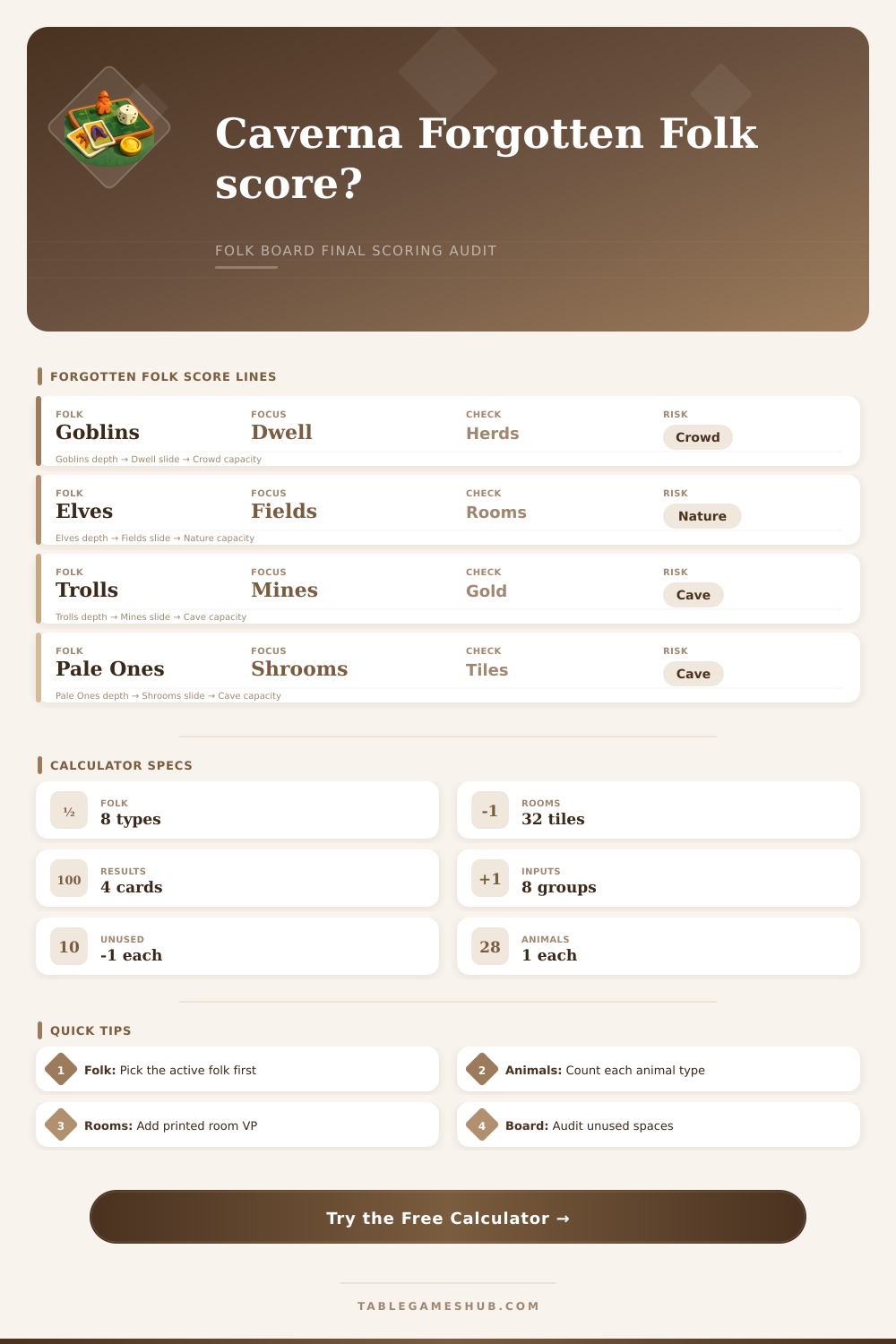
Total a Forgotten Folk endgame with folk type, dwellings, animals, fields, mines, expeditions, rooms, weapon strength, unused spaces, gold, and folk-specific scoring pressure.
| Folk type | Calculator focus | Special input watched | Final score cue |
|---|---|---|---|
| Cave Goblins | Extra family and dwelling crowding | Dwellings and family | Folk focus rises when family fits available dwellings. |
| Dark Elves | Furnishing rooms and mushroom counters | Room VP and goods | Room-heavy boards get a larger focus adjustment. |
| Elves | Nature coverage with animals and meadows | Fields, meadows, animals | Low unused space matters more than mine count. |
| Humans | Balanced base-game scoring | All board lines | Even development gives the cleanest audit. |
| Mountain Dwarves | Border cave, mines, and weapon pressure | Mines and weapon strength | Mining plus a strong weapon drives the focus score. |
| Pale Ones | Mushroom and overhang cave economy | Goods and unused cave spaces | Goods help offset unusual cave geometry. |
| Silicoids | Ore web and deep cave density | Mines, rooms, rubies | Dense cave development pushes the score shape upward. |
| Trolls | Treasure, gold, and armed expeditions | Gold and weapon strength | Counter score should visibly support the final total. |
| Score line | What to count | Modeled value | Calculator field |
|---|---|---|---|
| Family | Final workers or family members on the board | 1 point each | Family |
| Animals | Sheep, donkeys, wild boars, cattle, and dogs | 1 point each, minus missing type checks | Animals by type |
| Rooms | Base and Forgotten Folk furnishing room points | Entered room VP total | Room VP |
| Board coverage | Fields, meadows, and mines that shape final development | Coverage points plus folk focus use | Fields and mines |
| Counters | Crops, rubies, folk goods, and gold | Direct counter score | Crops, rubies, goods, gold |
| Unused spaces | Empty farm or cave spaces after tile placement | -1 point each | Unused |
| Component family | Expansion count | Calculator use | Audit note |
|---|---|---|---|
| Folk boards | 8 folk boards | Sets the focus adjustment and goods label | Choose the board actually used in the game. |
| Furnishing rooms | 32 room tiles | Entered as room count and printed VP | Keep printed points separate from focus score. |
| Other tiles | 32 caves, fields, mines | Fields, meadows, and mines inputs | These influence coverage and folk pressure. |
| Special goods | Gem fruits and mushrooms | Goods input changes by folk type | Use the good your folk board actually produces. |
| Goblin markers | 8 markers | Represented by family and dwelling pressure | Useful when auditing Cave Goblin end states. |
| Weapon strength | Expedition count | Calculator read | Best folk fit |
|---|---|---|---|
| 0-5 | 0-2 expeditions | Low expedition pressure | Elves, Humans, room-heavy Dark Elves |
| 6-9 | 3-5 expeditions | Useful tempo credit | Humans, Silicoids, Cave Goblins |
| 10-13 | 5-8 expeditions | Strong armed board | Mountain Dwarves and Trolls |
| 14+ | 8+ expeditions | Dedicated expedition finish | Troll treasure or mine-heavy boards |
At the conclusion of a lengthy Caverna session, after all has been said and done, someone eventually wins, but the counting process can be a tedious chore that drags out the victory lap… And minds often wander as players tally everything up. All those resources is strewn about the table alongside half-baked plans, and players frantically sort through their piles of scoring counters while racing against the clock to add up all the points. It feels like counting sheep, checking meadow coverage and calculating which rooms score which points; it stretches the game out by another hour and is simply frustrating.
That’s why something that reliably checks your final board state are necessary. You want a simple way to clear away all the noise and see what the signal looks like: did I successfully execute my strategy? Did I go down the wrong path? This includes all the various scoring lines on one page (summing them together with the calculator at the top), eliminating any need to do math in your head as you pack up.
Why You Need a Caverna Score Helper
This includes basic elements of a winning board: Animal + Dwellings + Family Members, plus complicated variables such as Weapon Strength Penalties, Expedition Bonuses, Folk-specific Focus Adjustments, etc… The fields, mines, goods, and rubbies is scored by the tool automatically, removing any possible math errors from casual scoring sessions. It’s not just about calculating the number. It’s about seeing what engine powered your win, and where you dropped points because you didn’t think to include something.
The one thing that can makes Forgotten Folk confusing is forgetting the different resources are valued differently on each board. While a stack of mushrooms might be worth nothing to Cave Goblins, it could be a highly scoring element for Dark Elves or Pale Ones. Remembering this make up another part of this tricky puzzle. To help, the tool asks you to select your active folk type first because this choice dictates how the counters count. Your folk choice determines which spaces will cost you points (or not) and which counters will apply to your special goods score. Choosing incorrect board here means an incomplete audit as the calculator can’t assume which mini-game was more important to you. It’s a minor step that helps avoid big mistakes when players fail to factor in their folk-specific bonuses into final calculation.
Just be aware of sneaky score-reducing traps as well. Empty spaces in caves and on farms will sneak up and knock points off at the end if ignored; it’s simple to forget about them until then. Thankfullly, those unused tiles actually gets considered in the penalty check by the calculator and instantly inform you how many points they took away.
The same is true of missed animal types. Because of the way the diversity bonus works, five distinct animals tend to earn more points than forty of only one kind. That’s why variety is better than focus when it comes to animal husbandry. This odd mechanic encourage you to diversify rather than produce an endless supply of one efficient thing.
The other thing that players often forget is the scoring for weapons and expeditions. You don’t just get points by getting action points or winning fights during a game. You also build up your weapon strength, which helps your final score through a new line item based off your weapon strength plus your expedition amount. This means you could potentially leave some points on the table if you went crazy building out expeditions and didn’t worry as much about your weapon rating. Why? Because the extra power from having lots of expeditions only works when combined with strong weapons, and this tool splits up the expedition power into its own category so that you can tell if your plan to go all-in on expansion realy paid off in terms of points or not, or if it was all just noise.
The scorekeeping in Caverna isn’t so much mathematical. Instead, it involves keeping track of all the tiles on each room you’ve built, how many goods you have, and what spaces are empty, all while running out of social time. The system for final scoring keeps the fun intact because it removes the drudgery of scoresheet. Allowing players to analyze their gameplay instead of just taking someone’s word for who won gives them a way to understand exactly how they earned every point, so they can approach the next campaign with much more intention and precision.
Count down. Breathe. Grab your counters. Don’t count anything down yet. The structure of the calculator makes sense out of the chaos. But it’s knowing the trade-offs that make those numbers meaningful, feedback. Because you could of not get better unless you know exactly how many points you gained and lost.
That’s what separates a strategist from a novice who just wants to figure out why they lost. That’s what turns an otherwise frustrating cleanup phase into something useful for the next time you go diving underground.