Seven Wonders Armada Calculator
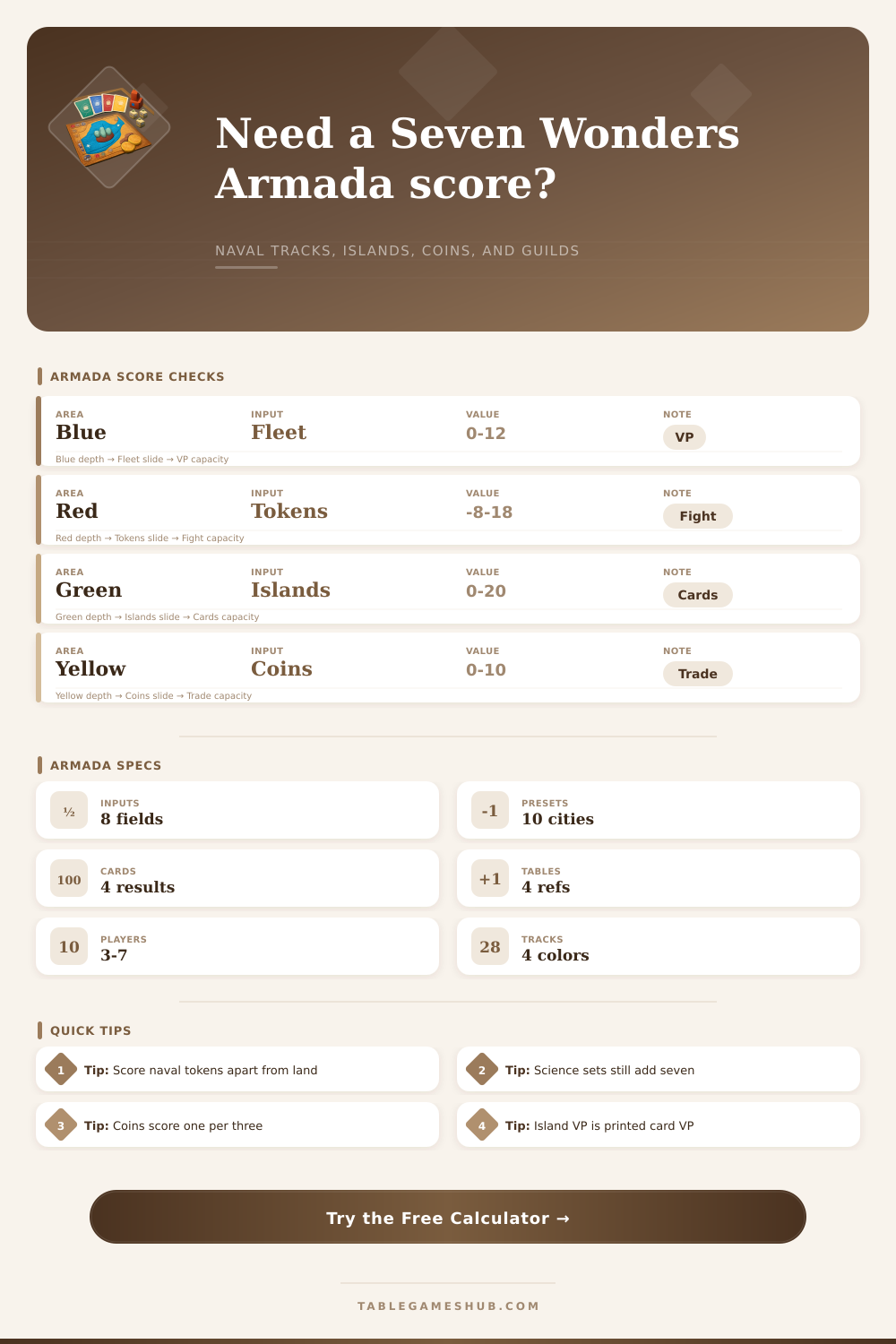
Total a 7 Wonders: Armada score sheet with the four naval track colors, naval conflict tokens, island cards, science sets, civilian cards, commercial cards, land military, coins, guilds, and player-count pressure.
Live score breakdown
| Score source | Entered count | Rule used | VP |
|---|---|---|---|
| Armada tracks | profile | track VP | 0 |
| Island cards | 0 | printed VP | 0 |
| Science | 0/0/0 | squares + sets | 0 |
| Coins | 0 | floor coins / 3 | 0 |
Naval track color scoring
| Track color | Calculator cue | Score entry | Check before total |
|---|---|---|---|
| Blue | Printed VP spaces | Track profile | Count visible blue fleet VP only once |
| Red | Naval conflict | Naval tokens | Keep land and naval tokens separate |
| Yellow | Coins and trade | Commercial field | Convert final coins at one per three |
| Green | Discovery and islands | Island VP | Add printed island card VP |
Science formula reference
| Science line | Formula | Example | VP |
|---|---|---|---|
| One symbol type | Count squared | 3 tablets | 9 VP |
| Two symbol types | Each squared | 2/3/0 | 13 VP |
| Complete set | +7 per set | 2/2/2 | 26 VP |
| Island science | Add symbols first | Card symbol | Use final counts |
Player-count conflict scale
| Players | Neighbor pressure | Naval swing | Audit note |
|---|---|---|---|
| 3 | tight triangle | high repeat hits | Check same rivals each age |
| 4 | compact table | medium-high | Red fleets can decide gaps |
| 5 | standard spread | balanced | Use both token rows |
| 6-7 | wide table | distributed | Island VP often separates scores |
Seven Wonders has a score phase where addition alone isn’t enough. In fact, it is more like a check of your whole civilization. With the Armada expansion, there are also some complicated trade routes that people can easily mess up, island cards, and new naval tracks to add to the mix. That’s when the calculator steps in, crunching math for you after you put in your board state. You don’t have to guess at conversions and coefficients any more, saving you tournament night headaches.
But that doesn’t mean nothing goes into it besides pressing the calculate button. The naval war in the game is important to know about. Naval war are scored independently of military victories. In the basic game, you get military victory points (which are represented by red tokens) through ground fighting. The Armada expansion add another pathway to gain military power at sea that looks very similar but gets counted separately.
Why You Need a Score Calculator
Why does it matter? Because many players mix up their tokens; they have red tokens out on the table representing both their land power and their sea power. It’s an easy error. They look down and spot some red tokens on the board and think: “Those all count towards my total.” They don’t. The tool helps separate those inputs so you can clearly see where your lead comes from. You can see how much was conquered in Mesopotamia versus what was held in the Med.
Adding to this complication, there’s also island exploration. Even veteran players will get tripped up here. You’re no longer seeking only resources when drawing cards from your deck; you need to track down both science symbols and printed victory points. You have to add up the printed VP value on those cards and then include number of science symbols you’ve found on them before running the equation.
Finally, the science score operate on a quadratic scale: each set you finish gives you an instant bonus (seven points for completing a set of three types). That’s why having a few straggler tablets lying around isn’t so great, those lone cards don’t do much; but finishing a set of three get you 7 points right away. Again, it sounds like nothing, but every point is worth something when it can take someone from first to fourth.
Coins and Trade are easier bets: If you can manage to accumulate coins, you get a point for each three coins you hold in your treasury when the game ends. If you stash 17 coins, you’ll gain only five points and waste two coins. It is not efficient by design. The calculator takes care of that conversion for you so you can spend time wondering if you would of done better investing them into civilian cards or commercial guilds.
The civilian blue cards grants instant points; the commercial yellow ones scale based off the number of trade routes you command. Since that represents two competing modes of strategy, it’s something else to keep track of on its own. One is building an engine that pays off more over time as the board shifts. The other is steady accumulation.
It also accounts for player count. When there are three players around the table, naval conflicts occur frequently and are very close together; lots of pressure to hit that red track. If there are seven players, it’s wide open; science sets and island discoveries tends to be the real differentiators. Depending on who is playing, the tool will adjust its reference notes to account for player count so that when you see your own number, you have an idea about how competitive it really is. A large military might look good on its own, but it doesn’t matter if everyone gets the sweet island contract.
The point is, understanding how all this works makes you a better player the next time around. Now you know that sea isn’t just something you ignore at a token cost. It’s also something you might not be able to ignore if you want to get some trade routes that will power your other engines. You can also grab some resources for yourself.
That calculator shows you where you’re at, but doesn’t show you why it turned into those numbers. It shows why you screwed up there. All it does is show you the facts, then lets you scream at each other about them without making you angry. It shouldn’t feel like solving a puzzle while blindfolded, it should feel like celebrating your strategy.
Separate out your naval tokens from your land ones. Audit your science after the islands. Remember the coin conversion rate. If you type in the right numbers then the numbers will be right. Learning why they look that way is the hard part. It makes for a chaotic final round. This becomes a lesson that you can use again tomorrow.