Dominion Seaside Calculator
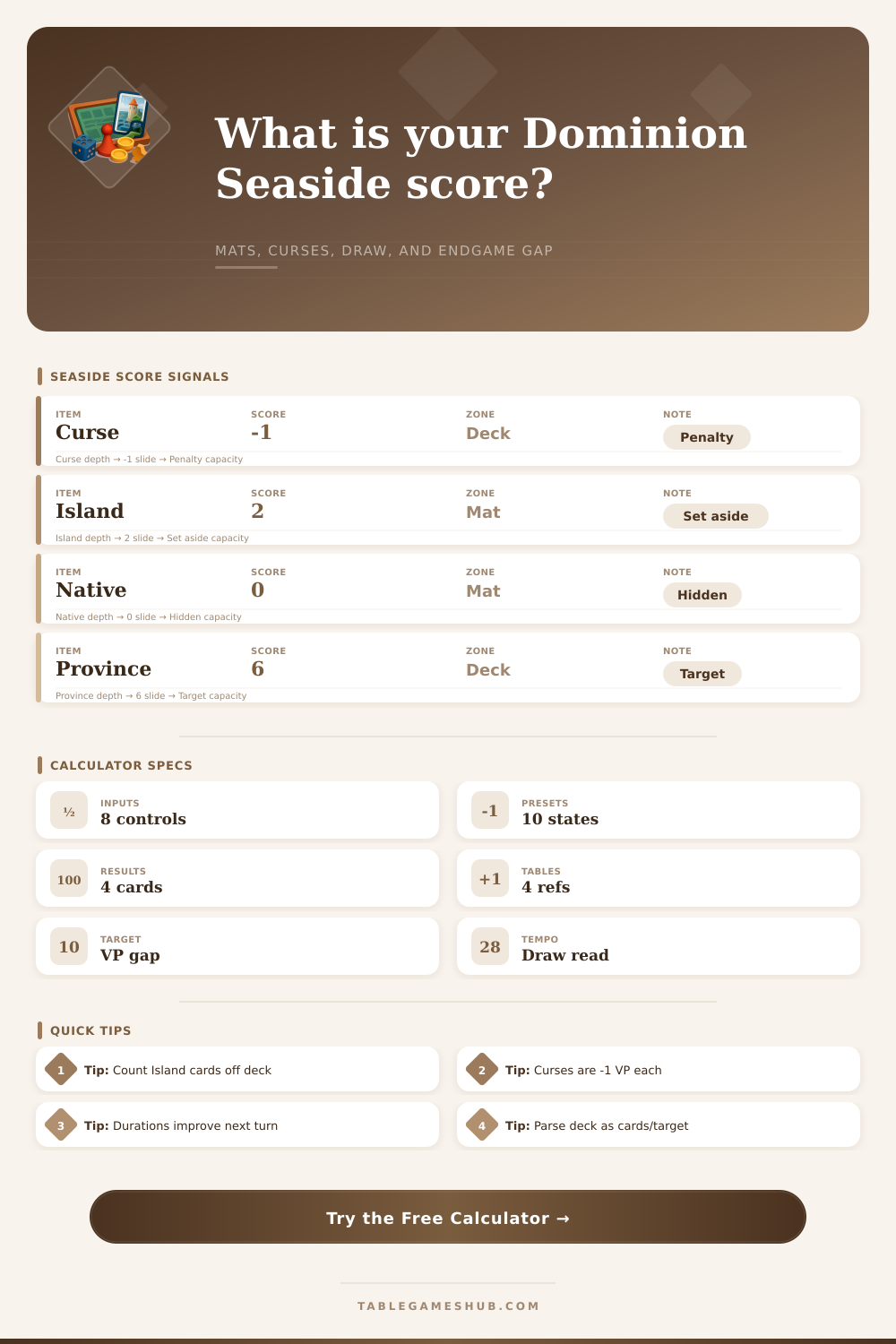
Total a Dominion Seaside endgame position with victory points, curses, Island cards set aside, Native Village mat effects, duration cards in play, Pirate Ship coin tokens, Treasury or Warehouse draw support, deck size, and target gap.
Live Seaside score breakdown
| Score source | Count | Rule | VP |
|---|---|---|---|
| Base victory cards | entered | printed VP total | 27 |
| Island cards | 2 | 2 VP each | 4 |
| Curses | 3 | -1 VP each | -3 |
| Total score | official VP | sum above | 28 |
Seaside mats and scoring zones
| Card or zone | Calculator effect | Score treatment | Deck effect |
|---|---|---|---|
| Island card | Add 2 VP each | Scores while set aside | Leaves active deck |
| Islanded card | Not scored here directly | Count VP cards in base total | Leaves active deck |
| Native Village mat | Shows set-aside card count | Score any VP in base total | Leaves active deck until reclaimed |
| Haven set-aside | Represent through duration count | Score by card type at end | Temporarily outside shuffle |
| Curse pile | Subtracts per Curse held | -1 VP each | Still counts as deck card |
Duration, Pirate Ship, and draw profile
| Seaside tool | Input field | Tempo read | Calculator note |
|---|---|---|---|
| Wharf | Duration cards | Strong draw next turn | Raises push and density read |
| Merchant Ship | Duration cards | Coin next turn | Improves buy floor |
| Tactician | Draw profile | Large rebound hand | Highest draw profile boost |
| Pirate Ship | Coin tokens | Token coin floor | Adds to next-turn push |
| Warehouse | Draw profile | Sift and cycle | Improves active deck access |
| Treasury | Draw profile | Top-deck reliability | Improves repeat turn quality |
Endgame target lanes
| Position lane | Typical target | Deck size read | Score check |
|---|---|---|---|
| Province race | 35-50 VP | 30-45 cards | Count Provinces and Curses |
| Island density | 40-55 VP | 35-55 cards | Add Island cards on mat |
| Duration engine | 45-65 VP | 40-65 cards | Check next-turn push |
| Native Village hold | Any target | Mat lowers shuffle size | Confirm hidden VP on mat |
| Colony variant | 70-90 VP | 55-85 cards | Use higher target entry |
At the end of a Dominion Seaside game, it sometimes feels like a last-minute scramble to do quick accounting on the fly. Yes, you’re winning (or losing) by a few, but there are still Pirate Ship tokens lying around, some Islands left out of your draw pile, and leftover duration cards on your board that could be the difference-maker, or nothing at all. The points add up, but they don’t just add. They add with time: that’s where the strategy comes in.
Island cards is usually viewed as nothing more than a source of VP, and while that’s certainly part of their function, it ignores its effect on reducing your deck size. Each time you play one from the mat, it are discarded from your active draw stack. That instantly densifies the rest of your deck, removing the need to sift through a bunch of dead weight just to get to the good stuff. To compensate for this, tool treats the Islands as set-aside assets. They add to your score, but don’t clog up your hand in future rounds.
The Art of Counting Points at the End of Dominion Seaside
Similarly, Native Village work in a similar way, but with one catch: any cards you put onto the mat are removed from the shuffle, though you can get them back later for treasure or action. This provides a secret reserve of potential strength that wouldn’t appear on a typical list of VP unless/until you choose to use it.
Keep in mind: Tempo and VP is two different things. While VP is static until the game ends, tempo is fluid and delicate. Your Merchant Ship or Wharf sit in play, promising rewards during upcoming turn. The calculator will include those in your “push”, calculating an estimate of how many card draws or buying power you may realize before shuffling up. Basically you’re playing with fire, you’re counting on having some strong duration engine, which means you’re loaning yourself VP for tomorrow in order to make it through today.
Pirate Ship tokens complicate this even further. These are potential coins available to you if you can choose the right mode at the right moment. This versatility isn’t easy to measure, but it frequently makes the difference between forcing your opponent into a bad play or having enough coin left to grab that last Province.
Curse management is still important in these games. Each Curse in your deck are worth -1 VP and takes up space that might of been used for something valuable. Since Curses don’t go away at the end of the game, the calculator penalize them harshly. They stick around until they’re either removed by other means or discarded. This reduces the size of your deck. A lot of people lose tight games because they didn’t consider their discard pile’s lingering curses. It seems like such a minor consideration, yet every point is crucial when every point matter.
It’s useful too to see where those numbers fit into decks because of handy reference tables provided on the page: what are the typical target point ranges for this type of strategy? How much room do you have to grow? Does your board need more Colonies, or are you racing Provinces? Your targets will change based off that, do you want to close the gap by forty-five or by seventy? What trade-off does it represent to buy an additional Island? That tells you if you’re trying to hit seventy points or just forty-five.
The tool takes all that information and runs the numbers. This shows you how you compare to that number. At its heart, determining your Seaside placement boils down to weighing current advantage against long-term reward: how many victory points do I require to remain in contention without making my deck unplayable? Running these calculations will inform you what actions is available, and which ones ought to be taken immediately versus those to be left until later.
Believe the numbers for the math; follow your gut for the when. As soon as you begin to think of the endgame as a progression of timed unlocks instead of a single fixed number, it all starts to click into place.