Carcassonne Traders & Builders Calculator
Score a Traders & Builders position with completed cities, roads, cloisters, farms, wine, grain, cloth, builder tempo, pig farms, inns, cathedrals, river links, and meeple pressure.
| Scoring Area | Input Used | Rule Applied | Points |
|---|---|---|---|
| City | 6 tiles, 2 shields | Completed city | 16 |
| Road | 5 tiles | Completed road | 5 |
| Goods | 2/1/1 vs 1/2/0 | Wine and cloth leads | 20 |
| Farm | 3 city links | Pig farm | 12 |
| Good Type | Your Tokens | Nearest Rival | Majority Result | Final Points |
|---|---|---|---|---|
| Wine | 2 | 1 | Lead | 10 |
| Grain | 1 | 2 | Behind | 0 |
| Cloth | 1 | 0 | Lead | 10 |
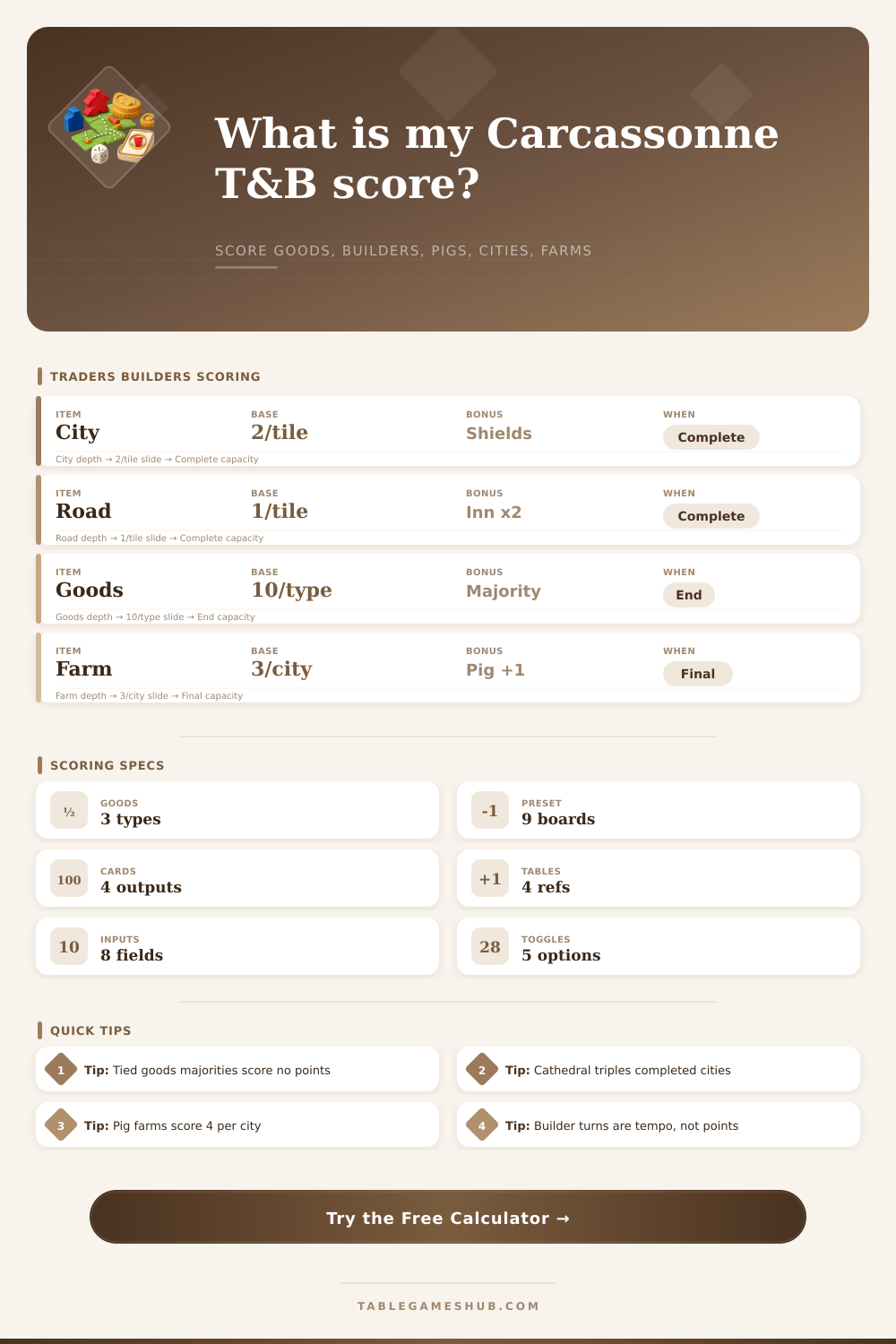
| Feature | Completed Base | Expansion Toggle | Calculator Treatment |
|---|---|---|---|
| City | 2 per tile plus 2 per shield | Cathedral city | 3 per tile plus 3 per shield when complete |
| Road | 1 per road tile | Inn on road | 2 per road tile when complete |
| Cloister | 9 per completed cloister | No toggle needed | Multiplies completed cloisters by 9 |
| Farm | 3 per completed city linked | Pig on farm | 4 per completed city linked |
| Goods | 10 per type majority | Wine, grain, cloth | Compares your count to nearest rival count |
| Toggle | What It Changes | Score Impact | Planning Note |
|---|---|---|---|
| Builder active | Shows estimated extra turns from extended city or road features | No direct points | Useful for tempo and tile-chaining analysis |
| Pig on farm | Raises farm city links from 3 to 4 points each | +1 per linked completed city | Only matters if the farm is won |
| Inn on road | Doubles completed road tile scoring | 2 per tile instead of 1 | Incomplete inn roads score zero outside this completed-feature calculator |
| Cathedral city | Triples completed city tiles and shields | 3 per tile and shield | Incomplete cathedral cities score zero outside this completed-feature calculator |
| River farm link | Adds one connected completed city to the farm count | +3, or +4 with pig | Use only when the river field actually connects |
With the Carcassonne: Traders & Builders expansion, Carcassonne transforms from a spatial puzzle game into an economic strategy contest where you must manage not only placement of tiles, but also time and supply chains. The calculator handles the arithmetic so you can focus on the tactical implications. Instead of doing math in your head, the calculator do it for you, freeing up your brain space to understand your situation. It scores road points, city points, and evaluates who has most majority wins in cloth, grain, and whine.
Doing that takes two approaches, building something gives you some security, but having a pile of good tokens can mean late game swing points. Knowing how those score engines play off each other is essential to winning the game over and over. You’ll notice that cities is the core of any sound plan. Their points are reliable: no matter what other people do, each tile will always add to your tally, as will every shield you collect.
How to Score Points and Win
Cathedral cities alter things dramaticly by multiplying the value of a finished city threefold. That means that rather than getting a modest six tiles to completion, you suddenly have a huge scoring potential. And the tool factors in multiplier if you switch on the toggle. Now you can consider cost of letting others complete small features while you go after those worth lots of points.
The pull of going for the big number is strong … but an exposed city leave you vulnerable to having someone block it. While cities bring benefits, roads and cloisters can help complement them. Though each has a low point value alone, they take minimal capital and you can build them quickly with builder tokens. The calculator distinguishes between standard road tiles and those enhanced by inns, which double their value upon completion. Once surrounded, cloisters produces a dependable revenue stream that acts as a safety valve if other scoring opportunities dry up.
This lets you keep the heat on the board even as others target the easier routes. Keep income coming from multiple sources so no one player can corner the market by owning only one feature. This makes things more complex and is initially intimidating to most players. Do you collect as many tokens as possible? Or do you spread out your tokens among cloth, grain and wine in order to achieve several majorities?
To determine your position different than your opponents, there’s a handy reference table that explains exactly what your token count means relative to other players’ counts. If you win one kind of good (cloth, grain, or wine), you gain 10 points. However, if you tie with another player for the lead, you gain nothing. That binary scoring means any marginally better score will be rewarded with zero points unless you have a clear lead on someone else. Keeping track of these scores in your head is prone to errors; automating this check allows you to save brainpower for more important choices such as where to place tiles.
Goods majorities work through token possession, whereas farms relies on geographic connectivity. Each link between a farm and a completed city earns points at the conclusion of the game. Also, the pig upgrade boosts each link by an additional point. To determine if your farm sprawl is worthwhile, use the calculator to weigh the cost of all those meeples up front against the return on each link. Pigs lower the bar to break even, meaning fewer city links must be connected before it makes financial sense.
This opens the door for late-game comebacks by those who fell behind during the early rounds. A player who focuses on farms can regain lost ground through the agriculture economy. The Builder tokens introduce a time element not seen previously in Carcassonne. These are additional turns which let you string together several plays in one turn. While they don’t show up directly on the point calculator, they provide an expected increase in tempo.
Strategically, however, these can be powerful. Getting an extra turn lets you claim important spots before other players have a chance to respond and even “lock” down your advantage. You need to plan ahead, because using them too soon could of left you with no back-up plan for once the board gets hotly contested. Traders and Builders is all about hitting that sweet spot between short-term profit and long-term growth.
Your results from the calculator are momentary snapshots. You need to learn what to make of any given combination of results and know whether to go all-in or sit out depending on what you’re missing. You must know when to press your luck, when to hold back, and what to do if you have three or four things and adding one more won’t let you complete something. Knowing when and where to put down your money, knowing that however much time you spent on a feature, it doesn’t count unless it’s done.
The trick is combining a fairly rigid set of scoring mechanics with an equally generous set of strategic choices. Those who learn this will find themselves making constant decisions based off the changing nature of the board. They will also find themselves calculating risks and maneuvering carefully through every game.