Ticket to Ride New York Calculator
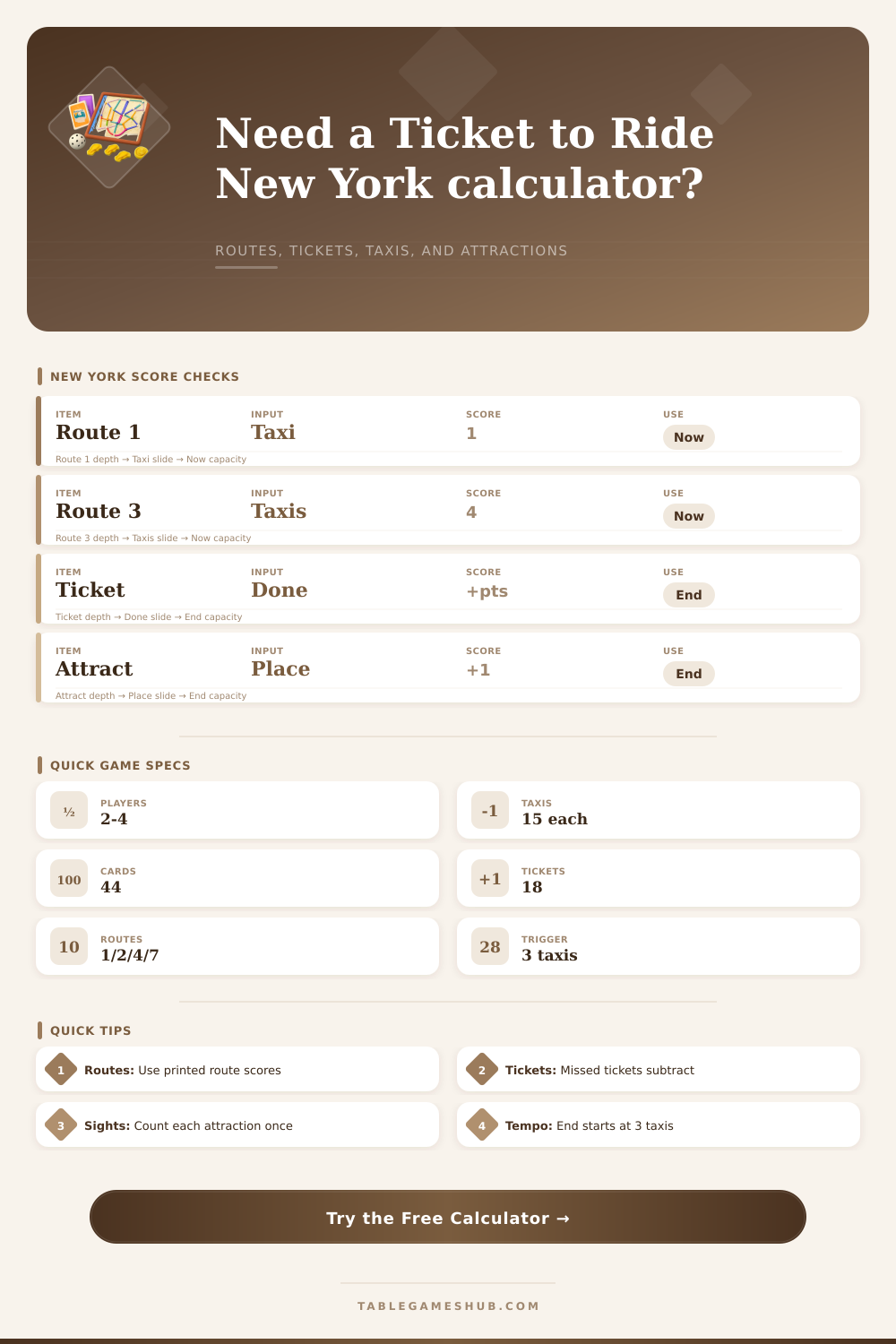
Total a New York endgame score with claimed route points, completed and missed destination tickets, tourist attraction bonuses, taxis remaining, claimed routes, player count, and scoring corrections.
1New York Score Presets
Load a named taxi network, then adjust the exact route score, ticket values, attraction count, remaining taxis, and penalty corrections from the player board.
2Taxi Score Inputs
3New York Component Grid
4Route and Scoring Tables
| Route length | Taxi pieces placed | Route points | Scorepad check |
|---|---|---|---|
| Length 1 | 1 taxi | 1 point | Short connector or blocker route |
| Length 2 | 2 taxis | 2 points | Common link for ticket completion |
| Length 3 | 3 taxis | 4 points | Efficient mid-board scoring jump |
| Length 4 | 4 taxis | 7 points | Highest single route score in New York |
| Ticket state | Entry field | Score effect | Endgame action |
|---|---|---|---|
| Completed route pair | Completed ticket points | Add printed value | Reveal and verify connected path |
| Missed route pair | Missed ticket penalty | Subtract printed value | Keep value positive in the input |
| Partially connected | Missed ticket penalty | Subtract printed value | Partial paths do not score |
| Multiple tickets | Both ticket fields | Add completed, subtract missed | Sum each pile before entering |
| Attraction contact | Calculator entry | Bonus | Counting reminder |
|---|---|---|---|
| One route touches it | Count 1 | +1 point | Attraction is connected |
| Several routes touch it | Count 1 | +1 point | Do not score duplicates |
| No claimed route touches it | Count 0 | 0 points | Nearby unclaimed routes do not count |
| Shared board location | Your route only | +1 if yours touches | Opponents do not give you the bonus |
| Taxis remaining | Taxis used | Game state | Score audit focus |
|---|---|---|---|
| 8-15 | 0-7 | Early network | Route score is usually modest |
| 4-7 | 8-11 | Late build window | Tickets and attractions start deciding totals |
| 1-3 | 12-14 | Endgame triggered | Final-turn scoring should be ready |
| 0 | 15 | Taxi supply empty | Confirm no claimed route exceeded supply |
5Scorepad Tips
Count tourist attractions from the map, not from tickets. A tourist attraction scores once if at least one of your claimed routes connects to that location.
Keep missed-ticket entries positive. The calculator subtracts that field automatically, which makes scorepad audits easier when several destination tickets failed.
In New York City, when someone puts their last taxi on a route, the game’s over for them. Maybe they spent two hours connecting dots across Brooklyn and Manhattan, using their precious hand of colored cards and wild taxis to build connections. Now it’s time for the after game debate: Who really won? And how do we count all these little yellow piece of plastic?
It’s boring. Tallying up all your ticket destinations by hand take too much time. Everyone at the table want to know who won, but you can’t recall which tickets was filled out. So you dig around for a pencil and paper while everyone else wait. That’s where calculator (above) comes in. Plug in your score for each route and how many ticket ended up getting filled out. It’ll crunch the numbers for you. No more fumbling with a piece of paper and a pencil. And no more ruining the victory high.
Easy Ways to Score Your Game
Unlike its larger relatives, New York doesn’t have any long-haul runs connecting distant corners of a continent (or country). Rather, it’s a densely-mapped playground full of brief runs that individually might not be particularly rewarding, but add up rapidly if you play them wisely. With fifteen cabs at the beginning, you’d think you’ve got plenty to work with, until you notice that three or four decently-long runs will leave half your supply depleted before game has even gotten started.
The resource crunch hits hard right away, never lets up and every decision become an exercise in risk vs. Reward; you don’t have time to sit on multiple cards hoping they’ll all pair off into something useful. The scoring system itself is simple, each length get one, two, four or seven points depending on how long it is. But here’s where things gets tricky: the tourist attractions and destination tickets you earn parallel to building up your network.
There’s always a trade-off between doing something now for quick point gains (by taking shorter routes) vs doing something now which may pay off later (if it leads to a higher-point value ticket connecting distant boroughs). Sometimes, you have to take a lesser route sooner to unlock a better-paying ticket later. Use this tool to see that tradeoff visually by entering both successful and unsuccessful tickets side-by-side. The tool will penalize you for not having fulfilled those goals, so instead of seeing your gross earnings you’ll be able to see your honest net standing.
In this edition, there are often quiet score boosters that players tend to overlook right at the end: tourist attractions. Unless you specifically look for them on your route, you may find yourself missing out on points because you didn’t realize you passed Times Square or Central Park as part of your way. Remember, you’ll only get each attraction scored once, no matter how many of your lines touch it.
Even longtime gamers falls prey to this nuance, thinking they can stack multiple touches of an attraction to get multiple bonus points… but nope. That’s not how this works. A quick glance at the reference table provided in the tool will help explain how things is being counted. This way, you won’t go nuts trying to count all those extra points at the end in a last-ditch attempt to eke out victory (which really should of be necessary). It is a tiny bit of mechanism, but it makes a big difference when it comes down to two or three points between first and second place.
There’s also a bit more strategy tension from the endgame trigger, which forces all players to take an extra turn after someone has three or fewer taxis left before everyone scores. This really comes into play when you’ve been saving up resources only to find someone else finished off their last route and now it’s suddenly urgent, you’re out of colored cards and can’t possibly make your largest ticket. With the calculator, you can adjust how many taxis is left. You can also run through these scenarios while feeling the pressure of realizing just how fast things can change in the last few rounds.
The end result, though, should always be efficiency for a packed board. No one else can control who draws what card in their hand or who’s going to grab the route first, but you can control how aware you are of all of your point sources. Do you need to stack some safe one-point connectors? Or do you have to gamble on a single big seven-pointer to catch up? The answer is still math.
Accurate scoring removes uncertainty from the winning formula, which takes the guesswork out of winning. After all the arguments about whose connection gets the ticket are done and the final numbers settle, you can tuck it away knowing it’s right. And that certainty is more valuable than any point on the board.