Go Komi Calculator
Compare Black and White scores after ordinary komi, reverse komi, handicap adjustment, half-point mode, and jigo handling for 19x19, 13x13, and 9x9 games.
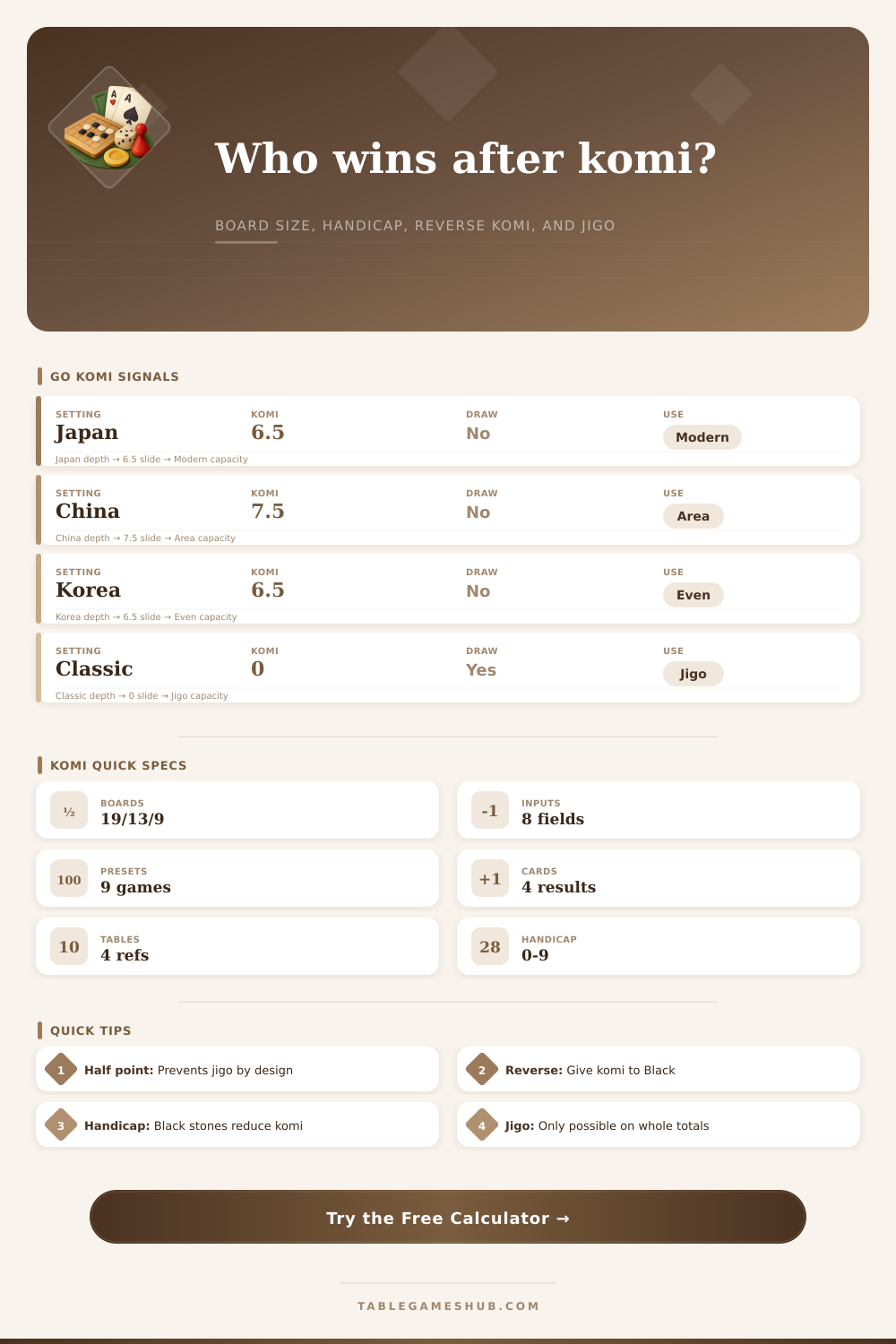
| Rule set | Common komi | Scoring base | Jigo cue |
|---|---|---|---|
| Japanese | 6.5 | Territory | No tie |
| Chinese | 7.5 | Area | No tie |
| Korean | 6.5 | Territory | No tie |
| Classic | 0 | Local | Can tie |
| Board | Points | Komi range | Typical use |
|---|---|---|---|
| 19x19 | 361 | 5.5-7.5 | Full game |
| 13x13 | 169 | 4.5-6.5 | Club ladder |
| 9x9 | 81 | 3.5-7.5 | Quick game |
| No komi | Any | 0 | Classic |
| Mode | What changes | Best for | Output |
|---|---|---|---|
| Preserve | Keep 0.5 | Modern | No jigo |
| Integer | Drop 0.5 | Old rules | Jigo ok |
| Round | Round margin | Review | Tie if 0 |
| Reverse | Black gets | Teaching | Black aid |
| Handicap | Usual komi | Adjustment | Check |
|---|---|---|---|
| 0 stones | 6.5/7.5 | None | Even |
| 2 stones | 0.5 | -1 | Local |
| 3-5 stones | 0.5 | -2 to -4 | Teach |
| 6-9 stones | 0 | -5 to -8 | Large gap |
Keep the pre-komi scores clean
Enter the board count before komi only. Prisoners, dead stones, and pass stones should already be reflected in the Black and White score fields.
Use reverse komi for teaching reviews
Reverse komi gives Black the compensation instead of White, which makes it useful for handicap tests or reviewing whether a teaching game was fairly balanced.
At the end of a Go game, it is up to you to perform the arithmetic of who won. After the last pass you’ve both captured prisoners and removed dead stones. To account for Black’s first-move advantage, White receives compensatory points called komi. Depending on handicap stones, board size, and rule set, amount of komi varies. The calculator knows how to add up all those factors without requiring you to pay attention to them as you observe the endgame.
The first changeable option is the most obvious: How do you want to score? Different areas has their own rules. In Japan, it’s territory plus a standard komi of 6.5 points. That half point are there specifically so that you can’t tie. With Chinese rules, they usually play area plus 7.5 points. However, some older or classic rules might just use territory plus a flat komi (0 or one). In those cases, you can actualy end up in a tie. You’ll be able to switch between these using the tool. And it will show where you end up with the same raw number as each other if you played with different conventions agreed beforehand.
How to Score in Go
Complicating things further are handicap games which tend to confuse beginners. At the outset white places an additional number of stones on the board. This tilts the odds in favor of black. Compensation come from eliminating or reducing the komi. Generally, one can consider three stones as needing a small komi for white. Nine stones typically have no komi because black’s presence is strong enough at the beginning to offset starting in second place. All too many players fail to make this mental adjustment and quibble about scores. The calculator makes up for this: simply enter number of handicap stones and it will automaticly calculate the correct amount based off normal norms for these differences.
The reverse komi flips it on its head. The points is given to black instead of white. Now it’s a reverse handicap challenge. It can be used when analyzing or teaching situations where you want to know how strong Black would need to play without the advantage of moving first. This reverses a normal game into a handicap one. This is maybe a way to review a loss and see if your opponent’s opening would hold up with some sort of deficit artificially imposed. It is not so much about what the final score will be, but more about the relative power over time during the middle game.
The size of the board makes a bigger difference than many realize. On a 19×19 board with 361 intersections there can be great depth of strategy. That’s worth compensating with larger values of komi. With fewer intersections (and a speedier game) on a 9×9 board it becomes more tactical. This means the offset tend toward lower numbers, or even different ratios entirely. You might play a couple of games quickly on a small board and find that it doesn’t feel like a full match. And the scoring should of reflect that intensity. It shows you what kind of thing you expect to see in formal tournament play vs club games.
Half the story is knowing who won, but half is also knowing why. Was it a close match? A win of half a point means you played nearly perfectly against a strong opponent. That’s great, you played almost flawlessly against a good player. Did one side have an enormous lead over another? That suggests there might have been a fundamental strategic error somewhere in the opening or middle game. Then that must mean there was some critical strategy mistake near the start or midway through the game.
The adjusted score is shown for each side on the calculator. From that you’ll be able to tell just how much the komi impacted the final results. Too many people gets so caught up in counting the number of stones that they lose sight of the value of playing the right moves in the right sequence. Separating the compensation points from the raw score shows a more accurate picture of your actual performance.
So how do we score? In Go, as much as math, it’s about agreement. Before your first stone is laid, you want two people agreeing to the rules. The half point makes a tie mathematically impossible. Handicaps eliminate bitterness over an uneven start. Choosing a rule set means everyone sees the game as counting the same things (area or territory). With these baseline agreements established, the rest is simply addition and subtraction. That’s where the tool removes the friction from this process. It lets you enjoy the art of the game instead of haggling over the math. It clarifies what the endgame looks like so the outcome reflects whose skills were demonstrated at play.