Rummikub Joker Value Calculator
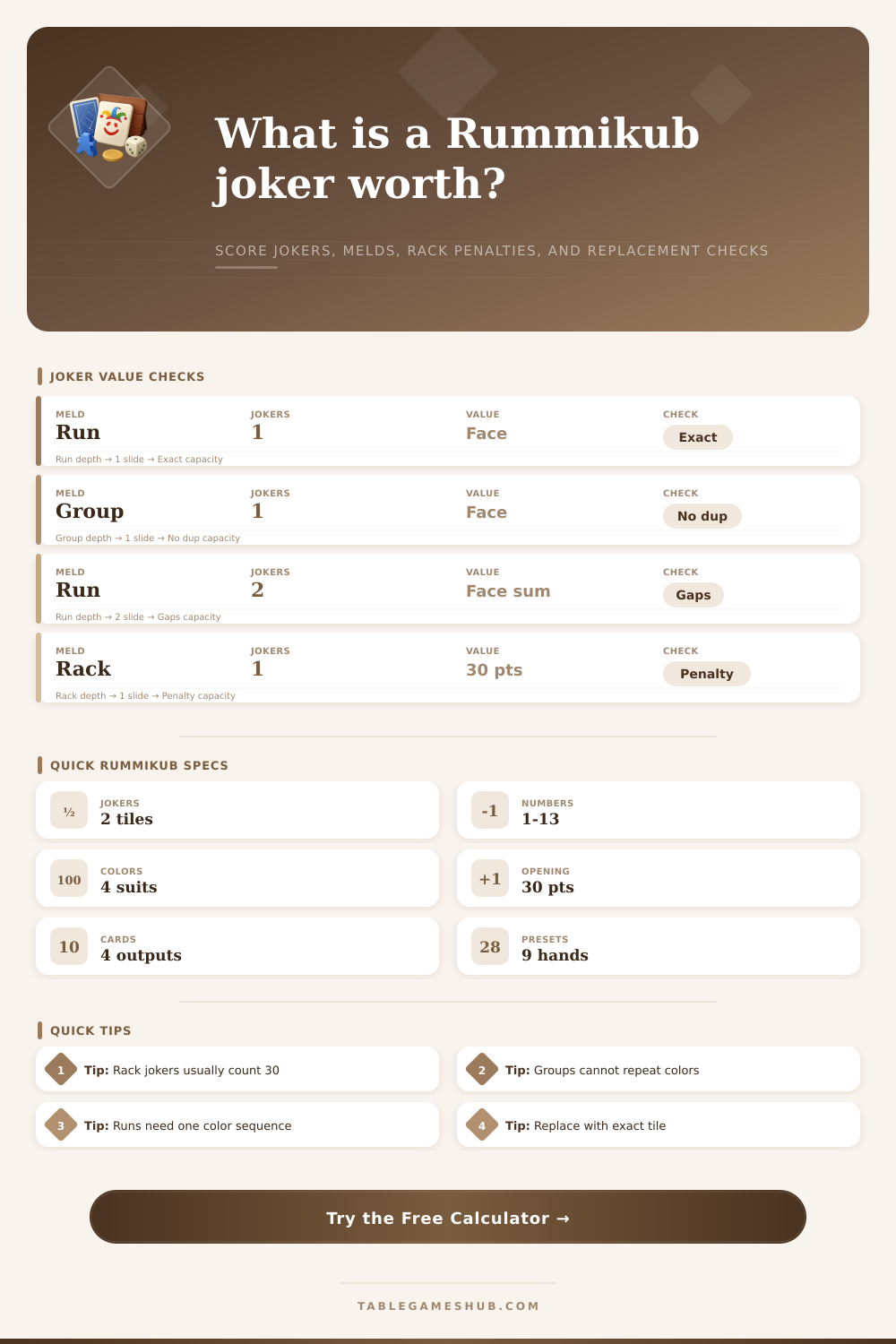
Value jokers as substituted tiles, check run or group legality, test replacement status, compare open-table points, and total rack penalties.
| Scoring mode | Joker value used | Main output | Best audit use |
|---|---|---|---|
| Meld value | Substituted tile face value | Open table total | Checking a run or group already on table |
| Rack penalty | 30 points per joker | End-rack penalty | Counting a losing rack after someone goes out |
| Opening check | Face value in meld only | 30-point gate status | Testing whether an initial meld reaches 30 |
| Tournament net | Face value plus avoided 30 | Score swing | Comparing table value against rack risk |
| Replacement state | Legal signal | Calculator flag | What to verify |
|---|---|---|---|
| Exact tile in rack | Strong replacement | Ready | The tile matches number and color represented by the joker |
| Exact tile missing | Not ready | Blocked | A near number or different color does not release the joker |
| Tile only on table | House-rule caution | Caution | Some tables require using a rack tile to replace |
| Two jokers in one meld | Needs both values | Audit | Each joker must stand for a distinct legal tile position |
| Meld type | Valid pattern | Duplicate problem | Joker check |
|---|---|---|---|
| Run | Same color, consecutive numbers | Repeated number breaks the sequence | Joker must fill a specific missing number |
| Group | Same number, different colors | Repeated color is not allowed | Joker must be a color not already used |
| Short meld | At least three tiles | Two-tile set is not a meld | Joker can help reach three only if shape is legal |
| Long run | Three to thirteen tiles | Skipping a number leaves a gap | Each joker covers one sequence gap |
| Table situation | Joker represents | Points added | Penalty if held |
|---|---|---|---|
| Run 5-6-Joker | 7 in same color | 7 | 30 if left on rack |
| Group 10-10-Joker | Third color 10 | 10 | 30 if left on rack |
| Opening meld 8-9-Joker | 10 in same color | 10 | Opening total must reach 30 |
| End rack joker | No table value | 0 on table | 30 per joker held |
Ever had one of those games where all the tiles are melded and board is thick? It is that game where you just can’t seem to move any more tiles down even though it seems like there’s plenty in your own rack. And then there it is. It is the joker. The most potent tile in Rummikub.
It will save the day by bridging an otherwise imposible gap. It will close out a group that simply refuses to be closed. But it is also the cause for many raging debates around the table. Is it worth ten points? Can I trade this joker for another if replacement tile is hidden underneath someone else’s set? If the shoe is on the other foot and you’re stuck holding it at the end, does it count for thirty?
How to Use the Joker in Rummikub
Why is it so confusing? Because of one thing: the joker has no inherent value. It gains whatever value it needs based off context. Whether it’s alive on the board or dead in your hand, it change. This is what sets apart the casual player from those who consistently lower their final scores.
Substitution is at the heart of it all. When a joker replaces a legal meld already on the table, it take on the numeric value of whichever tile it stands in for. Use it to complete a red run from five through seven? That joker’s worth seven for scoring purposes.
Why does this matter? Because it lets you know exactly how many points you’ll have if an opponent goes out before you do. By entering the exact number that the joker covers into the calculator above, it’ll crunch the numbers for you. There’s no need to add up different values in your head while everyone else are rushing through their turn. Just choose the meld type and which face value the joker is substituting for, and let the tool recalculate the total. Little things like this make a difference when you want to check whether or not your opening meld meets the minimum thirty point requirement without accidently counting wrong.
Once the game is over, however, and all the tiles are still lying around in your rack, that’s when things get interesting. Here is where many players stumble. A joker on the table might have been worth only three points as part of a low-number run. Now, that very same tile could be a thirty-point smackdown as you realize how final tally includes it in your hand.
That tension is what makes Rummikub such a strategy-laden game. Because a joker can serve so many purposes, it seems like a surefire keep-it-in-your-hand move. But should someone clear their rack without you playing it first, that would of cost you big time. The decision becomes whether to use the joker right now (which probably serves some purpose) or hold onto it (which means risking a giant hit in the end). It pushes you to make a choice, to actually meld instead of just stockpiling possibilities.
Regarding legality, many people don’t realize they can only play the joker if it makes sense within the game itself. That is, playing multiple cards of identical colors is not legal. For example, having both a Blue Ten and Red Ten does not mean the Joker is now a Red/Blue Ten as well. It’s still just one card of each color, it becomes a Red or a Blue when used as a substitute for any missing suit you might need. So make sure you’re familiar with the rulebook.
On this page, you’ll see the reference table showing how duplicate checks prevent illegal plays based on duplicate colors. And when you’re working with runs, the joker fills a unique gap in the sequence, so again, it has to fill a specific gap, it doesn’t just skip across two random numbers. Think of it like this, you want an exact replacement tile to later replace the joker so you free up your hand to work on some different combos.
The next level comes into play when we’re talking tournaments. That is the net swing, which compares the points gained using the joker to the points you would of avoided losing on the rack without it. For advanced players, this is used to determine whether they should break up one meld and apply the joker for higher point values. Sometimes you are better off securing a lower value meld rather than going after something that might leave you open.
The part about replacing logic explains why having exact matches is crucial. Even if there was a near match, or a tile of a different suit, that does not legally free the joker. It isn’t all about removing tiles. It’s also about keeping the structure intact within your melds.
In conclusion, there’s not really any rule to master when playing the joker; rather, it’s all about taking risks. Look at that blank white tile. See the reward it offers. But also see the punishment it threatens. When you can predict whether or not it’ll benefit you, by how much, and whether being left behind will cost you or not, you stop guessing. And you start calculating.
The chaos clears from the board. Now it appear as a collection of doable equations. You develop an appreciation for that thirty-point penalty such that you never let it occur. You also appreciate the power of that face you get in exchange, using it carefully. This is where winning games happens.