🀄 Mahjong Han Calculator
Total Japanese riichi yaku, dora, riichi bonuses, yakuman overrides, honba, and riichi stick payments.
| Yaku | Closed Han | Open Han | Calculator Treatment |
|---|---|---|---|
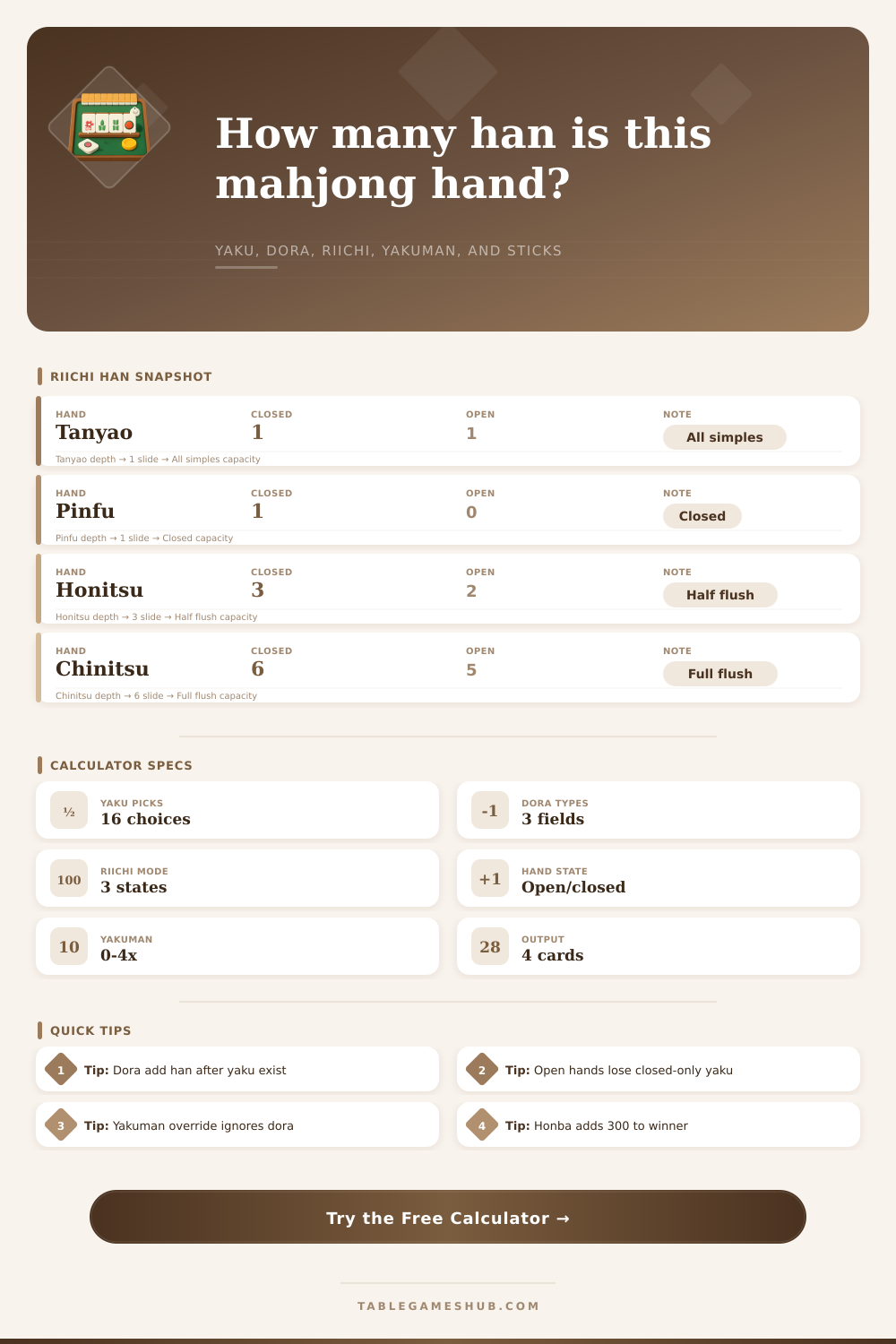
| Tanyao | 1 | 1 | Always counts when selected |
| Pinfu | 1 | 0 | Ignored on open hands |
| Sanshoku Doujun | 2 | 1 | Open hand loses 1 han |
| Honitsu | 3 | 2 | Open hand loses 1 han |
| Chinitsu | 6 | 5 | Open hand loses 1 han |
| Limit Band | Han Range | Base Points | Common Trigger |
|---|---|---|---|
| Mangan | 5 han | 2000 | 5 han, or high fu lower han |
| Haneman | 6-7 han | 3000 | Riichi plus heavy dora |
| Baiman | 8-10 han | 4000 | Flush or dora-heavy hand |
| Sanbaiman | 11-12 han | 6000 | Very large normal hand |
| Kazoe Yakuman | 13+ han | 8000 | Counted yakuman limit |
| Win Type | Dealer Formula | Non-Dealer Formula | Counter Add |
|---|---|---|---|
| Ron | Base x 6 | Base x 4 | 300 per honba |
| Dealer tsumo | All pay base x 2 | Not used | 100 each per honba |
| Child tsumo | Dealer pays base x 2 | Others pay base x 1 | 100 each per honba |
| Riichi sticks | Winner takes all | Winner takes all | 1000 per stick |
| Dora Type | Adds Han | Needs Yaku | Special Note |
|---|---|---|---|
| Dora indicator | Yes | Yes | Bonus, not a yaku |
| Ura dora | Yes | Yes | Only after riichi |
| Aka dora | Yes | Yes | Red five bonus tile |
| Yakuman | No | Override | Ignores normal dora |
Tip 1: Confirm one actual yaku first
Dora, ura dora, and aka dora increase value only after the hand already has a valid yaku or yakuman.
Tip 2: Recheck open-hand reductions
Calling tiles can remove riichi, pinfu, iipeikou, and ryanpeikou while reducing many sequence and flush yaku.
It’s arithmetic, in Japan, they call it “riichi” mahjong. Suddenly, there you are sitting at the table with that perfect hand, and too late you realize youve called a tile that cost you half the score. That’s how it works: The game doesn’t just pay for making something. It pays you for making something specific… And being disciplined enough to make it on your own, without assistance from other people’s discards.
Winning? Players get that most of the time. They tend to overlook how much it matter. In fact, what separates a decent payout from a hand big enough to clear the table? Often, all the difference was whether you left your wall open for a fast fixup or managed to keep it shut tight.
Why You Should Use a Scoring Calculator
After you make those decisions, the calculator does math for you. It eliminates the brain strain of calculating your base points multiplied by your seat multiplier, then adding your honor bonus. Just tell it what you’ve got.
Is there a riichi declaration winner? One han. Unless you called down tiles, that is. Got all your simple numbers? Another point for you. Little bits like this build up fastly. What may appear as an average looking hand on its own can suddenly become a manzan limit when you factor in ura dora bonuses and dora indicators. The tool takes care of those coefficients for you and lets you concentrate on strategy instead of the multiplication table.
The trick to learning how to play this part of the game is understanding why some yaku becomes closed only. For example: Pinfu depends entirely on opening hand and how well you can discard while not giving away your intentions. You must also ensure you don’t waste tiles in triplets or chows. It must be a particular shape. Once you call a tile, that efficiency bonus is gone.
Iipeikou relies on parallel sequences that appear messy on the surface, yet are difficult for the opponent to decipher. That’s their score. It’s a high-scoring yaku, but it depends heavily on mystery. Open the hand and that’s gone. What the calculator does here is subtract those bonuses when you change its status from open to closed. It makes you realize just how valuable the remaining portion of your hand is now with a pon or chi.
The next wrinkle that catches new players off guard are hand limits. After five han, you don’t have to count every individual hand anymore. From then on, the score advances to mangan and remains at that level until winner hits eight han (baiman). This cap prevents losers from going broke while also paying high rollers exponentially more. A handy table on the page spells it all out, making clear just where those limits are. Having these breakpoints in mind will help you determine when it’s time to risk a complicated hand versus when you should take easy money instead. Going for that six-han glory isn’t always worth it when you get nothing back.
Many players are confused about the weight given on wind tiles. Round and seat wind form a premium pairing. By themselves they score nothing. Together they count for one han each. Choosing between chasing a sequence or holding onto a pair of east dragons is a factor to consider. If you check the right yaku boxes, the tool takes those into account.
The infrequent but cool yakuman override also works, overriding all other regular scoring and giving the hand its full value immediately. That’s there because there are just certain hands that are too strong to limit with normal rules.
Late game is all about honba counters. The amount added to your winnings depends on how many sticks are on the table. This changes how late-game play works alot. In close games, this encourages aggressive moves that otherwise would never be made. Small hands starts paying off and players are willing to go out on a limb they wouldn’t ordinarily risk. These bonuses get factored into the overall count for what the winner actually wins (you can see it displayed on the calculator).
What’s on your table isn’t everything. There’s also the state of the table. The balance between risk and reward is a constant in playing well. There’s always the pull to call out to try and win, but there’s also the safety of keeping tiles. Some rounds are best won by letting go and folding. Others are best won by pushing hard for that limit hand.
Those choices are fed back into your game through the numbers. Do I settle for too little? Did my aggression pay off? The values show you this. They teach you what to think about every turn. They make you see your score potential ahead of time. That anticipation is where the difference is between a serious competitor and a casual player.
Uncertainty becomes a strategy when you master the scoring system. Instead of guessing, you calculate probabilities based off what you know. Experience provides the intuition. The tools provide verification of that intuition. Continue to track your hands, continue to play, and allow the points to lead you to your next decision.