Pig Out Dice Calculator
Estimate Pig Out bust risk, safe roll value, planned reroll exposure, bank threshold pressure, and roll-or-bank recommendations from the dice profile you are using.
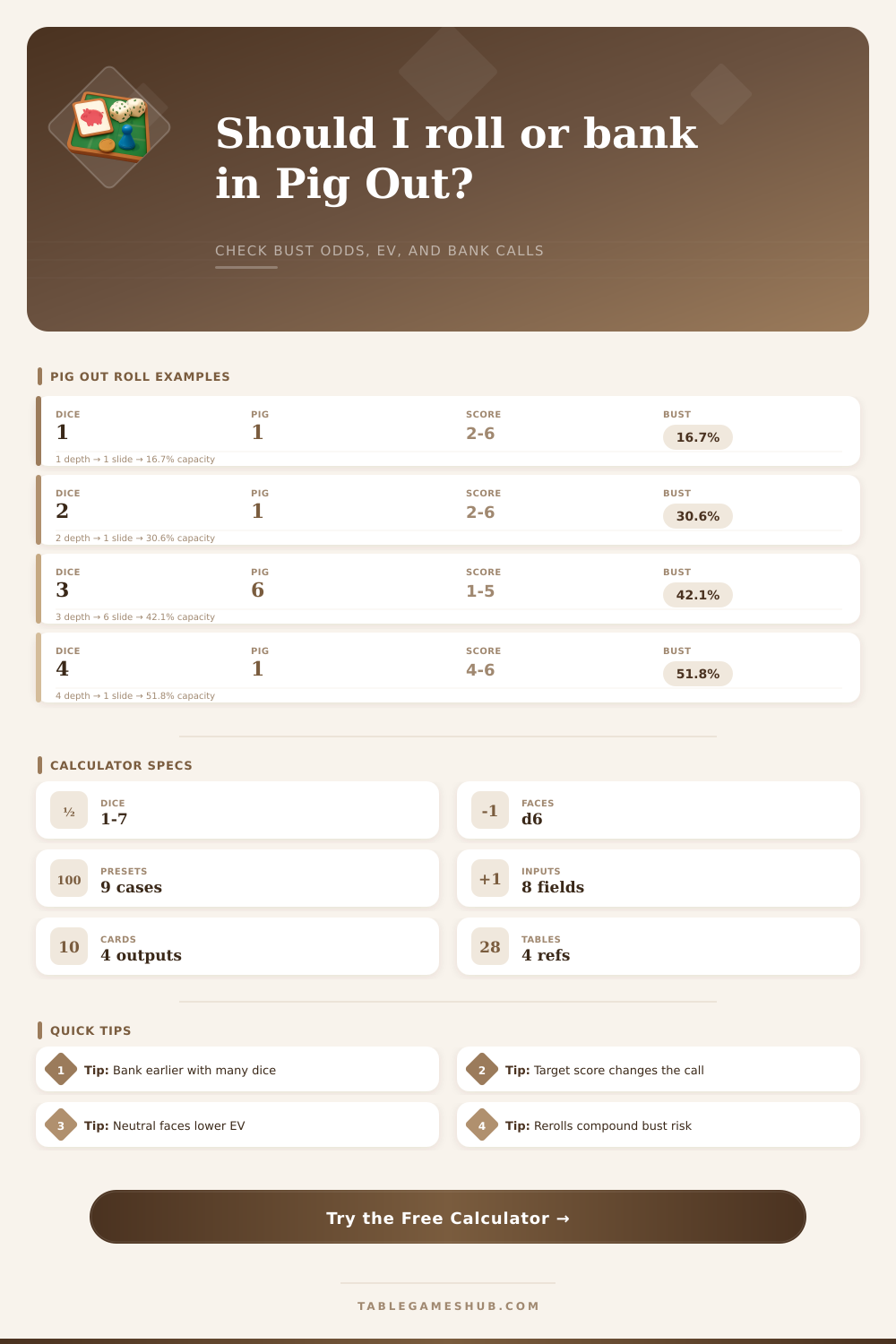
| Dice rolled | Any single pig face | Survive one roll | Survive two rolls | Use at table when |
|---|---|---|---|---|
| 1 die | 16.7% bust | 83.3% | 69.4% | Opening a turn or protecting a small bank |
| 2 dice | 30.6% bust | 69.4% | 48.2% | Balanced push with moderate turn points |
| 3 dice | 42.1% bust | 57.9% | 33.5% | Chasing a threshold from behind |
| 4 dice | 51.8% bust | 48.2% | 23.3% | High pressure catch-up rolls only |
| 5 dice | 59.8% bust | 40.2% | 16.2% | Large swing turns with low current points |
| Scoring face set | Faces included | Best with pig face | One-die safe average | Decision note |
|---|---|---|---|---|
| Classic non-pig | All safe faces | Any face | About 3 to 4 | Highest scoring density, but bust still controls the call |
| Upper run | 4, 5, 6 | 1, 2, or 3 | About 3 | Strong for small dice counts and target chases |
| High only | 5 and 6 | 1, 2, 3, or 4 | About 2 | More neutral rolls, so threshold progress slows |
| Odd or even | Three faces | Opposite set | About 2 to 3 | Good for house sheets that score patterns |
| Only sixes | 6 only | 1 to 5 | 1 point | Low EV unless a six has a bonus in your variant |
| Risk style | Bank trigger | Roll trigger | Best current turn | Practical read |
|---|---|---|---|---|
| Cautious | Low EV or over threshold | Only clear positive EV | 12+ points | Protects already-earned turn points from bust loss |
| Balanced | Threshold met or EV negative | Gap is reachable with sane risk | 8 to 24 points | Uses both math value and stop-point discipline |
| Press | Very high bust exposure | Positive EV or catch-up gap | 0 to 18 points | Accepts more volatility for bigger turn scores |
| Desperate | Target already reached | Target still out of reach | Any score behind | Chases the score target harder than the threshold |
| Preset | Dice | Scoring faces | Turn pressure | Risk style |
|---|---|---|---|---|
| Single Die Safe Starter | 1 | 2, 3, 4, 5, 6 | Fresh turn to 20 | Balanced |
| Two Dice Classic Push | 2 | 2, 3, 4, 5, 6 | 12 held, bank at 25 | Balanced |
| Four Dice Catch-Up Burst | 4 | 2, 3, 4, 5, 6 | Behind pace | Press |
| Odd Face House Sheet | 3 | 1, 3, 5 | 15 held, 30 target | Cautious |
| Last Turn Chase to 100 | 3 | 4, 5, 6 | Needs a finish | Desperate |
| Plan length | Bust exposure | All-safe chance | Safe points added | Expected turn |
|---|
And then there it is. That silent moment between dice and floor where you hold them in your hands and gravity does its thing. A game of chance becomes challenge of nerves.
You’ve racked up a few turns. You haven’t racked up so many turns as to make you comfortabley, but you have just enough that you know they count. Do you bank or do you roll again?
How to Decide When to Stop Rolling
On the surface, it’s a simple question with a simple answer. Underneath, it’s anything but, each one feels like a gamble. And that’s why a framework for deciding makes all the difference. That’s what the calculator above is for. It run the numbers for you, transforming that gut feeling into something real, a real probability, so you’re able to distinguish strategy from impulse.
The key thing here is that most people only think about reward, the potential score they could earn; without considering the compounded danger of the loss that they could suffer instead. And that’s where the trap lies. Whenever you roll one more die. Or plan for a second reroll. You’re doing something else: you’re increasing your exposure to busting.
Your chance of getting into the pit doesn’t go up by an extra point. It goes up exponentially. Every time you consider rolling again, your risk of busting increases. Anytime pig-out face comes up, everything gets wiped off the table. The calculator models this as a hard stop where the selected pig-out face become a dead end.
This understanding completely changes how you approach each roll. It is not a number to hit but a sequence to survive long enough to gain value. The tool will break down the odds against you and your survival rate. This depends on which dice you have in hand and which scores you has marked for keeping.
Pressing Hard vs. Playing Cautiously: Suppose you’re catching up from being behind. Pressing hard involves throwing more dice than usual. While that’s necessary sometimes, it’s also riskier. Four dice sounds like an easy way to close the gap, but your odds of getting one of those bust faces shoots through the roof each time you add another die. And this is where probability math comes into play.
Here’s the reference table from the page. See how fast your chances go downhill when you start throwing more dice in the cup? Balance comes from combining expected value and threshold discipline.
Remember, you don’t throw extra dice because you need points; you throw them because you are trying to manage the variation in your score. If you have good points on the board this turn compared to your bank threshold, then the marginal gain (rolling again) doesn’t typically offset the risk of resetting all the way back down to zero.
The rhythm of those turns is also determined by what scores. Are only high numbers (like 5 and 6) counting towards your total? Then you’ll have to roll more times before reaching your goal, which automatically means more time at risk of busting. On the other hand, do all but pig faces score? Your points pile up quicker so you can bank sooner, and with more safety.
The calculator understands this and changes its suggestion to match… A quick scoring turn can take less risk and still hit the same threshold. And it considers the risk-taking style of individual user. Someone who’s desperate for a last ditch point total will tend to be more reckless than someone playing cautiously to protect their lead. The tool follows this by sliding its bank call along with the risk style selected, knowing that there’s more going on here then just some math.
Learning how to know when’s it’s time to call it quits can be an art form. Novice players don’t realize there’s this invisible cliff edge coming up and they keep on rolling till they bust. Savvy players can sense the tide changing and know when the average outcome of next roll is less than where they sit. No need to be a math whiz to get it. Simply realize each following roll is a coin flip and each one gets worse odds.
The numbers are spelled out by the calculator. But the lesson goes beyond that, it reminds you that you should of respect the variance and cherish what you’ve already got versus what you’re hoping for.
In the end, Pig Out’s really a game of probability masquerading as randomness. The dice don’t give two hoots if you’re desperate; they don’t take pity on you because of how far ahead you are. The dice only care about the likelihood of what happens next. A tool like this helps measure that likelihood… Which eliminates the guesswork from the decision-making equation.
The guessing stops; the planning begins. Know your bust risk, whether you’re just getting started or racing against the clock for a hundred. And play confidently instead of playing in fear.
The aim isn’t simply to win the round, but to know why you won. That’s where the luck becomes skill: one roll at a time.