Drop Dead Dice Calculator
Model a Drop Dead turn with starting dice, live dice, dead faces 2 and 5, scoring faces, current turn score, house stop thresholds, reroll policy, and target total pace.
Classic Drop Dead keeps rolling, so the best table action is to continue until every live die has shown a dead face.
Current live dice outlook
| Live dice | Clean roll chance | Expected points left | Expected rolls left |
|---|---|---|---|
| 5 dice | 13.2% | 47.90 | 4.79 |
Classic Drop Dead state guide
| Live dice left | Chance to score next | Chance at least one dies | Turn reading |
|---|---|---|---|
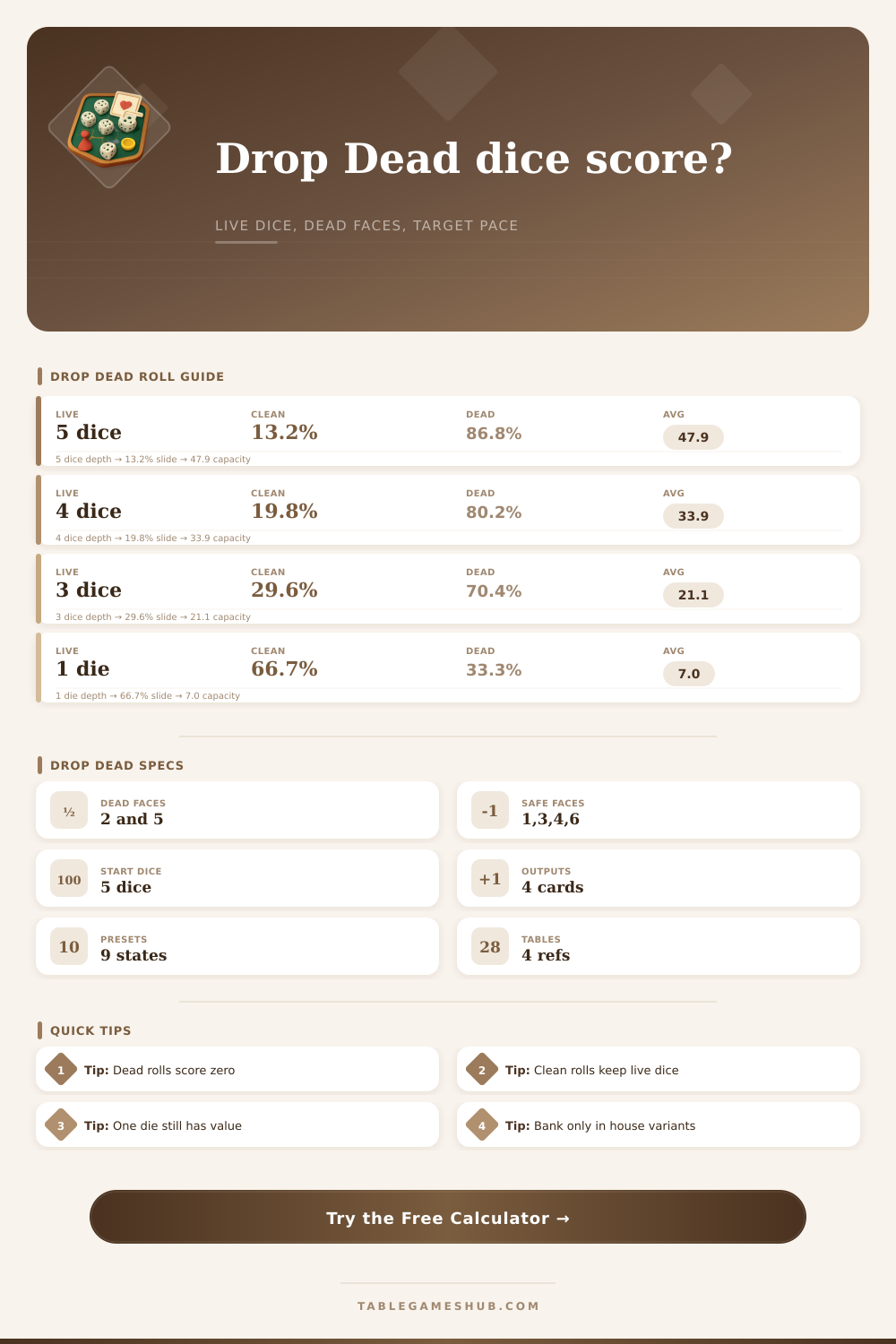
| 5 dice | 13.2% | 86.8% | Opening rolls often remove dice before scoring |
| 4 dice | 19.8% | 80.2% | Clean rolls are still uncommon but valuable |
| 3 dice | 29.6% | 70.4% | Midturn score swings begin to stabilize |
| 2 dice | 44.4% | 55.6% | Each clean roll averages 7 points |
| 1 die | 66.7% | 33.3% | One die can add repeated safe pips before dropping |
Dead face and scoring setup
| Setup | Dead faces | Scoring faces | Use case |
|---|---|---|---|
| Classic Drop Dead | 2 and 5 | 1, 3, 4, 6 | Default family dice game math |
| Single-dead training | 2 only | All non-dead faces | Longer turns with higher scoring |
| Hard mode table | 2, 5, and 6 | 1, 3, 4 | Shorter turns and lower clean-roll chance |
| Low-face house row | 2 and 5 | 1 and 3 only | Scores only low safe faces on clean rolls |
Reroll policy comparison
| Policy | Stop condition | Calculator output | Best fit |
|---|---|---|---|
| Classic forced reroll | All dice have dropped dead | Roll until live dice reach zero | Traditional Drop Dead turns |
| Bank at threshold | Current turn score meets threshold | Bank when house line is reached | Push-your-luck table variants |
| Bank at target | Current turn score meets target | Stop when the target total is already made | Short challenge rounds |
| Preview next roll | No automatic banking | Shows one-roll value and drop chance | Teaching odds before rolling |
Drop Dead. It’s a game where you gets together with some buddies, and for the initial rounds it feels like pure luck. Roll out five dice, and you might watch half of them vanish into the dead box on a single turn. It is fun and chaotic.
However, there is a mathematical engine driving the game. Understanding that engine turns the game from a random toss into one of calculated risk management. There’s no need to guess any longer about when to score out what you have left… You know how many are left, and you know the odds against those live dice.
How to Play Drop Dead with Math
It’s a simple but punishing core mechanic: The die showings of two and five is dead faces. Any die showing those numbers gets tossed out immediately and do not count towards your turn. You only get points when you make a “clean” roll; all your dice need to be showing ones, threes, fours, and sixes.
That has a huge impact on greed because while it decreases the likelihood of getting a totally clean roll, it also means you have more dice in play. Five dice give you about a 13% chance of a totally clean roll. That means there is a good chance you will get at least one dead die on almost every roll, resulting in no points. Most casual players don’t pay attention to this harsh reality until they’re down to one die on the board.
To avoid having to calculate binomial distributions in your head during the game, this calculator does all the heavy lifting with the complicated probability trees. It lets you input the number of dice you currently have alive, then it’ll tell you precisely how many points you can expect to add before end of the turn. Because the value of a roll changes depending on how many dice are left, this is very important.
A five-dice roll has huge potential upside, but also carries significant risk. The more dice that die off, however, the lower the ceiling becomes, but the odds of actualy pulling something off go up as well. If you’re down to your last die, you have a sixty-seven percent chance of rolling a save face and adding some points to your overall score. One die might seem like nothing, but it’s actually your best bet for picking up incremental gains, even if the maximum possible score plummets.
Another common error among players is the idea that once you’ve rolled up to some arbitrary number, say thirty or twenty (that’s it: time to bank and go home). Unfortunately (or fortunately for me) in the classic rules you can’t do that; you’re stuck rolling till every die falls dead on the table. But with variant house rules where people can choose to bank whenever they wish, then understanding expected value is important.
Is your expected remaining score so low that you only have a couple of dice left? Then holding what you got may well be the smart move. Or maybe there’s four or five alive dice? In that case, statistically speaking, you’ll probably add more points than you think, and it would of been wise to risk it by keeping on rolling.
That’s explained pretty well in the reference tables on the page; each gives a chart of increasing odds of getting a clean roll when you’re down to fewer dice. But it’s not just about the core mechanics; the house rules can have a big impact too. Some groups switch out the dead faces or change what numbers counts. A group playing with two as the sole dead face increases your chances for a clean roll ten times over, changing the strategy to amassing points in an aggressive way. Adding six as a dead face makes things tougher, shortening turns while increasing unpredictability.
You can toggle these options within the tool to fit how you’re setting up your game night. It matters because Drop Dead is regularly played with tweaked rules that differ from the directions on the box. The point isn’t to just roll as many as you can (though admittedly, that’s fun too). It’s to know the balance between reward and safety with each roll.
Each one you take is a gamble: the value of all the safe faces still left on your roll must exceed whatever it’ll cost if you lose your dice, but don’t score any points. With the projections, you’ll be able to determine whether or not you’re getting an acceptable return. This allows you to decide which moves are worth taking a chance on and which ones protect your lead.
The dice are random… But your strategy doesn’t have to be. Know exactly what rolling a two or a five has cost you, turn by turn, and learn how to soften the impact before the last die falls.