Twenty One Dice Game Calculator
Compare kept dice, running total, bust threshold 21, reroll choices, banking rule variants, target score pace, turn count pressure, and risk setting before the next roll.
| Choice | Outcomes | Bust Chance | Exact Threshold | Expected Bank | Use When |
|---|---|---|---|---|---|
| Reroll 1 die | 6 | 0.0% | 16.7% | 18.5 | Near the line |
| Banking Rule | Score Formula | Strong Total | Exact 21 Effect | Best Fit |
|---|---|---|---|---|
| Bank running total | Total if not bust | 18 to 21 | No bonus | Simple family table |
| Exact 21 adds 8 | Total + 8 on exact | 17 to 21 | Major bonus | Comeback-friendly table |
| Safe margin adds 3 | Total + 3 if 4 under | 15 to 18 | No extra bonus | Lower-bust table |
| Bank 17+ only | Zero below 17 | 17 to 21 | Extra 10 points | Strict score table |
| Risk Setting | Comfort Bust Line | Needed EV Gain | Good Reroll Zone | Decision Style |
|---|---|---|---|---|
| Conservative table | 18% | 2.0 points | Total 13 or lower | Protect a useful bank |
| Balanced table | 32% | 0.5 points | Total 15 or lower | Value and safety mixed |
| Bold chase | 48% | -1.0 points | Total 17 or lower | Accept swingy rolls |
| Last-turn push | 64% | -4.0 points | Total 18 or lower | Chase target pressure |
| Target Score | Turns Left | Needed Pace | Banking Read | Reroll Read |
|---|---|---|---|---|
| 60 | 5 | 12.0 | Bank medium totals | Small chase only |
| 100 | 6 | 16.7 | Bank 17 or better | Reroll low teens |
| 120 | 5 | 24.0 | Exact bonus matters | Push with bonus rules |
| 150 | 8 | 18.8 | Bank near 19 | Compare before 17 |
So you plug in your starting numbers (your running total and the dice you’ve already put aside). That’s your starting point, and it matters because it’s telling the calculator what your odds will be based off your current state. Did you roll a one and a two? Then you’re in a very different place then someone who rolled a six and a five.
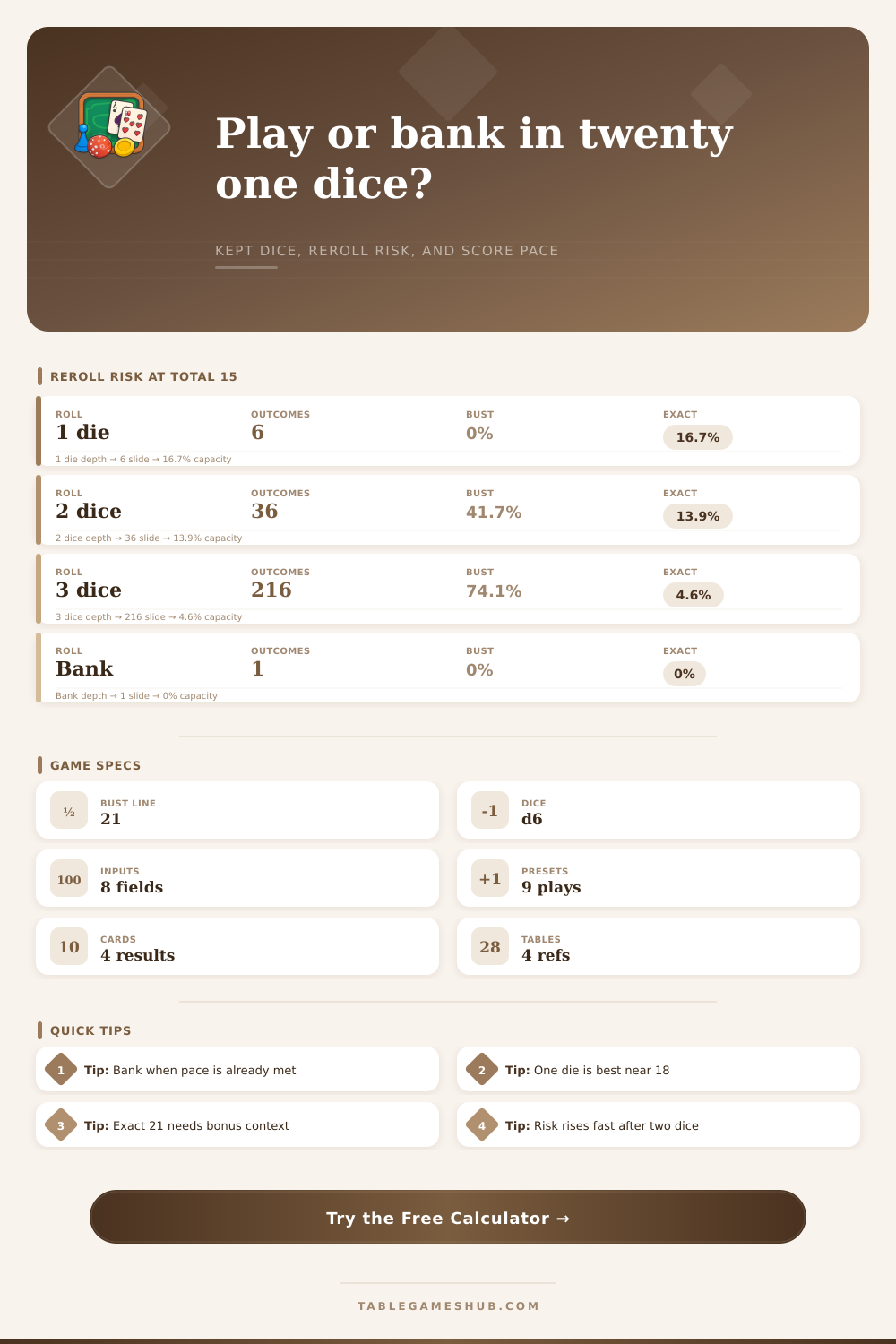
Next you tell the calculator how many dice you want to re-roll. Intuition fails here for most of us. Sure, we figure we increase our chances of landing a big number if we keep rolling those dice. But we fail to consider the increasing chance that multiple bad numbers could comes up. Take an example: How much worse is it to reroll three dice than it is to reroll just one? You can picture what happens with a single die… Six potential results. But what about with three dice? Two hundred and sixteen possible permutation. That’s an explosion in risk that doesn’t scale linearally at all.
Why Use a Calculator to Win
The risk tables on the page makes that clear. Rerolling a single die might have a low bust percentage. But if you add another, and then another, that risk quickly rises well above the comfortablly zone. It may be a little thing but oh man does it matter over time when it comes to your long-term scoring average.
Different groups play different. Some tables will give a huge bonus if you hit exactly twenty-one. Others won’t let you go over the line and will give you nothing more. That completely alters the risk calculation. Even if the odds of busting look scary, chasing that perfect twenty-one is mathematicaly sound if there’s an exact bonus at stake. To account for this difference, the calculator allow you to choose which type of banking you’re playing. Does it pay a jackpot for going over? Or just a few safe points? That’s reflected in expected value calculation.
Another level of strategy is added with turn count and target score. “You can’t make good decisions in a vacuum.” For example, “I’ve got six turns remaining, I want a hundred points, so that’s about sixteen and two-thirds points per turn that I need to average.” This is a difficult pace to maintain and it makes you take chances you wouldn’t of otherwise take if you were merely looking to stay above fifty. On the other hand, if you say, “I’m down by twenty, but I’ve got three turns left; that’s the smart play to bank for fifteen,” the tool will compare your rate of return against how much more you need. It will then color-code how reckless you can be or how desperately you should being chasing.
This is Twenty One. You don’t want to go bust on this number. There’s nothing wrong with being swept up in the rush to make that big score, but discipline is what win these things. When the math tell you to bank, you do it… Even if your gut is screaming at you to “go one more time.” That self-control distinguishes those who consistently hit their marks from the rest of us which are merely playing casualy.
So pull out that sheet of numbers before reaching for those dice. Let cold logic point your finger, and save excitement for moments where you realy need it.