Exactly Two Sixes Calculator
Calculate exact dice-face odds with binomial combinations, repeated rolls, reroll ones or sixes, and a target comparison for table-game probability checks.
| Exact count | Combinations | One-roll probability | At least once in attempts |
|---|---|---|---|
| 2 faces | 10 | 16.08% | 82.58% |
| Reroll rule | Single-face p | Exact-count odds | At least once |
|---|---|---|---|
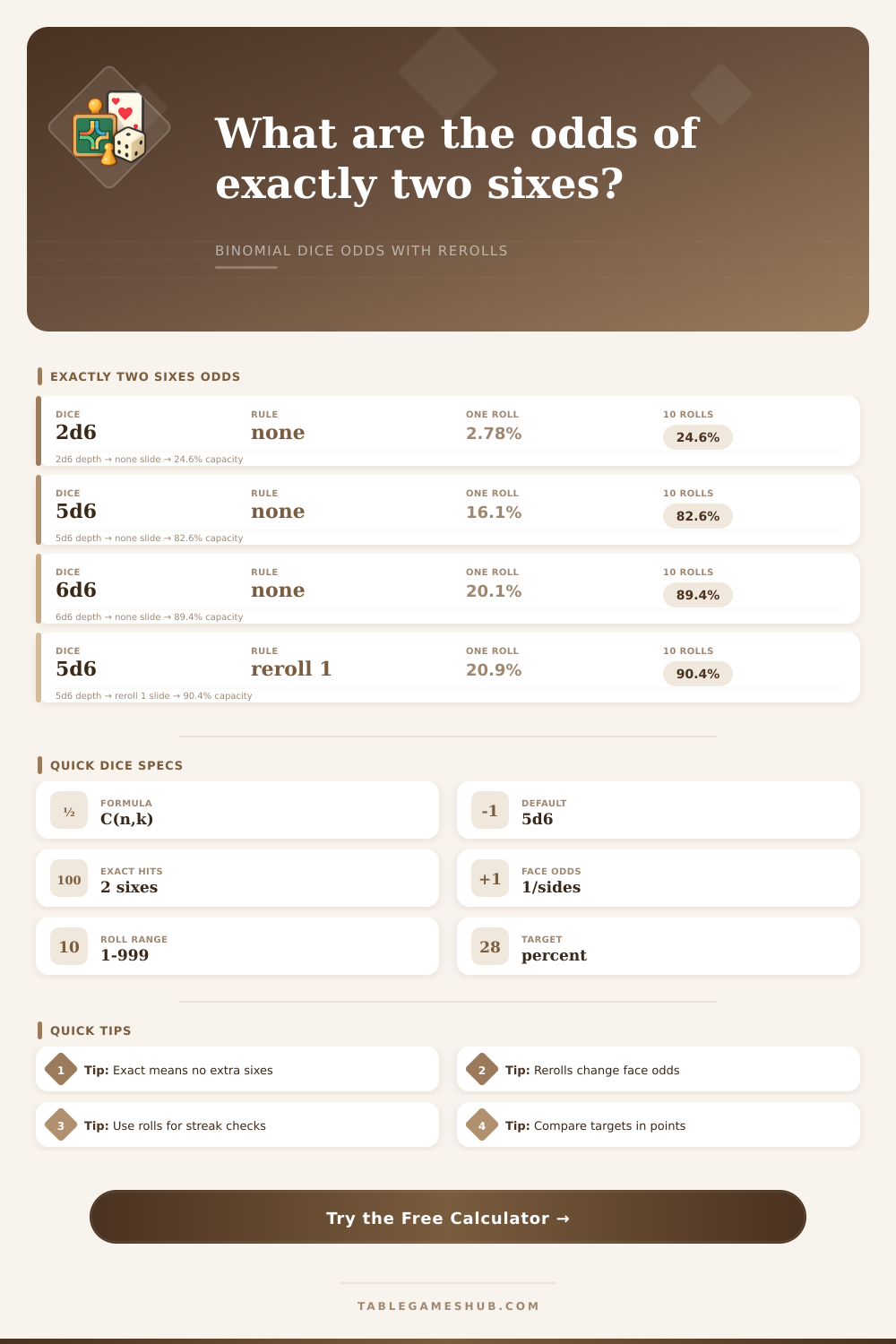
| No rerolls | 16.67% | 16.08% | 82.58% |
| Attempt count | At least one exact result | Gap to target | Table note |
|---|---|---|---|
| 10 rolls | 82.58% | +2.58 pts | Target met |
| Dice setup | Exact result | No-reroll odds | Useful table check |
|---|---|---|---|
| 2d6 standard pair | Two sixes | 2.78% | Double-six only |
| 3d6 attack roll | Two sixes | 6.94% | Exactly two hits |
| 5d6 cup roll | Two sixes | 16.08% | Yahtzee-style count |
| 6d6 dice pool | Two sixes | 20.09% | Pool threshold audit |
| 10d6 large pool | Two sixes | 29.08% | Large-hand variance |
Rolling two sixes is easy enough to think through, right? Well… not so fast. How do you account for that possibility? It’s got to be two sixes, nothing else… No three, no four. (If it was any number greater than one then we’d just say “two or more.”) That’s important since most of us conflate exact rolls (“exactly two”) vs. At least two rolls (“at least two”).
Understanding how it works makes the tool more effectively. The binomial distribution covers all possible outcomes, including those dice which don’t land on sixes. If you’re rolling five dice, wishing for exactly two sixes mean the other three dice cannot be sixes. The negative space is what matters. Allowing for three or four sixes instead will increase your chances, because it accommodates more outcome.
Why Getting Exactly Two Sixes Is Tricky
The exactness you demand rules out combinations that include your success condition but are more then what you want. This seemingly minor rule alters mathematics of your turn. These base probabilities changes based off house rules and mechanics of the games (some of those alterations won’t be in your favor).
It would appear that the ability to re-roll ones is a plus; after all, who doesn’t want more rolls? But what if you need exactly two dice with a value of six? If so, rerolling ones decrease your chances at achieving that result. Your ones represented a legitimate number other than a six that filled out the necessary void. Re-rolling that one as anything else risks creating a third or fourth six, thereby breaking the precise quantity rule. Depending on your desired win condition, the perceived benefit could of actually turn out to be a harm, as illustrated by the reference table.
What’s odd here: Players tend to think more is always better when it comes to any mechanic that favors higher rolls. But it’s not the number on the dice that determines success. The rules do. In a “too-many-hits” situation (one where going over a threshold is penalized), having too many hits can be just as bad as having too few. Toggle some of those reroll options, and you’ll be able to see this change in real time via the tool. Watch the probability on that single face adjust and see how that change impact the eventual exact-count result.
There’s one more wrinkle to the calculation: it adds up with repeated attempts. If you know your odds on any given roll, that’s great, but most games consists of multiple rolls. When you multiply all of those possibilities by 10 or 20 rolls, the odds rise sharply that you’ll see that specific occurrence at least once. That’s what we refer to as compound probability. Even though each individual roll may have a small percentage chance, it will occur in due time if you’re given enough tries. It’s the principle of the law of large numbers.
The calculator lets you see how these probabilities build up over time to figure out whether you’ve got enough dice in your pool to get the number of rolls you need. Players will tend to see just the most likely number or the average and will rarely if ever check out actual distribution curve. Seeing those hard edges lets you know how much variance there is in the way you play. Does this strategy really pay off each time? Or is it completely unpredictable? While you don’t have to be able to spout off the combination’s formula to enjoy its result, seeing that certain variables affects the shape of the risk curve will enable you to make more intelligent decisions during the game.
Dice are chaotic thing. But they’re predictable if you count, rather than guess. If you’re curious about probability (or, hell, even trying to hit a specific target within some larger system), then here’s the solution: Respect the constraints of dice rolling. Want two sixes? Fine, figure out how many aren’t sixes. That’s what most people miss.
That is how you know if your strategy will hold up under pressure.