Minimum Roll Probability Calculator
Estimate the chance that a dice pool reaches a minimum natural face and a modified total threshold, including low rerolls and keep/drop handling.
| Modified Total | Exact Chance | Cumulative At Least | Use In Roll Check |
|---|---|---|---|
| 15+ | 30.0% | 30.0% | Run the calculator for your dice pool. |
The preview shows the most relevant totals near your threshold after rerolls, keep/drop mode, and modifier.
| Mode | Common Table Use | Total Behavior | Natural Floor Behavior |
|---|---|---|---|
| Keep all dice | Damage rolls, total checks | Uses the full pool total. | Checks the highest die in the full pool. |
| Keep highest 1 | Advantage style rolls | Uses only the best face. | Best face must meet the floor. |
| Keep highest 2 | Skill pools and duel checks | Rewards high paired results. | Either kept die may satisfy the floor. |
| Keep highest 3 | Attribute and quest rolls | Softens one or more low dice. | Highest kept die is tested. |
| Drop lowest 1 | 4d6 attribute generation | Removes the weakest die. | Dropped die cannot satisfy the floor. |
| Drop highest 1 | Disadvantage style totals | Removes the strongest die. | Only remaining dice can satisfy the floor. |
| Die | Minimum Natural | Single-Die Chance | Typical Meaning |
|---|---|---|---|
| d20 | 20+ | 5.0% | Critical-only natural result. |
| d20 | 18+ | 15.0% | Expanded high-face trigger. |
| d12 | 10+ | 25.0% | Upper-quarter die trigger. |
| d8 | 6+ | 37.5% | High but reachable table result. |
| d6 | 5+ | 33.3% | Common success face on board dice. |
| Die | Reroll Low Values | Average Face Before | Average Face After |
|---|---|---|---|
| d6 | 1 only | 3.50 | 3.92 |
| d6 | 1-2 | 3.50 | 4.17 |
| d8 | 1 only | 4.50 | 4.94 |
| d10 | 1-2 | 5.50 | 6.20 |
| d20 | 1 only | 10.50 | 10.98 |
| Preset | Dice Setup | Success Gate | Why It Is Useful |
|---|---|---|---|
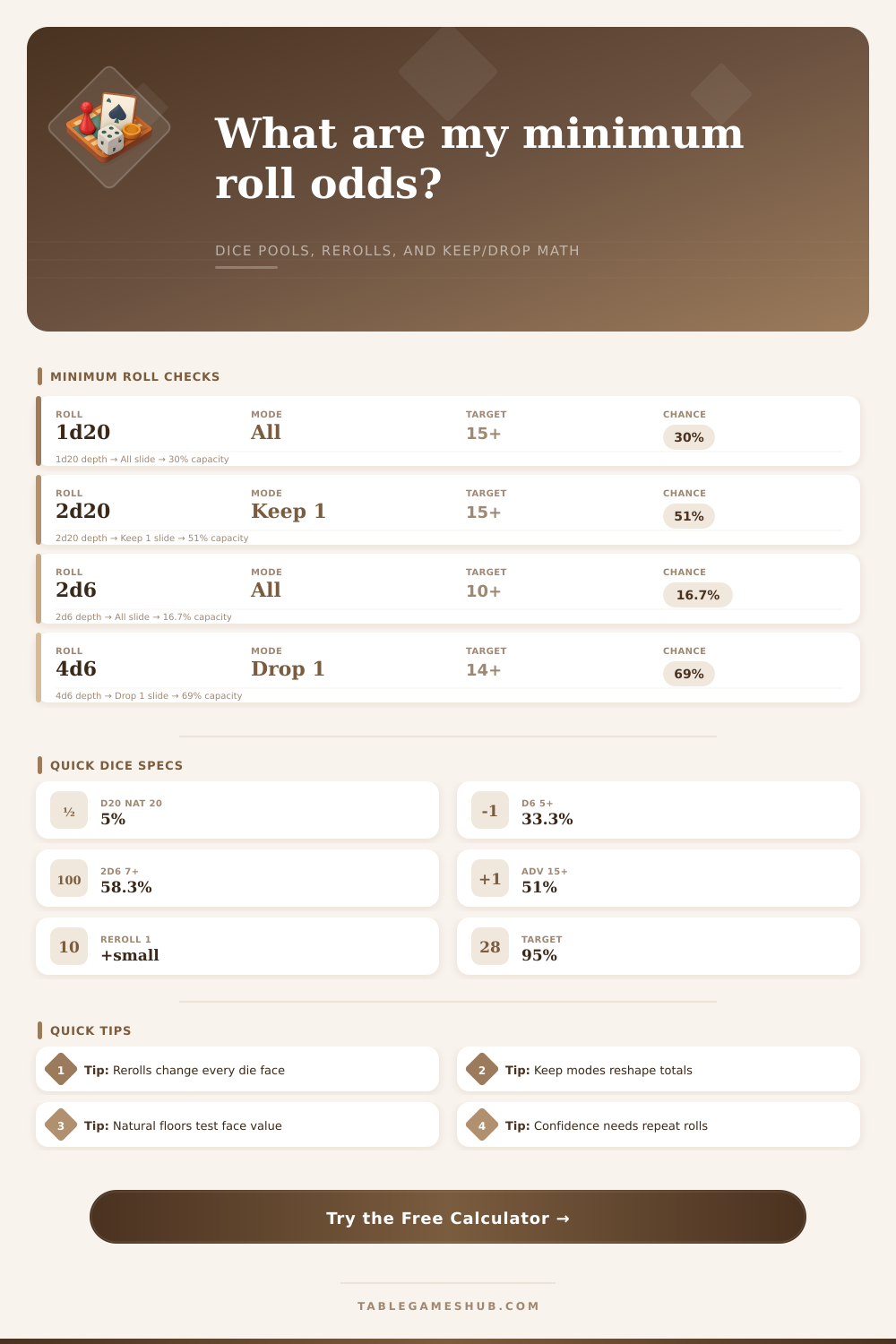
| Solo d20 DC 15 | 1d20, keep all | Total 15+ | Clean single-die threshold baseline. |
| Advantage Nat 18+ | 2d20, keep highest 1 | Natural 18+ and total 15+ | Shows how a natural floor stacks with advantage. |
| 2d6 Reroll 1-2 | 2d6, reroll 1-2 once | Total 10+ | Compares low reroll rules against a high sum. |
| 4d6 Drop Lowest | 4d6, drop lowest 1 | Total 14+ | Models classic attribute-style dice pools. |
When reaching for a die, most table-top gamers rely on their gut instinct, but details of keep and reroll modes, and the various rules surrounding them, aren’t realy about gut instincts. An added bonus to your roll seems like simple math, until you add a rule that requires dropping lowest result, then another rule that lets you reroll low rolls. That’s a mathematical probability curve whose shape becomes intuitive once you graph it. That’s what this calculator does.
It connects what’s happening at the table with what’s written on your character sheet so you can determine if that magic trick or extra feat point are worth it to tip the scales in your direction. It takes away all noise of house rules so you can clearly see how likely it is to succeed.
Why You Should Use This Dice Calculator
Players commonly fall into trap of thinking their dice pools simply sum together. But once you have more than one die, there is no longer an even spread; instead, it become a sort of bell curve around the average. That affects what’s possible, since it moves away from unusual results and group things toward the average.
Games where you drop the low die are removing the tail end of that curve in order to raise your floor. By having an option to choose between keeping/dropping dice (shown below), the tool compensate for that, with huge implications on how the resulting sum act. Keeping just two high dice out of five really reduces the bad luck without reducing the good luck.
The other thing that’s easily ignored are the reroll mechanics. Every time you reroll a 1 or something below your target #, you change all of the faces on the dice. In effect, they becomes slightly higher on average, though not necessarily any particular high number. This may sound like nothing, but when you’re trying to squeeze through a narrow threshold it counts. Set a reroll limit and watch what happens in the calculator, maybe it’s better to go for a flat +2 instead of a risky reroll mechanic, depending on target number.
Knowing this tradeoff will help you build the right character for expected challenges. A natural floor also creates a condition that neither total thresholds nor simple probabilities covers by themselves. You might have a roll higher than what you needed to succeed, yet still fall short because none of the dice you rolled were high enough to trigger a special effect or critical effect. Many intuitive estimates rely on treating these as independent events, which is not true here so it’s easy to see why they don’t work by themselves. The page has some tables as a reference which make all of this clear. When you’re facing a high stakes encounter, you’ll want to plan with both the overall total and highest individual die in mind.
This isn’t strictly about individual rolls, it’s also about having a concrete framework for deciding what to do with confidence targets. “I’m only thirty percent likely to succeed” doesn’t tell me as much as “I’ll be ninety-five percent confident that I got one shot off in five tries.” This reframes things from the immediate to the arc of an encounter, the arc of a session and even the arc of a campaign. It lets me calculate attempts based off those odds so I can measure risk over time instead of simply in the abstract.
The other thing people sometimes overlook about modifiers is that they’re applied *after* the dice get rolled, not prior. That difference in timing are important since it means you won’t be able to save a bad roll with your bonus even if it happens at floor level. Even if you’ve got some huge modifier going for ya, if the underlying dice don’t match what the game system require for faces, then you’ll come up empty anyway. The tool will handle that math for you and give you an answer that reflects actual order of events, instead of just adding them up as if they were equal.
You should of used it sooner.
In conclusion: Probability isn’t a cure for uncertainty; it’s a way of dealing with it. Luck is impossible to calculate, but it is possible to define its limits. Once you understand how keep modes, rerolls, and natural floors work together, you go from guessing to optimizing. You make informed decisions based on the math underlying the magic and embrace the amount of risk you’re willing to take. The dice will continue to fall as they will, but now you’ll know precisely why.