Mau Mau Score Calculator
Total a Mau Mau round from remaining-card values, action-card profiles, jokers, missed Mau calls, wrong finishes, round caps, and per-opponent score markers.
Pips + aces + court + action + jokers
Selected event adds profile penalty
Min(raw score, profile cap)
Capped score / affected hands
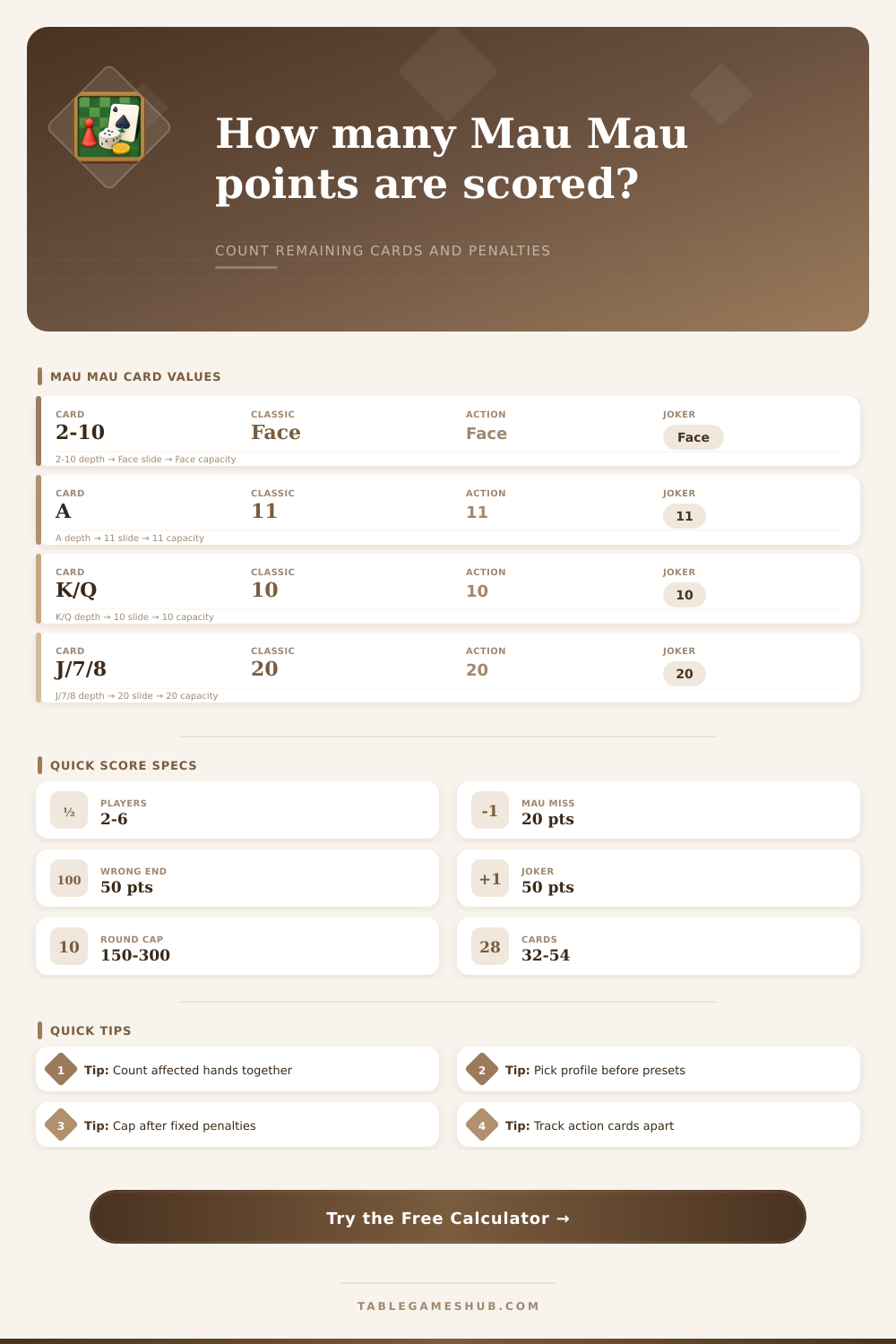
| Profile | Ace | K/Q | Action cards |
|---|---|---|---|
| Classic 32-card table | 11 | 10 | 20 for jack or local action card |
| Action-card bonus table | 11 | 10 | 20 for jack, seven, or eight groups |
| Number-and-face simple table | 11 | 10 | 10 when jacks are kept with court cards |
| Soft ace family table | 1 | 10 | 20 for local action cards |
| Profile | Missed Mau | Wrong finish | Round cap |
|---|---|---|---|
| Classic 32-card table | 20 | 50 | 200 |
| Soft ace family table | 20 | 50 | 150 |
| Joker deck table | 25 | 50 | 250 |
| Tournament cap table | 30 | 75 | 300 |
| Event | Base count | Fixed add-on | Result meaning |
|---|---|---|---|
| Winner scores remaining cards | All affected hands | None | Points credited to the round winner |
| One player records own cards | One hand | None | Penalty marker for the holding player |
| Missed Mau call penalty | Remaining cards | Mau penalty | Exposure plus missed-call value |
| Wrong final-card penalty | Remaining cards | Wrong-finish value | Exposure plus bad-ending value |
| Remaining group | Enter in | Typical value | Why separate it |
|---|---|---|---|
| Number cards | Pip total field | Face value | Fastest way to total mixed 2 through 10 cards |
| Aces | Aces left field | 1 or 11 | Ace value changes by profile |
| Kings and queens | K/Q field | 10 each | Keeps face-card math compact |
| Jokers | Jokers field | 0 or 50 | Only joker-deck profiles add them |
There’s this moment in every Mau Mau round where it feels like everything’s gone on too long, and everybody simply wishes they could go home. That’s usually because no one is paying attention to the scoreboard. Strategy goes out the window as the conversation turn to who can bluster his way through his hand without having to count cards.
Enter the calculator above. It will add your scores together. Even better, it’ll turn the mess of card at your table into a clean number. It also accounts for the difficult stuff like penalty caps and action card bonus, which would of otherwise require math and ruin your night.
Why You Need a Mau Mau Score Calculator
In theory, Mau Mau scoring is easy: When someone goes out, count the points they have left in other people’s hands. In practice, it’s annoying. Number cards are fine, they’re just worth their face value. Face cards is also pretty easy, each adds another ten. Then things get complicated when you throw special cards into the mix and/or variant rules.
If you pick the wrong profile, you’ll end up arguing about the math after the round are scored. Are you playing a straight-up thirty-two card game, where an ace counts for eleven? Or did you pull out the whole deck with jokers who can add fifty points to a round if they’re not covered up? Pick the right profile, and you know the math will be accurate based off your house rules.
This also means that most folks overlook how penalties aren’t just added on top of everything. There are some specific interactions between penalties and card exposure. For example, if you play the incorrect final card, or claim Mau but have additional cards remaining to show, then the penalty will sting. Once the number of exposed cards has been counted, the calculator assess these fixed amounts.
Why? Most local groups puts a cap on the maximum points possible per round. Without such a cap, one lousy hand could set someone back two hundred points and ruin their chances of winning. Even if they score fifty jokers and blow their Mau call, they only lose so much and stay in the game. This makes the game more about competition then punishment.
The second level of complication (which catches everyone) is the action cards. Depending on which variant rules you’re following, they may be worth 10 points, but in some variants, jacks or sevens is worth 20 instead. These are Jacks or Sevens. So if you don’t separate out the special cards from the rest, you’ll miscalculate your score by a lot.
This tool lets you do just that. It also lets you record the number of action card remaining for all hands that was impacted. Then it recalculates the total based off those cards. Again: little thing, but it makes all the difference in the math. At the end of the round, when you audit your scores, you won’t have someone mistakenly value an action card as something else because they didn’t separate it.
My favorite and possibly least discussed component of this tool is the per-hand average. Knowing that someone won a certain amount is fine when they win money off several people. But to know how those hand were distributed is even better. A hand where three guys lose twenty points apiece versus a hand where one guy loses sixty and three others lose nothing is going to tell you something about the nature of the round. Did he get lucky on a couple hands? Are you getting beat down evenly at the table? If it’s a long session and momentum starts swinging, this can be an important data point.
I know a lot of people make Mau Mau scoring harder than it needs to be, trying to mentally convert numbers into scores as they manage their hand. It’s slow, it makes mistakes, and takes away from the game. Having an independent calculator eliminate all of this mental work. Instead of thinking about numbers, you can just play. If you like, you can also use the reference tables built into the design to double-check the rules whenever you want. But trust me, after using the tool to convert penalties to pips to a total score, you’ll never remember how you attempted to do it manually again.
Mau Mau is a game of memory, tension and knowing what’s going on with both the cards in your hands and the cards not in play. Is it worth taking a chance on a blocked suit? Or should you play it safe for those potential points? To know that, you have to know how many potential points are at stake. That’s where accurate scoring comes into play. It makes the tension honest and ensures each point earned is real and each penalty earned is fair.
Next time you’re at the table and the scores start to get fuzzy and the conversation gets noisy, put down the cards and pick up the tool. Let it handle the math so you can handle the cards.