Brisca Score Calculator
Total a captured Brisca hand, infer the other side from the 120-point deck, and update a match race without recounting every card twice.
Brisca hand result
Spanish Brisca
Uses a 40-card Spanish deck. Scoring ranks are As, Tres, Rey, Caballo, and Sota for 120 total points.
Italian Briscola
Uses the same point structure with Asso, Tre, Re, Cavallo, and Fante. A 61-point hand wins.
Portuguese Bisca
Commonly keeps the 40-card, 120-point count, with local labels for court cards and match targets.
Local Bonus Play
Some tables add a last-trick marker. The calculator keeps the bonus separate from classic card points.
| Scoring card | Brisca value | Copies in deck | Maximum points |
|---|---|---|---|
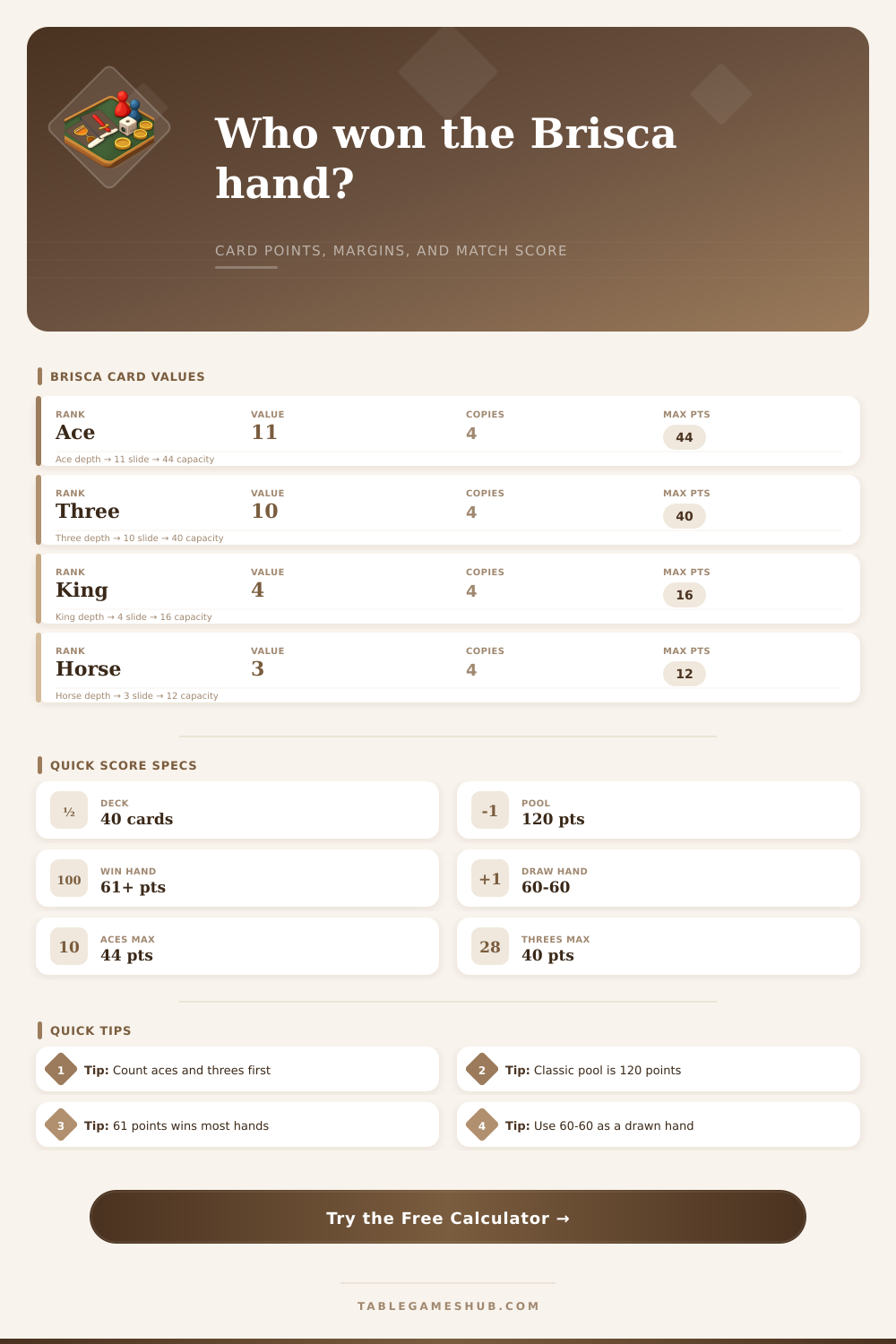
| Ace / As / Asso | 11 points | 4 | 44 points |
| Three / Tres / Tre | 10 points | 4 | 40 points |
| King / Rey / Re / Rei | 4 points | 4 | 16 points |
| Horse, queen, or dame | 3 points | 4 | 12 points |
| Jack / Sota / Fante | 2 points | 4 | 8 points |
| Seven, six, five, four, two | 0 points | 20 | 0 points |
| Hand total | Classic outcome | Opponent total | Match effect |
|---|---|---|---|
| 61 to 120 | Team wins the hand | 59 to 0 | Winner gains one match hand |
| 60 | Drawn hand | 60 | Depends on table draw rule |
| 0 to 59 | Team loses the hand | 120 to 61 | Opponent gains one match hand |
| More than 120 | Bonus or correction present | Check table variant | Use breakdown audit line |
| Table format | Deck use | Common deal shape | Scorekeeping note |
|---|---|---|---|
| 2 players | One 40-card deck | Hands refill from stock | Track each player's captured pile |
| 3 players | One 40-card deck | Local variants differ | Use Team A as one player against table |
| 4 players | One 40-card deck | Partners sit opposite | Combine partner captured cards |
| 6 players | Local rotation setup | House format | Confirm deck and target before counting |
| Match target | Typical use | Hands needed | Calculator setting |
|---|---|---|---|
| 1 hand | Single quick game | Win this hand | Target 1 |
| Best of 3 | Short match | First to 2 | Target 2 or race 3 by house rule |
| Best of 5 | Club table | First to 3 | Target 3 |
| Race to 5 | Long table session | First to 5 | Target 5 |
Brisca scoring leads to arguments, which is why there’s a calculator. When the hand ends, it’s a quiet moment: four people silently trying to calculate what they think happened. Each player has a stack of cards, but your partner also have one. And in the middle of all this, reality of who actualy won is buried; pulling it out will require counting and arguing.
It gets tiresome having to rely on your head for numbers, because you make mistake. Let the calculator do the math for you. It transforms a messy pile into something obvious and certain.
Why You Need a Brisca Score Calculator
Scoring in Brisca makes sense. The reason novices get confused is that high cards is disproportionately valuable. All told there are 120 points from a pool of forty cards. Eight of those card (the Aces and Threes) score an astonishing eighty-four points, nearly seventy percent of all available points. Start with those top cards as your first count, as they will tell you half the tale. And the calculator wants Aces and Threes to count earlier so they makes up most of total before moving down to lower-ranking court cards. Why? Because it means that the mistake of under-weighing the rapid buildup of points won’t be made.
First, know about raw card points as applied to match structure. If you reach sixty-one, in classic play you win the hand flat-out; you don’t need seventy or even eighty points. All you really want is one point higher then half the deck. The tool confirms this instantly, but it also addresses those grey areas which cause arguments.
If each team scores exactly sixty points the hand is drawn, and various groups deal with draws differently: some award neither player any points at all, others mark both sides equally, still others just carry the draw status forward. Choosing your local rule here is essential, because how you interpret a draw might change dynamic of a best-of-five match. That ability means that scoring will be consistent with your real-life house rules.
It’s a longer game beyond any one hand you’re playing. You must consider what a single win mean, does it change everything or is it minor? That depends on the target hands and the match standing right now. If you are down two games to none in a best-of-five series, winning a narrow sixty-two point hand feels very different from winning a sixty-one point squeaker when the score is tied.
The result tells you not only whether you won or lost, but also by how much. Did you dominate the high cards and have a large margin? Or was it due to luck with your low cards or maybe your partner making a mistake? Knowing this can show how you adjust your strategy for the next deal.
There are other considerations too, like local variants; for example, the option to score bonuses when you take the final trick. In casual games, this is not uncommon, but in standard competitive Brisca it isn’t a factor at all. You can switch the bonus on/off here with the option, then give it a point value if you like. That way, you keep the classic card points separate from any local modifiers that might apply. This lets you audit your game accurately regardless of the ruleset.
It also recognizes variations in how you label the deck: maybe you play Reys and Cavallo, Kings and Horses, or some kind of French-suited adaptation. The actual card values is exactly the same, but the interface will adapt to your terms, and nobody gets confused over what each card is worth.
Any scoring aid will do that: eliminate friction from the game. Nothing kills game flow quicker than arguments about arithmetic. It’s worse then bad luck. Externalizing the math lets you keep your eye on the prize: Partnership and strategy. It is not simple addition. You should of trusted the numbers.
There’s never a question in your mind when the final score pops up. That alone lets you go right back into the cards and begin the next round in record time. You won’t have to stare at a controversial number anymore. Letting them count it out for you lets you take all the time you need to shuffle up the deck. Only strategy will be in dispute, not the total.