Ramino Score Calculator
Total Ramino hand penalties, jokers, bad opening penalties, closing bonuses, caps, and table limits for two to four players.
Score Breakdown
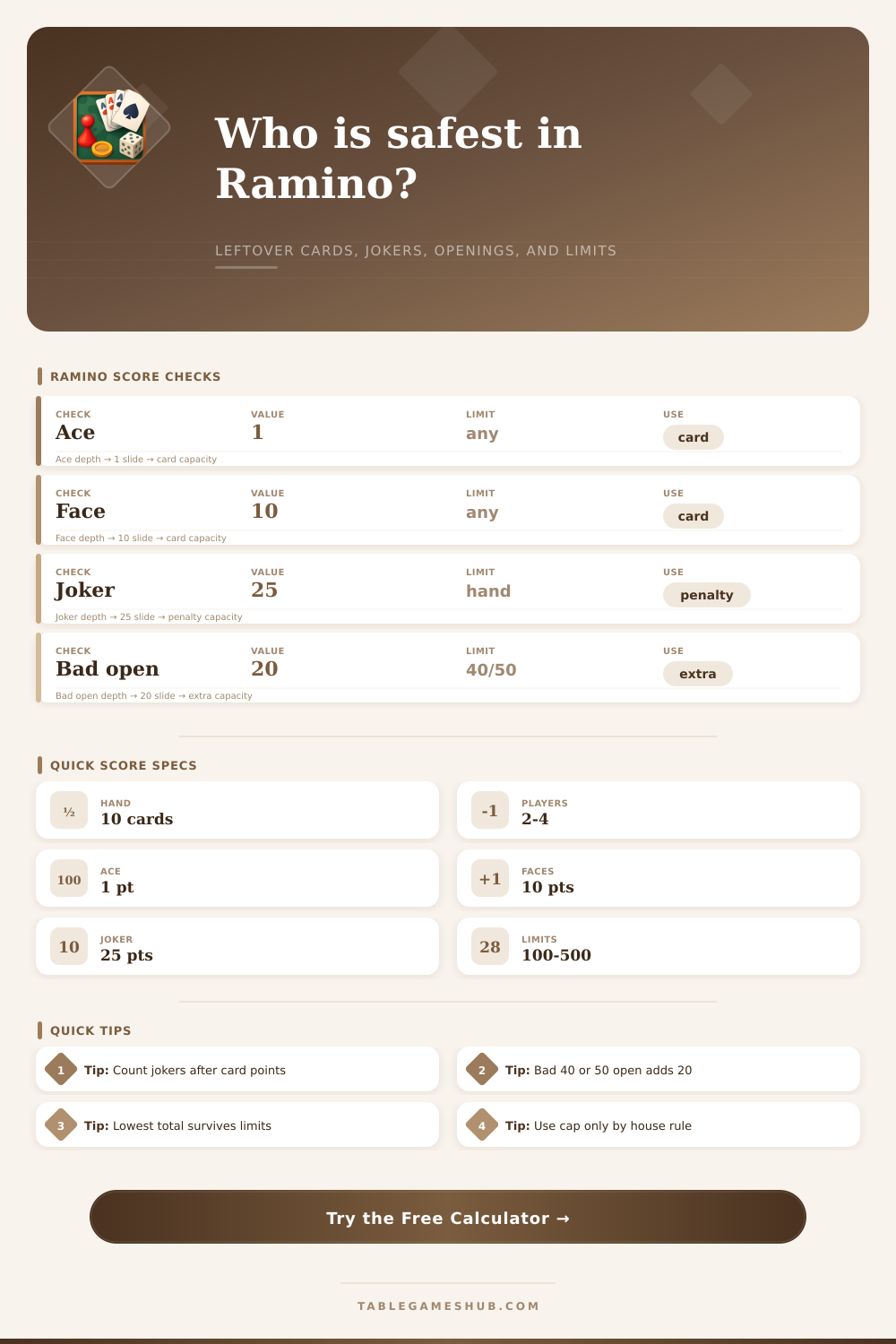
| Card Type | Ramino40 Value | Rumino Seven Value | Calculator Field |
|---|---|---|---|
| Ace | 1 point | 1 point | Include in card points |
| 2 through 10 | Face value | Face value | Include in card points |
| Jack, Queen, King | 10 points | 10 points | Include in card points |
| Joker left in hand | 25 points | 10 points | Enter in joker field |
| Profile | Score Direction | Joker Default | Best Use |
|---|---|---|---|
| Ramino / Rummy40 | Penalty points added | 25 points | 10-card opening games |
| Rumino seven-card | Penalty points added | 10 points | Gin or Rumino checks |
| Classic winner score | Winner gains opponents total | 15 points | Positive rummy score sheets |
| House penalty cap | Capped penalties added | 25 points | Tables limiting one bad hand |
| Situation | Formula | Who Receives It | When To Select |
|---|---|---|---|
| Normal go-out | cards + jokers + extras | Opponents only | A player discards last card |
| Clean Ramino | finisher -10, others count | Finisher and opponents | Table awards clean hand |
| Bad 40 or 50 open | hand score + 20 | Marked player | Opening threshold missed |
| Stock blocked | everyone counts hand | All active players | No one can go out |
| Players | Deck Setup | Cards Dealt | Score Sheet Focus |
|---|---|---|---|
| 2 players | 1 deck plus jokers | 10 each | Head-to-head limit race |
| 3 players | 1 deck plus jokers | 10 each | Lowest total at limit |
| 4 players | 2 decks plus jokers | 10 each | Elimination and rebuy checks |
| Blocked hand | Use current deck | Remaining cards | Everyone adds leftovers |
In Ramino the game will often begin with laughter around one point, and end with a serious discussion on who realy won or lost. You’re playing a fast-paced game of rummy. Cards is being thrown around, and somebody goes out with their hand. The room freezes.
Then comes the not-so-glamorous portion of the game, where everyone has to count up their leftover cards, jokers, and any penalty for bad openings. In this high pressure environment it’s easy to mess up; you might be distracted by the social aspect of the night, or even be tired! A simple math snafu can change the whole dynamic of the game: who is feeling vulnerable and who is feeling safe for the rest of the match. Knowing your score correctly tell you if you’ll survive in a penalty-based game, which is more important then winning the hand.
Why You Need a Score Calculator
Most new players has trouble understanding the value of jokers sitting in their hands at the conclusion of a round. While a regular playing card has its face value (i.e., a king equals 10 points), a joker that sits untouched will cost you much more based off whatever the ruleset says at your table. For example, a single joker might equal twenty five points in an old-school game. With that kind of swing, especially if your goal is to not exceed a match total of one or two hundred points, it’s easy to see why people gets flustered.
Enter the information into our calculator above and let it do the work for you when the heat is on. You can easily swap between multiple scoring profiles and it will automatically adjust for how many points a Joker is worth (is it 15? Is it 25?), you don’t need to memorize that stuff; you just pick the right profile and enter the raw card numbers.
Another wrinkle often missed by non-serious players are the opening penalties. You have to achieve a certain point minimum (maybe 40-50 if you count meld points) otherwise you are penalized for opening your hand. Typically, that adds an extra 20 points to your score right then and there. So impatience gets punished and lack of planning will get you docked. When you check the box for bad opening, the system knows to add that penalty in properly before computing the final standings.
Keep in mind, though, this isn’t just points added to your score, but a strategic hint that being conservative with those early openings may be better than going all-in and hoping for a lucky hand. In penalty formats, whoever has the lowest score win. Every point matters towards staying in the running. When it comes to managing your score through several hands, the larger picture matter more then the single round. Keep tabs on your running tally for both overall and versus the match limit to see if you are still close to winning or at risk of being eliminated or settled.
Winning a hand may mean making clean discards, yet if those left in the game push themselves beyond the match limit cutoff then they’re not safe from elimination even though they won that hand. The calculator also includes reference tables that detail how different finishes (e.g., blocked hands: where all players count their cards despite one going out) will impact those scores. This changes the math significantly because winners and losers does not cancel each other out. Instead, everyone adds what remains to their ongoing total. This can quickly ramp up scores and end matches earlier then expected.
In short, knowing those margins is everything, do you have enough to go conservative and save some of your jokers, or do you need to get aggressive? Do you need to hang on to every point because you’re way back? Or maybe you’re leading and you know you’ve got to protect it. That’s where the danger margin on the calculator comes in; it displays how much each player is at risk for every single hand. How far off the pace are they? By how many points are you ahead or behind someone else? Being able to see that removes any potential fighting and lets the game flow easy. What was once a wild count-off becomes a clear data point that anyone can look at instantly and agree with.
Ultimately we want to play well but also keep things honest so the right person survives until the end. The real answer is that Ramino, at its core, has as much to do with math and memory as it does strategy and luck. If you keep your wits about you throughout the scoring process, you can feel confident in your play for the next hand. Accurate tracking helps even a 2-player quick match become more than chaos, and it allows those skill to shine through over a tournament style 4-player game. Consistent calculation removes friction from disputes and lets you focus on the cards in front of you.
Who will remain cool when the stock is depleted? It is always the player who knows where they stand in relation to the limit. That’s how you tell the difference between a good Ramino player and a great one.