Escoba Score Calculator
Total one Escoba hand from escobas, captured cards, coins, sevens or primera, seven of coins, optional all-card bonuses, and match target pressure.
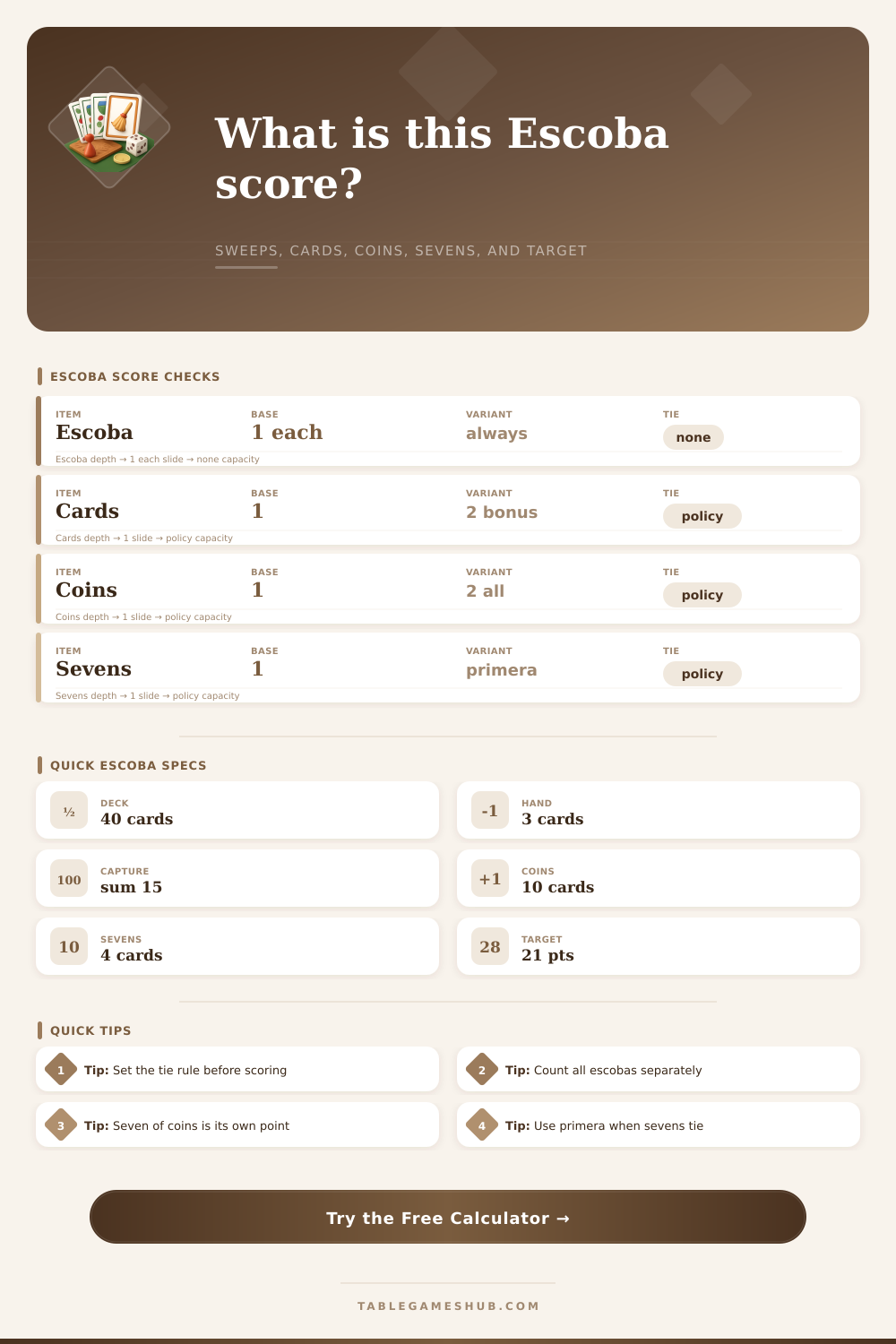
| Category | Standard value | Calculator input | Score trigger |
|---|---|---|---|
| Escobas | 1 point each | Side sweeps | Every sweep scored during play |
| Most cards | 1 point | Cards captured | Higher captured-card pile wins category |
| Most coins | 1 point | Coins captured | Higher oros / coin-suit count wins category |
| Most sevens | 1 point | Sevens captured | Higher seven count wins, unless using primera |
| Seven of coins | 1 point | Seven of coins selector | Side that captured the seven of coins scores it |
| Primera card | Score value | Why it matters | Calculator note |
|---|---|---|---|
| Seven | 21 | Best card for primera / setenta | Use one best card from each suit |
| Six | 18 | Second-best primera card | Strong replacement when seven is missing |
| Ace | 16 | Third-best primera card | Often used in Italian-style prime scoring |
| Five, four, three, two | 15 to 12 | Middle fallback values | Enter the final total, not each card |
| Court cards | 10 | Lowest primera cards | King, horse, and jack all count as 10 |
| Rule profile | Cards / coins ties | Sevens rule | Best use |
|---|---|---|---|
| Standard | Selected tie policy | Most sevens | Fast casual score sheets |
| Primera / setenta | Selected tie policy | Higher primera | Tables that award prime instead of simple sevens |
| Strict ties | No point on tie | No point on tied sevens | Published rules where equal leaders cancel |
| Shared ties | Tied leaders score | Tied leaders score | Online-room or house variants that share points |
| All bonus | Selected tie policy | Sevens plus all-card bonus | Tables that reward all coins or all sevens |
| Preset | Scenario | Likely swing | Audit focus |
|---|---|---|---|
| Classic Close | Card lead, coin lead, tied sevens | Small Side A edge | Seven of coins and tie policy |
| Coins Sweep | One side has all coins | Bonus-sensitive | All-coins house rule |
| All Sevens | One side has four sevens | Large category swing | Seven of coins plus all-sevens bonus |
| Primera Tie | Same seven count, different prime | Primera decides | One best card per suit total |
| Final Hand | Both sides near target | Winner check | Running score plus hand points |
There’s quiet on the table for a second. There is a stack of four cards in the middle. You look at what’s in your hand and do the math to find your total. Escoba, after all, are a numbers game. If you win every trick but forget to pay attention to the layers of scoring accumulated across ten rounds, you might end up losing the match. Quick thinking and long-term planning makes the scoresheets stressful. As a player, it is important to have an effective way to check your points, especially when debating with someone who thinks they should of won the coins round.
After plugging in your capture totals, the calculator above will perform the tricky math for you. That way you don’t have to do any adding while you’re under influence of the fight-or-flight response (or whatever other chemical response occurs during a fight).
How to Score in Escoba
If you play with just the most basic categories and no variants, then you only need to keep a mental tally of sweeps and basic category in your head. As soon as you add variants like setenta or prima, however, things becomes more complicated. Also, did you agree to split the point between them in the event of a tie? Or do you award neither side any points, even though they technically won nothing but earned a tie? Depending on this one rule, you could be off by a few points over a long game, which can make all the difference if you’re playing a close match. Before you enter your numbers, the tool prompts you to choose these house rules so that you’ll end up with an accurate match of what agreement was reached at the beginning of the game.
In addition to the sweeps there are four other primary areas where scoring is based off in Escoba. They are having the seven of coins, holding the most sevens, holding the most coins, and capturing the most cards. By default each is worth a single point. Whoever ends up with the highest number of cards of that type (or suit) get a point. It’s as simple as it seems until you get tied. Then things can get complicated. While some groups play strictly by the tie policy… Meaning there is no score for anyone when a count is even, others will split points. The calculator adjusts its output based on this preference. This eliminates the “we think” factor that typical results in a post-game debate.
One exception is the seven of coins. In this game, it’s a stand-alone point. Holding it scores you that point. It doesn’t matter how well your opponent is doing or whether you beat her/him. That can alter the way the mid-game plays out. A player might feel they have built up a good prima value but sense their opponent has a seven of coins. In this case, they will sometimes risk a sweep just to pick up that seven of coins.
Prima adds another layer of value to the game where instead of just counting sevens, there is a value associated with the cards. Each suit contains a highest valued card that gives you points towards your score. Aces equal sixteen, sixes equal eighteen, and sevens equal twenty-one. Because of this, you end up doing a bit more math in your head throughout the game. You need to keep track of what cards your opponent might have in hand to guess at how high their potential prima score could be. To take some of the work out of remembering these values, the tool comes with a set of reference tables to lay everything out for you so you don’t have to memorize everything each time you sit down to play.
The most hotly contested area tends to be collecting coins. Only ten coin cards is included in the deck. If you can get five or more, you will win the point, unless your opponent also gets five. In that case, we use the tie breaker once more. When the scores are close coming into the last hand, it becomes an even higher-stakes affair. One player may feel compelled to go all-in on coins if he thinks they will give him the lead over his opponent. They might ignore a potential sweep they could of made themselves, which could have saved them points elsewhere. This is the heart of the advanced game, should I press forward against my opponent’s weak spots, or am I better off defending what I’ve got? The calculator illustrates this with the net swing between each side and how far ahead (or behind) either side need to be to reach match point, commonly twenty-one points.
Sweeps are easier to track, but you have to be on top of them. If you sweep (get rid of all the cards on the table) at once, that’s an escoba. It is minor, sure, but it counts. Two cards cleared? That’s still a whole point. Newbies often miss opportunities for sweeps because they focus too heavily on capturing coins or sevens. These are also tracked separately, so you’ll know how many points were earned based on what you did rather than what you had. This will allow you to look back after the game and know whether you won because you played aggressively and cleaned up the table, or if you simply lucked out with a good hand distribution.
Last but not least, there is a way to run the scores manually and adjust as needed. Most games involve more than one deal. It’s easy enough to forget your total score. Enter the previous score alongside current hand’s points to see exactly where everybody stands at any given moment. No more guesswork at crunch time. If both sides are within range of the goal you can take a risk, or gamble on desperation. Many times it’s a single sweep away, or a single coin that decides who wins or loses. If the score is accurate, the outcome will be decided by skill rather than math errors.