Buraco Score Calculator
Total both teams with melded card points, clean and dirty buracos, royal runs, go-out bonuses, dead pile penalties, cards left in hand, and match target progress.
Choose the profile your table uses, then adjust any point value. Buraco variants differ, especially for twos, jokers, semi-clean buracos, royal runs, and whether closing requires a clean buraco.
Team A
Team B
meld score = low cards x low value + middle cards x middle value + twos + aces + jokersbonus score = clean + dirty + semi-clean + royal + ace-to-ace bonuses entered for that teampenalties = cards left in hand + dead pile penalty when the pile was not taken or not usedround score = meld score + bonus score + closing bonus - hand penalties - dead pile penaltiesCard point values by profile
| Profile | 3-7 | 8-K | 2 | A | Joker |
|---|---|---|---|---|---|
| Brazilian no-joker | 5 | 10 | 10 | 15 | 0 |
| International | 5 | 10 | 20 | 15 | 30 |
| Italian common | 5 | 10 | 20 | 15 | 30 |
| Buraco Plus | 5 | 10 | 20 | 15 | 30 |
Buraco and run bonuses
| Bonus | Brazil | Intl | Italian | Plus |
|---|---|---|---|---|
| Dirty buraco | 100 | 100 | 100 | 100 |
| Semi-clean | 0 | 0 | 150 | 150 |
| Clean buraco | 200 | 200 | 200 | 200 |
| Royal run | 500 | 500 | 0 | 500 |
| Ace-to-ace run | 1000 | 1000 | 0 | 1000 |
End-round adjustments
| Situation | Score effect | Where entered |
|---|---|---|
| Team closes | +100 default | Closed field |
| Cards in hand | Subtract value | Hand counts |
| Dead pile not taken | -100 default | Dead pile status |
| Dead pile taken unused | -100 default | Dead pile status |
Common match settings
| Table style | Players | Deck | Target |
|---|---|---|---|
| Brazilian express | 2 or 4 | 104 | 1 round |
| International | 2 or 4 | 108 | 2000+ |
| Italian Burraco | 4 pairs | 108 | 2000 |
| Club match | 4 pairs | 104/108 | 3000+ |
Casual Buraco games are played with mental scores kept on honor system; which doesn’t always work out. People usually just has a memory failure about whether it was a clean buraco or not, and now there’s an argument.
That’s where this calculator comes in: You input all your point sources first, then declare a winner. No more embarrassing moments of “Well I thought you had 7 points but I guess I don’t”, let the calculator do the math for you!
Why Use a Buraco Score Calculator
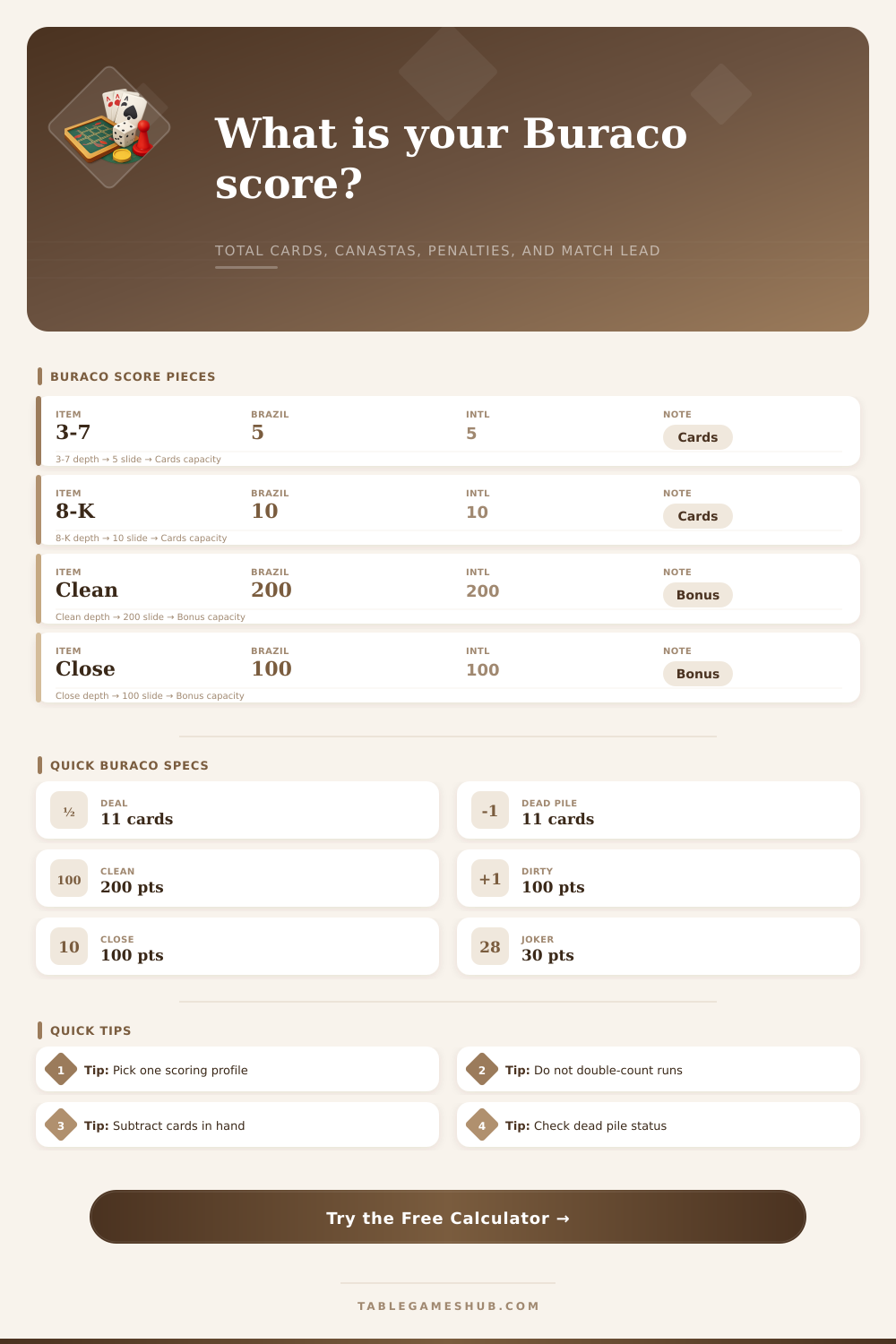
A good count starts with knowing how card ranks translate to point value in your chosen variant. Generaly speaking, low cards (three-seven) is valued at five points per card, and high cards (eight-king) are worth 10 points a piece. The reason for this: it’s much tougher to lay down low cards so they’re that much more valuable when you do.
The calculator adds this base number based off the profile you choose, e.g., International (where twos and jokers count for more), Brazilian no-joker. Selecting the proper profile is the single most important initial step; if you enter an International game with Brazilian values, for instance, and happen to be sitting on a few twos, your total will be off hundreds of points.
The math gets interesting with bonuses, where many player miscount. Most variations give two hundred points for a clean buraco; all natural cards, no wilds substituted. It is riskier to hold on to natural cards and hope your partner finishes melding them before time runs out so this is considered a nice bonus. Half as much (one hundred) goes for dirty buracos that include twos or jokers. Less risk; less reward. These are the distinct divisions marked by the tool, you don’t want to overvalue a messy pile just because you think there’s lots of it.
Royal runs and ace-to-ace sequences is worth even higher premiums, potentially five hundred points, one thousand points, depending on house rules. It’s a swing point, and they can change the outcome of a game in one turn.
You should also consider what didn’t go on the table as well as what did. Cards left in your hand after each round counts against you. These represent potential points that you missed out on. That’s an intentionally harsh penalty, designed to be a major reason not to keep good card in your hand out of either caution or spite.
The other factor here is the dead pile status. It’s worth noting that, if a team choose not to take the dead pile (or takes it but can’t play any cards off it), there’s a standard one hundred point penalty. This is another way to discourage passing a turn without purpose, and it punishes bad planning based on discard stack. When you enter your pile status and hand counts into the calculator, it will automatically tally those penalties for you.
But accurately keeping score has another strategic benefit: It shows what’s truly happening. Yes, your team may have 50 points over theirs, but maybe all their high cards still sits unmelded while they desperately cling to some bonuses. Keeping track round-by-round lets you know if you’re ahead because you’re making smart plays, not just because your competition is making costly errors with the dead pile. Long-term, careful notes will show a pattern in your game that goes unnoticed by a casual eye… Say, an inability to put together low-card melds before it’s too late.
In short, you must get the score as close to the target (two thousand points is common) with no wiggle room. Playing in teams of twos or heads-up, there’s no way anyone can be confused about what they have. Clarity brings no arguments and no delays to the game. That is why the calculator gives it to you in bite-sized chunks, showing exactly how each individual point was gained or lost. It won’t make you play better… but at least it’ll shut up when the math disagree.