Coinche Score Calculator
Total a Coinche or Belote Coinchee hand with contract points, coinche, surcoinche, belote-rebelote, declarations, all-trump normalization, capot checks, and match target pressure.
Suit: raw cards + der. All trump: raw x 152 / 248 + der. No trump: raw x 152 / 120 + der.
Contract check = attack tricks + attack declarations + attack belote. Capot/general also need 8 tricks.
Bid-only: attack score = hand points + contract x multiplier. Defenders score their hand points.
Bid-only: defenders score fail base + contract x multiplier. Failed attack keeps belote if selected.
| Card | Trump | Non-trump | Notes |
|---|---|---|---|
| Jack | 20 | 2 | Top trump |
| 9 | 14 | 0 | Second trump |
| Ace | 11 | 11 | High non-trump |
| 10 | 10 | 10 | Strong counter |
| King | 4 | 4 | Belote half |
| Queen | 3 | 3 | Belote half |
| 8 or 7 | 0 | 0 | No card points |
| Contract | Need | Made score | Failed score |
|---|---|---|---|
| 80 | 80 or 82 | Hand + 80 | Base + 80 |
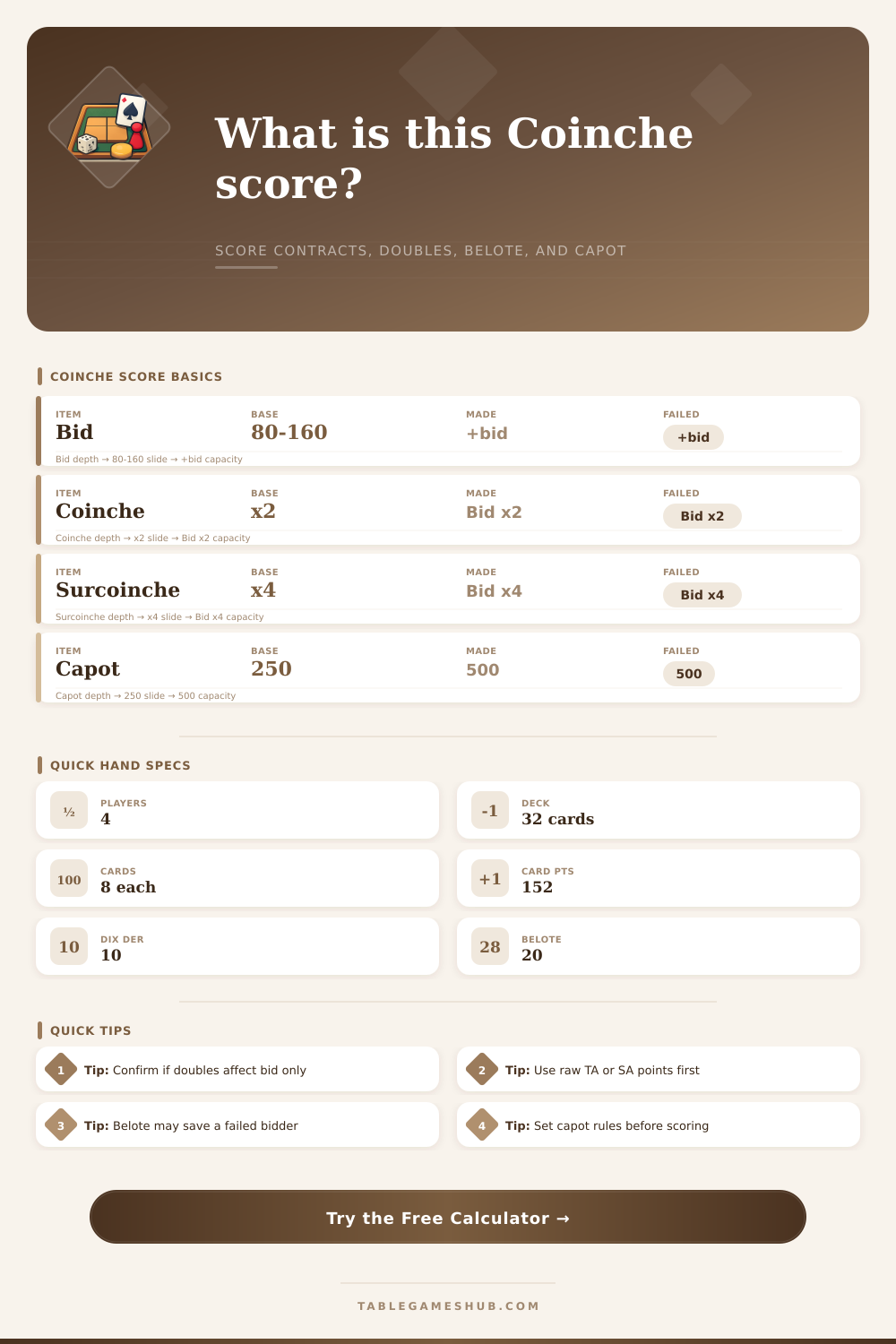
| 90-160 | Bid value | Hand + bid | Base + bid |
| Capot | 8 tricks | 250 + 250 | 500 common |
| General | 8 tricks solo | 250 + 500 | Base + 500 |
| Coinche | Same need | Bid x2 | Bid x2 |
| Surcoinche | Same need | Bid x4 | Bid x4 |
| Declaration | Value | Use | Contract help |
|---|---|---|---|
| Tierce | 20 | 3-card run | Yes if valid |
| Fifty | 50 | 4-card run | Yes if valid |
| Hundred | 100 | 5-card run | Yes if valid |
| 4 Jacks | 200 | Square | Yes if valid |
| 4 Nines | 150 | Square | Yes if valid |
| Belote | 20 | K + Q trump | Usually yes |
| Mode | Raw total | Factor | Belote |
|---|---|---|---|
| Suit trump | 152 | 1.000 | Trump suit |
| All trump | 248 | 152/248 | House rule |
| No trump | 120 | 152/120 | Usually none |
| Dix de der | 10 | Add after | Last trick |
| Capot der | 100 | House rule | All tricks |
| Rounding | Tens | 5 up | Score sheet |
Once the score hits five-hundred, something shifts at a Coinche table. Risk management become part of the game, because everybody wants to increase theirs. Sometimes you’ll find yourself holding a hand you’re sure will get the trick. But then you forget about the coinche or surcoinche that multiplies the value. That’s why card counting isn’t enough; you also need to keep a running total in your head of what score is.
That’s why I use this calculator: Once you input your contract (and any doubles), it do the math for you, which prevents mathematical mistakes when things start getting tense. But first we should of understand what all of those levers do. Each scoring profile are simply a set of house rules developed over time through play.
Understanding Coinche Scoring Rules
One table may start with a base failing bid of one hundred sixty-two points whereas another may want it at one hundred sixty. Sounds small, but once you’re down twenty points in the match you’ll be glad you knew how many points your team would lose on a failed bid. Use tool to turn these options on or off. This lets the outcome reflect your table instead of trying to make every table follow a single standard that does not naturaly apply.
Doubles are frequently misunderstood by players. A coinche multiplies your bid by two, and a surcoinche multiplies it by four. However, many players argue about whether these multipliers also applies to declarations and card points. Some tables will double the entire hand including card points and declarations; other tables only penalize you for contract amount itself. The difference can be dramatic when you have a close hand in which each player wins some trick but loses on declarations.
The table on page explains it all clearly and demonstrates how different scope of multipliers affect final score. Agree on this one before dealing your first card; it influence bidding strategy for the whole game. This only scratches the surface of the scoring system.
When playing with no trump or all trumps, total points for each hand must be converted into the familiar range of 152 points. In suit trump hands, however, the card values can simply be added up. Novice players will forget to convert their score into the correct range and simply sum up raw point value. Not converting means the score will be artificially high and not a reflection of the true strength of the hand.
The calculator handles this conversion automatically depending on which trump mode you select. So, for example, an all-trump hand won’t be unfairly punished or awarded because of math failure. There’s an extra level of complication with declarations, which turn a hand from making a bid to being down by twenty points in a matter of seconds.
The team that makes the declaration get a hundred-point bonus. However, this only happens if it is properly declared and confirmed before play starts, and no one argue about whose card was the belote that caused the contract to fail. That means there is some question as to whether the belote should have been credited to the defense or not. By establishing this rule in the tool, we remove that uncertainty when something goes wrong and the teams disputes who earned the twenty points.
When you take this sort of game seriously, tracking the match target is often ignored more than anything else. Too many teams thinks of every hand as completely separate from all the others, ignoring where either side stands relative to two thousand points. With forty to go but your opponents at only ninety, it may make sense to lay back with a low risk contract instead of bidding a risky slam. You can enter the score and it’ll show you how far there is to go for both teams.
Does that mean pushing to win? Or is it making sure you don’t lose too much ground? It’s that kind of strategic understanding which, over time, will beat pure card power. After all, knowing about the structure of the whole game are better than simply having cards in your hands at the moment.
The game is part chance and part managing information. To do well, you need to understand not just which cards are in your hand, but which cards count towards points based off your set of house rules. Knowing this allows you to avoid some very expensive miscommunication mistakes, which will derail even a good performance.
These tools remove the math from your brain, freeing it to focus on the gameplay itself: the true skill and intuition portions. Ultimatelty, you want the score sheet to reinforce your decisions (not dictate them); because the action on the table is the star of the show.