Setback Card Game Calculator
Score a Pitch or Setback hand, test whether the bidder makes the contract, compare game pips, estimate point-card odds, and see the score swing before the next deal.
made points >= bid
The bidder makes the hand only when awarded point cards plus Game reach the contract.
made ? +points : -bid
A missed contract subtracts the bid from the bidder instead of adding captured points.
10=10, A=4, K=3, Q=2, J=1
The Game point belongs to the highest pip pile unless your table has a tie rule.
C(g,k)C(n-g,h-k) / C(n,h)
Hypergeometric odds estimate drawing enough point cards in the starting hand.
Breakdown
High, Low, Jack, and Game are active.
No jokers are included in this model.
Bid range is checked against active points.
Use your table target if it differs.
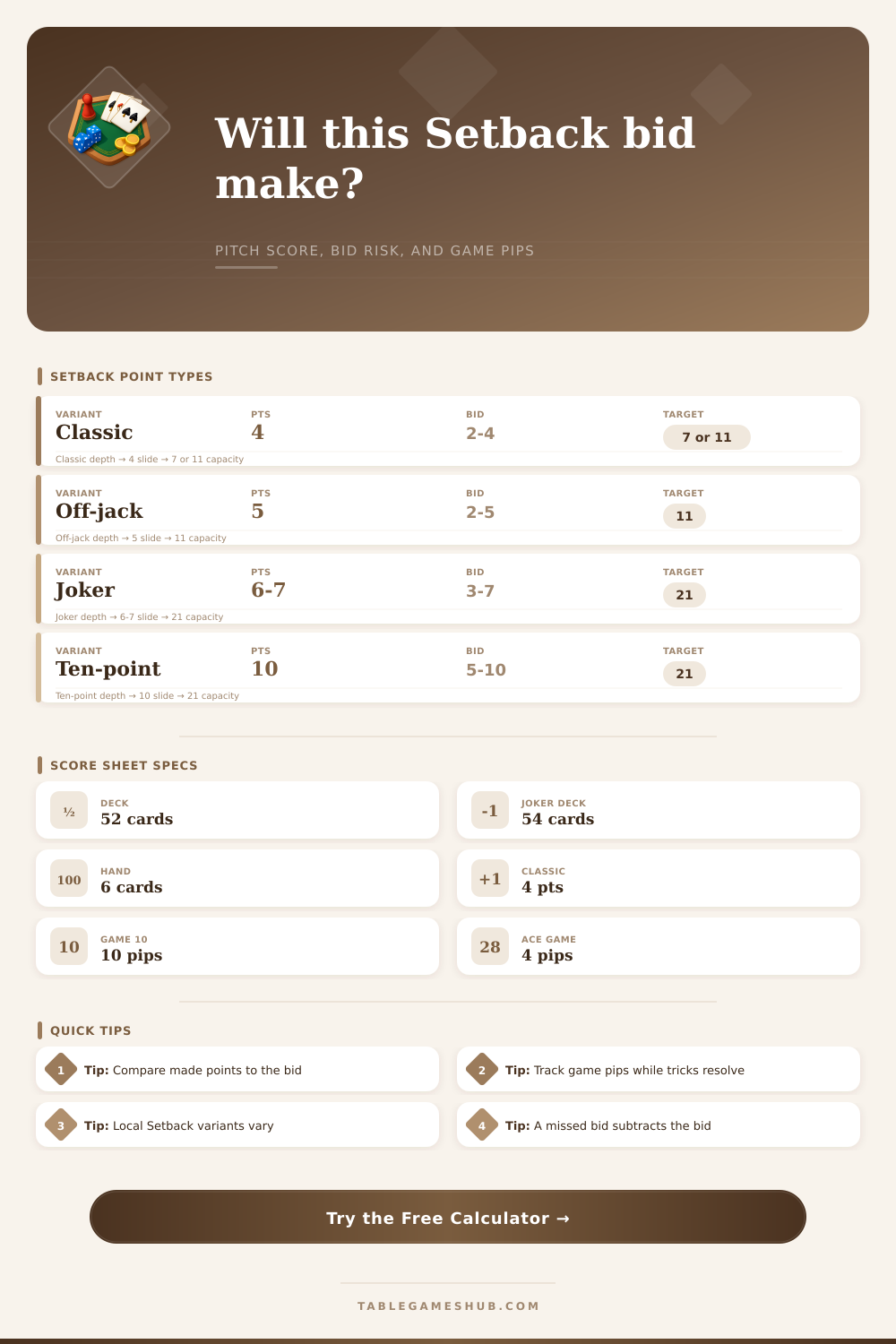
| Variant | Active points | Typical bid | Deck |
|---|---|---|---|
| Classic Setback | High, Low, Jack, Game | 2 to 4 | 52 cards |
| Off-jack Pitch | Classic plus off-jack | 2 to 5 | 52 cards |
| Joker Pitch | High, Low, Jacks, Jokers, Game | 3 to 7 | 54 cards |
| Oklahoma-style 10 | A, 2, J, off-J, jokers, 10, 3, Game | 5 to 10 | 54 cards |
| Game pip card | Pip value | Count in deck | Use in calculator |
|---|---|---|---|
| Ten | 10 pips | 4 cards | Biggest Game swing |
| Ace | 4 pips | 4 cards | Strong trick and Game value |
| King | 3 pips | 4 cards | Medium Game value |
| Queen / Jack | 2 / 1 pip | 8 cards | Useful tie breakers |
| Made points | Bid | Bidder delta | Score note |
|---|---|---|---|
| Below bid | Any bid | Minus bid | Bidder is set back |
| Equals bid | Contract | Add points | Contract is made |
| Above bid | Contract | Add all points | Extra points count |
| Shoot / max | All points | Variant rule | Check house rule |
| Preset | Variant | Bid | Why it matters |
|---|---|---|---|
| Classic Bid 2 | 4-point | 2 | Baseline contract |
| Shoot Four | 4-point | 4 | No missed point room |
| Joker 6-Point | 6-point | 4 | Jokers widen swings |
| Oklahoma 10 | 10-point | 7 | Three is worth 3 |
In card games such as Pitch or Setback where bidding aggressively mean committing yourself to taking certain tricks, there’s a particular sort of heartbreak involved when you lose those tricks, as it doesn’t just mean zero points but actualy subtracts from your standing. There you are opposite your partner as the cards come out, watching helplessly as you understand you’ve promised more points then you possess. Not only do you not get any points for this bad bet, but it actually removes some amount of value from your position, expanding the gap between you and competitors. Each point matter, moving you further from your goal with every hand dealt.
A good bid isn’t always obvious; there’s no simple “is my hand worth it?” answer, unless you understand that the answer depend on your chances of winning those cards against the rest of the deck and the number of point card in the mix. Every game variant alters those probabilities, turning a wise bid into foolhardy if you didn’t consider all the scoring components. Enter your variant configuration and page’s calculator will handle the math. This saves you from guessing at coefficients or doing arithmetic when you should of thinking about strategy.
How to Bid Smart in Pitch
So what do you decide? What are the weighted cards on your table? For a regular game, there are generally four: The Game point card (typically called just “the point”), the suit’s Jack of trump, the High card, and the Low card. But variations is common in many circles where extra points is earned from other suits’ jacks or from pip value on cards like the ten, three, or even joker(s). This not only changes the range of potential points that can be scored per hand, but it also changes the risk/reward ratio of each bid.
That said … Once you define the active points, you evaluate what you actualy hold in relation to those targets. Are you holding the ace of trump for High potential? Do you have the Jack or jokers within reach? You can mark each of these elements separately, which enables the tool to figure out how likely you are to capture them before the cards are all played out.
Why is this level of detail important? A single little point card can make the difference between being set back completely versus making a bid. It forces you to look at your hand precisely instead of relying on general feeling of strength, which often leads to an expensive overbid.
Then there’s the game pip, another element of strategy that the casual player may miss entirely. It’s the point value of each card, an ace is worth four; a ten is worth ten; a two is worth two, and so forth, all the way down to jack, queen, king. Whichever team has captured the highest value of these pips get the game point, often the decider in close matches. Put in your best guesses for what the pips will be, then find out whether you think you’ll have enough to clinch the extra win…or whether your opposition will swipe it away despite your lead in other categories. That’s the difference between good players and the great ones at competitive tables, where every single point make the difference.
In addition to cold mathematical odds of the cards, there’s also the factor of score dynamics and psychological pressure of bidding. If you’re way behind, you might need to take a big swing at catching up fast, but then again, if you miss and dig yourself an even bigger hole, oh well. If you’re comfortabley ahead, you could be more conservative while still defending against an aggressive opponent. The chart on this page gives some examples of various situations where your current distance from the target and your potential swing affect your score. Try them out to see if it’s worth going all-in, or if it would be a foolish emotional decision you’d regret later.
There’s no perfect formula for all friend groups or geographical locations; different houses has wildly varying house rules. In some games, only the person who played the lowest card gets Low; in others, it goes to whoever wins that trick. Depending on where you live, jokers may beat aces or fall below Kings in value. These are things you realy want to know ahead of time, because they dictate both which cards you’re likely to chase and how aggressive you’re willing to get with particular holdings. What seems like a solid hand according to one set of rules could be downright garbage according to another, when your goal is to score points that don’t even exist in that game variant.
The bottom line on learning Pitch or Setback is paying close attention to detail while applying discipline in measuring the risk against the potential reward. There’s no controlling what cards other players might have. You can control how carefully you consider the odds of getting those hands before you commit. Having a systematic approach to evaluating every hand takes the emotion out of bidding and replaces it with taking calculated risks that will hold up under fire over time. When you sit down at the table knowing exactly what you’re chasing is as valuable as the cards that you need to catch it.