Gin Score Calculator
Score a gin rummy hand with knock difference, defender layoff, undercut, gin, big gin, house bonuses, target checks, and match add-ons.
| Convention | Gin | Undercut | Match notes |
|---|---|---|---|
| North American common | 25 | 25 | Often uses 31 big gin and 100 target |
| Bicycle classic | 20 | 10 | Game bonus and hand-win bonus after target |
| Common mixed table | 25 | 20 | Useful when undercut is lower than gin |
| Traditional low bonus | 20 | 10 | Good for older printed score sheets |
| Outcome | Who scores | Formula | Layoff? |
|---|---|---|---|
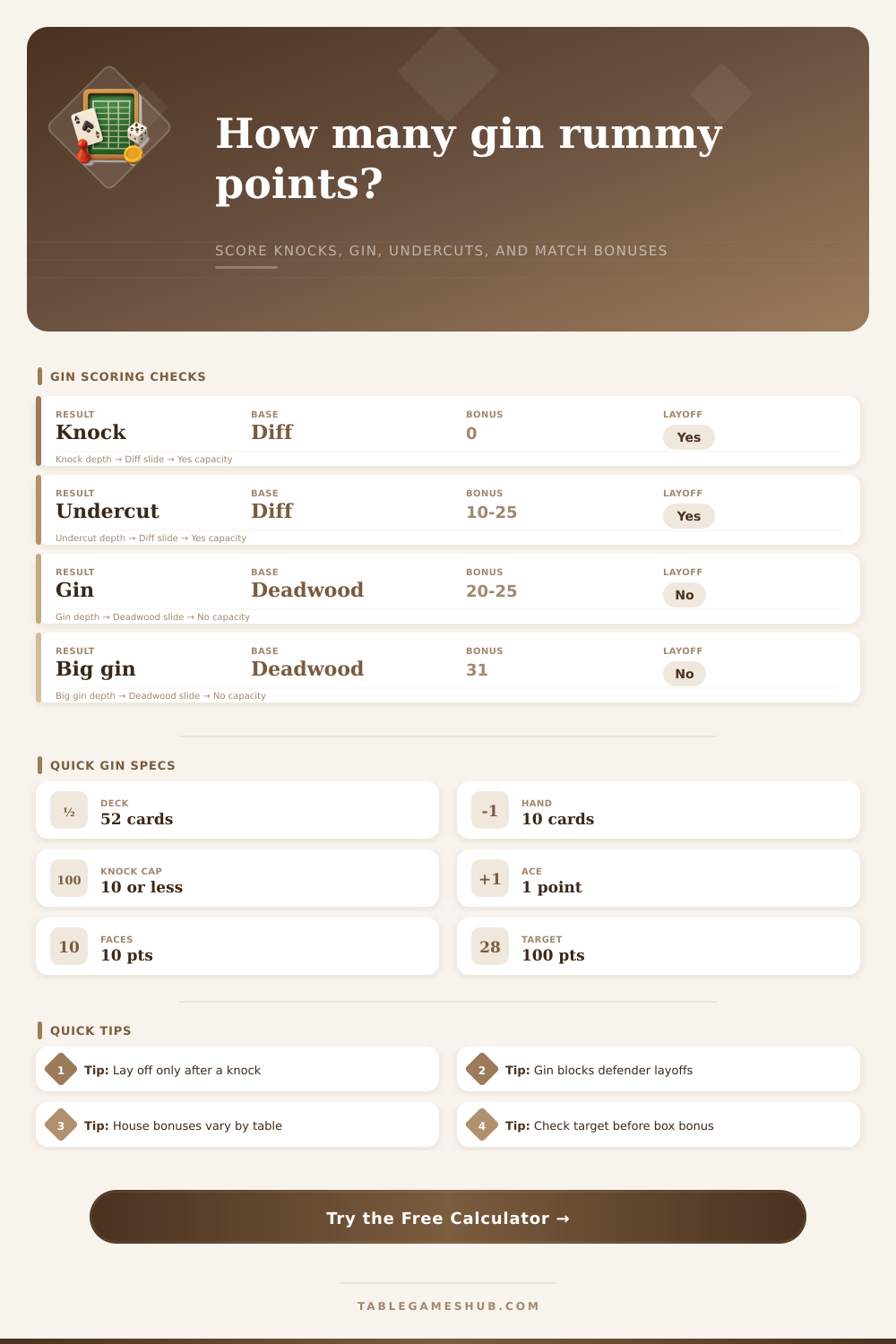
| Knock win | Knocker | Defender after layoff - knocker deadwood | Yes |
| Undercut | Defender | Undercut bonus + knocker - defender after layoff | Yes |
| Gin | Gin player | Gin bonus + opponent deadwood | No |
| Big gin | Big gin player | Big gin bonus + opponent deadwood | No |
| Card | Deadwood value | Run note | Score impact |
|---|---|---|---|
| Ace | 1 | Low in standard gin | Low risk deadwood |
| 2 through 9 | Face value | Same-suit sequences count as runs | Exact pip count |
| 10 | 10 | Can join 8-9-10 or 10-J-Q | High deadwood |
| Jack, Queen, King | 10 | Face-card runs are legal by suit | High deadwood |
| Bonus | Typical value | When added | Calculator field |
|---|---|---|---|
| Game bonus | 100 | After reaching target | Game bonus |
| Line or box bonus | 20 or 25 | Per hand won after target | Line bonus |
| Shutout bonus | 100 | Loser won no hands | Shutout bonus |
| Oklahoma spade | x2 | Hand score is doubled | Hand multiplier |
You hear it at the card table. Someone slams their cards down and the table goes quiet. That’s the cue in gin rummy; the hand is over and now comes the math. This is where arithmetic meets skill, and a basic rule misinterpretation can transform a winning hand into a costly embarrassment. There’s no need for accountants here, just a clear head and something to keep track of what comes next.
Plug in your deadwood counts in the calculator above and let it do the math; it will save you from doing the math yourself, with all the conversions and factors in play as the adrenaline flow.
How to Count Points in Gin Rummy
The deadwood come first. Deadwood is the set of cards that aren’t in sets or runs; these cards simply has their pip value for scoring purposes. Aces are worth one point, faces are ten points, the rest is what they say on their face. The idea here is to play down your card cleverly so your score goes down and eventually you either go out entirely or get it down to the level of the table. At which point someone says “knock.” This means that they’ve played down all of their deadwood (typically 10 points) and now give others an opportunity to lay off whatever they might have onto the other players’ melds.
Here’s where most people mess up: They don’t realize that when they make the layoff, it subtracts from their own score BEFORE a comparison even occurs. In other words, if the other person’s score doesn’t come down after the layoff, he undercuts the original player. It’s a nice turnabout, but only if you track who’s holding what accurately. This tool cleanly splits out those two cases.
Enter the opening deadwood of both players and indicate what the defending player can lay off. Then, let the logic determine if there is a knock win in plain sight or something more like an undercut. If you are playing by standard North American rules, the presets will suffice. If not, there are custom fields for the table’s non-standard bonus structure.
One thing to keep in mind: big gin and gin do not even consider the layoff. In the event that one player goes out with deadwood equal to zero, the other player doesn’t get a second shot. Instead, the score is just a flat bonus plus the points left in their hand. That makes for very strict scoring that honors aggression while punishing hesitation.
There’s another twist on top of hand scores: Match scoring. Most games is played to one hundred points, though there is no set way to get there. Some groups adds a box bonus for hitting the mark, or subtract a shutout penalty for when someone fails to win even one round. These accumulators are different than hand results and the calculator separates them out. Why? You need to keep in mind how much immediate points mean versus your overall match equity. You may be down a hand, but up because you picked up some early bonuses. Having those streams separate allows you to see where you really stand instead of blindly responding to what happened last time around the table.
What can cause tension between players is that they think their house rules apply everywhere. During an extended match, a twenty-point gin bonus isn’t quite like a twenty-five-point one. The page has some of more popular conventions, such as traditional low-bonus formats and the bicycle classic style, listed in its reference tables. Before beginning your play, it’s a good idea to glance through them so arguments don’t arise during game time.
If you’re a beginner, too, looking at the scoresheet your friend or neighbor uses will help teach you why yours appears differently. You’ll have a better time playing if everyone agree how the math works.
All in all, then, gin rummy is as much about quick math, probabilities, and yes, even memory, as any other game. But don’t let the speed of the cards make you hurry through the scoring, or else you’ll find yourself losing ground before long. A consistent way of counting points will assure that undercuts, knockers and bonuses is placed precisely in their proper place. What might of been a source of dispute becomes a matter of confirmation. And now that argument is out of the way, you can concentrate on the hand you’re dealt rather than the one just played. That’s what keeps the deals flowing smoothly at the table.