Ladder Ranking Calculator
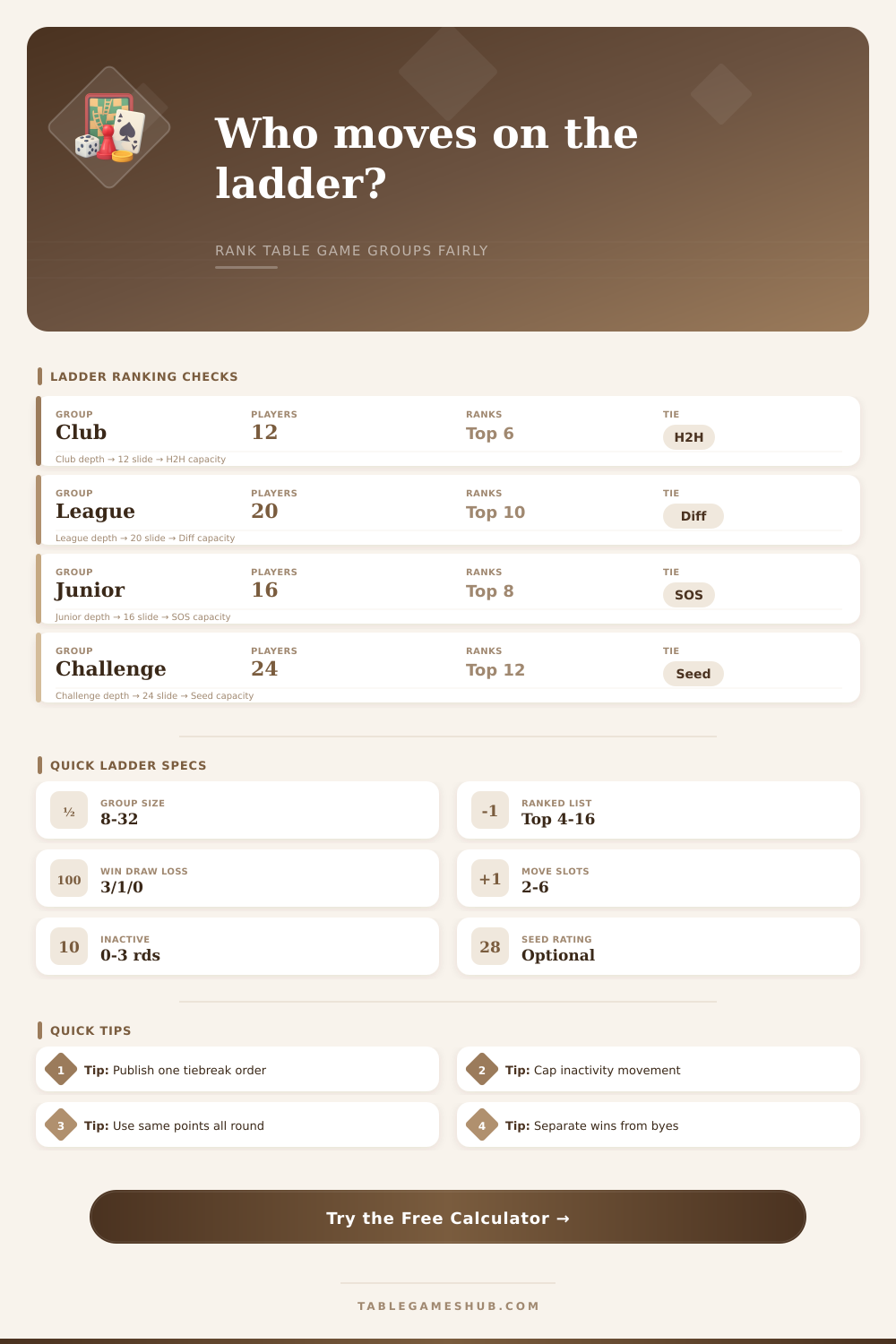
Rank a table game club, board game league, chess night, card ladder, or tournament group using match points, win rate, tiebreak rules, movement slots, inactivity policy, rounds played, and optional seed rating.
wins x W + draws x D + losses x L
points per round + win rate + activity
selected rule normalized to 0-100
current rank adjusted by allowed slots
| Profile | Win | Draw | Loss |
|---|---|---|---|
| Three-one-zero | 3 | 1 | 0 |
| Chess club classic | 1 | 0.5 | 0 |
| Backgammon night | 2 | 0 | 0 |
| Penalty ladder | 3 | 1 | -1 |
| Tiebreaker | Best input | Typical range | Use after |
|---|---|---|---|
| Head-to-head | Score versus tied players | 0 to 100 | Match points |
| Game differential | Games, sets, boards, or legs | -20 to +20 | Win rate |
| Strength of schedule | Opponent score percentage | 0 to 100 | Equal records |
| Rating seed | Pre-cycle rating or seed | Any scale | Unplayed ties |
| Ladder size | Published ranks | Common slot cap | Update style |
|---|---|---|---|
| 8 to 12 players | All or top 8 | 2 positions | Weekly |
| 13 to 20 players | Top 10 | 3 positions | Weekly or biweekly |
| 21 to 32 players | Top 16 | 4 positions | Round cycle |
| 33+ players | Division top lists | 5 or more | Division update |
| Policy | Climb allowed | Drop allowed | Best for |
|---|---|---|---|
| Hold rank, no upward move | No | Only by others passing | Casual clubs |
| Freeze rank completely | No | No | Short breaks |
| Demote missed rounds | No while inactive | Yes | Competitive ladders |
| Remove from movement list | No | Listed outside ranks | Season resets |
There’s a certain panic that sets in if the guy who beat you last week has the same exact record as you do tonight at chess night. Five wins, one draw, and two losses. The spreadsheet can’t tell you who should of been higher. So this is where ladder management gets philosophical instead of mathematical. There needs to be someone to break the tie, and you want something that would hold up under examination. You don’t want some whim passing as fairness.
But the calculator above do that math for you. It knows how to balance win rates with match points with tiebreaker weights. It handles math so you don’t have to perform mental gymnastics while serving tea. The key isn’t just having the correct rank at the end of the day; knowing what those inputs translate to in a social context is equally valuable.
How to Keep Your Game Ladder Fair
Total points are the easiest thing to explain, and most casual league operate this way. Three points for a win, one for a draw, zero for a loss. It is good enough until everybody ties. And then, well, you gotta fall back on some other rule. Your Friday night will get held up over a discussion about who has a better game differential different than their head-to-head record.
A tiebreaker tell you something about how your club values its players. Direct competition, head-to-head, values direct competition. The guy who won against his competitor means the most. Sounds fair, inside the room. Harder sections of a Swiss pairing gets punished because they got pulled into tougher games. Dominance, or game differential, flatters competitive egos. Sounds good on paper, but neglects the challenge of one’s draw. One guy beats three beginner; he’ll look good on paper. Another guy barely scrapes past three masters, but he did the harder work. The quality of opponents (strength of schedule) explains this imbalance, but it is a tiring calculation to do by hand.
What about those ladders with inactive players? Unavoidably, there are people who go on vacation and never come back, or just dissapears after round four. What do you do with them? Should their rank be frozen? That way, no one new will ever go past them, creating a frustrating artificial ceiling for other active player. Should you demote them right away? Then when they check back in, their spot is missing (leading to resentment). To help with this, the tool provides a variety of policies ranging from keeping everything frozen to lowering one slot per missed round.
There’s no right answer. Just select the policy closest to your group’s tolerance for change. A competitive table tennis league probably wants people moving up/down based off current form; a more casual card club might value stability over all else.
As a safety net against mayhem, caps constrain how much movement there is. In their absence, a player with a hot streak might jump up 15 spaces in one update. That messes up the whole board, and drives the rest of the field right off the edge of the cutoff line. A two or three-spot cap per cycle softens that volatility. It makes the ladder consistently trackable without sacrificing long-term merit-based progression. Although the site’s reference table on this page offers suggestions for caps depending on group size, tailor it to your own culture. Loosen the cap if your players love action, and tighten it if they become bitter at incremental changes.
The second piece of nuance come from Seed ratings; especially for larger group sizes or when there’s a mix of experience levels. Without seed ratings, you’ll have an entire round where people who are already good at that game start at 0 points, which gives beginners an advantage against experts. That’s not fair to the more experienced player. The seed rating evens out that first-round disadvantage. It lets the ladder converge quicker towards being truly meritocratic. No, it’s not about playing favorites. It’s about setting up the ladder so it measures how much people improve and how well they play, not just who can win when they are new.
At its heart, however, a ladder is simply a story of digits… But it’s the competitors who fill the tale. It’s their matches that provide the drama, not the tools. Establish the parameters up front. Display the scores unashamedly. Know that being fair doesn’t necessarily mean being mathematically perfect; sometimes it’s about consistency. When players understand what’s at stake and when they know the system isn’t going to shift, even those who lose will accept the outcome. And that’s how you get ‘em lining up again for round two.