Solkoff Score Calculator
Total opponent scores for Swiss tiebreaks, compare cut variants, and audit schedule strength from one score list.
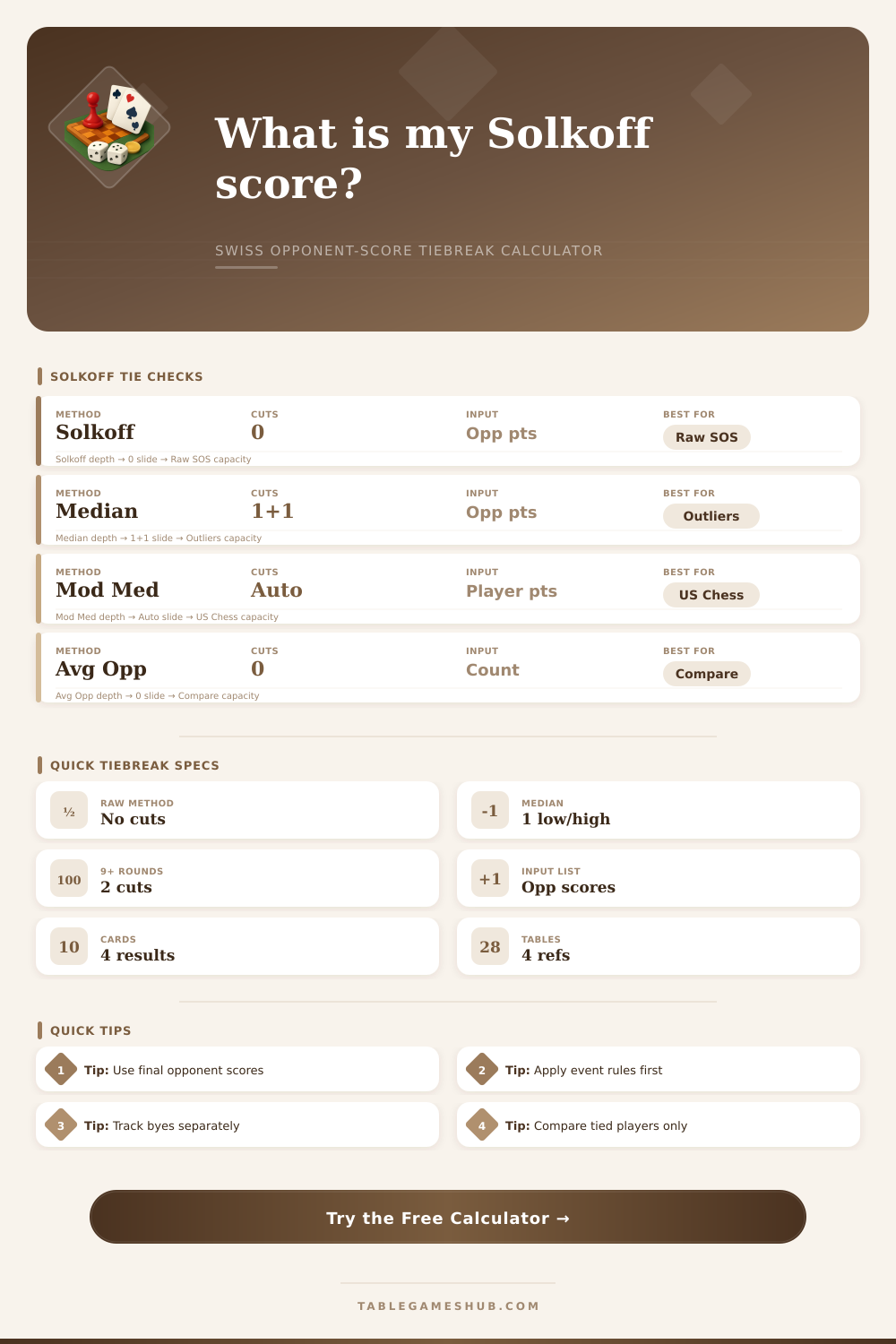
Solkoff is the full sum of your opponents' final scores. Use the cut controls to compare related Buchholz or median variants, but keep the raw Solkoff card as the no-cut schedule-strength result.
Raw Solkoff
S = sum O
Add every counted opponent's final adjusted score. No high or low score is discarded.
Median Cut
S - low - high
Median-style comparisons remove extreme opponent scores before summing.
Modified Median
cut by score
Above 50% cuts low; below 50% cuts high; exactly 50% cuts both.
Average Opponent
S / games
Normalizes Solkoff when comparing events or players with different counted games.
| Tiebreak | Core calculation | What it rewards | When to use |
|---|---|---|---|
| Solkoff | Sum of all opponent scores | Harder schedule | US-style Swiss tiebreak lists |
| Buchholz | Sum of opponent scores | Harder schedule | FIDE-style terminology |
| Median | Cut highest and lowest, then sum | Outlier resistance | Short Swiss events with uneven pairings |
| Modified Median | Cut depends on player score band | Score-band fairness | Common scholastic and club comparisons |
| Rounds | Common raw max | Median cut pattern | Audit note |
|---|---|---|---|
| 3 rounds | 9 opponent pts at 1-point scale | Usually no or 1+1 cut | Cuts can remove too much data |
| 5 rounds | 25 opponent pts at 1-point scale | 1 low and 1 high | Good for small Swiss sections |
| 7 rounds | 49 opponent pts at 1-point scale | 1 low and 1 high | Raw Solkoff becomes steadier |
| 9+ rounds | Rounds squared at 1-point scale | Often 2 low and 2 high | Long events tolerate deeper cuts |
| Score scale | Win | Draw / tie | Solkoff entry example |
|---|---|---|---|
| Chess standard | 1 | 0.5 | 4, 3.5, 3, 2.5, 2 |
| Swiss match points | 3 | 1 | 12, 9, 9, 6, 6 |
| League table | 2 | 1 | 8, 7, 6, 5, 4 |
| Custom event | Event rule | Event rule | Use final standings score list |
| Result band | Average opponent | Schedule read | Practical check |
|---|---|---|---|
| Soft schedule | Below field average | Opponents scored less than field pace | Compare tied players carefully |
| Balanced schedule | Near field average | Typical Swiss path | Raw score is usually stable |
| Strong schedule | Above field average | Opponents performed well | Solkoff helps distinguish equal scores |
| Distorted schedule | Many byes or drops | Adjustment rules matter | Audit unplayed rounds before ranking |
Use final adjusted scores
Solkoff is only final after every opponent's last-round score is known. If the event adjusts byes or withdrawals, enter the adjusted opponent totals rather than early standings.
Separate raw and cut scores
Raw Solkoff and median-style cut scores can rank the same tie differently. Publish the exact tiebreak order before applying the numbers.
Solkoff is basically a way to figure out how difficult your section was and compare two people’s sections if they each ended up tied at the end of the event, say after 5 rounds. They has the same score on paper, but maybe one person won against a bunch of weak opponents where the other person had to play tougher ones. Solkoff adds up your final scores for each of those opponents to get what we call your Solkoff score. It then shows whose path to victory was more challenging.
A raw score doesn’t always tell whole story about how well someone did in competition. The Solkoff score does more than that by figuring out a competitor’s schedule strength and showing who really had it tough coming through the field. The score is the final one in that column after all rounds have been completed. It may be adjusted by the director if an opponent withdrew late or was given a bye; make sure you enter what’s shown on official results.
What is Solkoff Score?
Solkoff assumes you are providing the full picture of how everyone in the field performed… Don’t use stale numbers. The site lets you enter your opponents’ scores in several ways, using line breaks or commas between them, which can be easily copied from printout or a spreadsheet instead of fussing around with editing out spaces. No more laborious adding up yourself with a chance for transcription error!
To understand how it’s effective, one must look at the type of pairings found in the Swiss format. Early rounds have noise due to luck or untested ratings. The system attempts to even pairings based on relative strength, but there is plenty of noise in those initial rounds. Someone who happens to beat a bunch of lower rated players in opening rounds will end up with better point total but may actualy face stronger players later. Conversely, someone who has an off day early on will end up with more favorable matches later.
What Solkoff does is sum the strength of your opponents over all of the tournament instead of each individual round. The idea is that if you have a lot of points from beating highly scoring players, then you had a tough draw. And having an off week would of give you a lighter draw. That reasoning make sense especially when considering really large fields with a normal spread of ratings and typical pairing algorithms.
There are a few problems with raw summation. That’s where cut comparisons come in, but even they has their blind spots. A tough round will boost your score more if you happened to draw one great opponent. In contrast, a weak round can harm your total more if you drew a very good opponent. So the median variant tosses out the high and low scoring opponents and then sums up the remaining ones. It reduces the outlier effect, making a player’s difficulty rating less prone to how hard he matched-up against his best (or worst) opponents.
Modified median adds another layer to make things fairer towards those whose final score falls in top and bottom ends of field. It adjusts cuts based on your final score band. Why? Tournament directors want options when the normal rules result in some uncertain rankings.
Another point to remember is that some tournaments will count byes and unplayed rounds different than others. For example, one may only give half points. Another may give no points at all, and still another may give the opponent’s average of their field. That’s why there are options in the calculator that allow you to adjust for those variations so that your Solkoff matches the local regulations. That’s something you don’t want to skip over because then you might have a different result between two areas or organizations. So always make sure the opponent unplayed adjustment fits the particular tournament you’re participating in before you settle up for your entry.
To help illustrate this, a reference table is provided on the page. It compares the methods by format and shows that they have some commonalities in their results. You’ll notice that the median methods tend towards stability in terms of not getting hurt by outliers and Solkoff rewards tougher schedules consistantly. Because the impact of any single opponent diminishes relative to the whole as the round count increases (a 9+ round event is considered “long”), the raw Solkoff gets even more stable. With shorter events, where every game counts more, the cut can be more important. So having an idea about what method is used for your event can help in mentally preparing for tie breaking scenarios.
This is the bottom line. The tiebreakers exist because they’re backup metrics used to split ties when two competitors have identical scores on everything else. They aren’t a substitute for skill; they’re the tiebreaking tool that seems most reasonable (versus drawing straws, counting backs, etc.). Having a good Solkoff means you can deal with the pressure and play well against tough competition.
Knowing what all those numbers mean clarifies the tiebreaking system instead of confusing it, regardless of whether or not you walk away victorious. Instead of looking at the leaderboards as a bunch of static information, you’ll read them as a story about who’s doing well and who has been challenged. That change in mindset helps you understand your Solkoff value instead of just seeing your rank in the prizes.