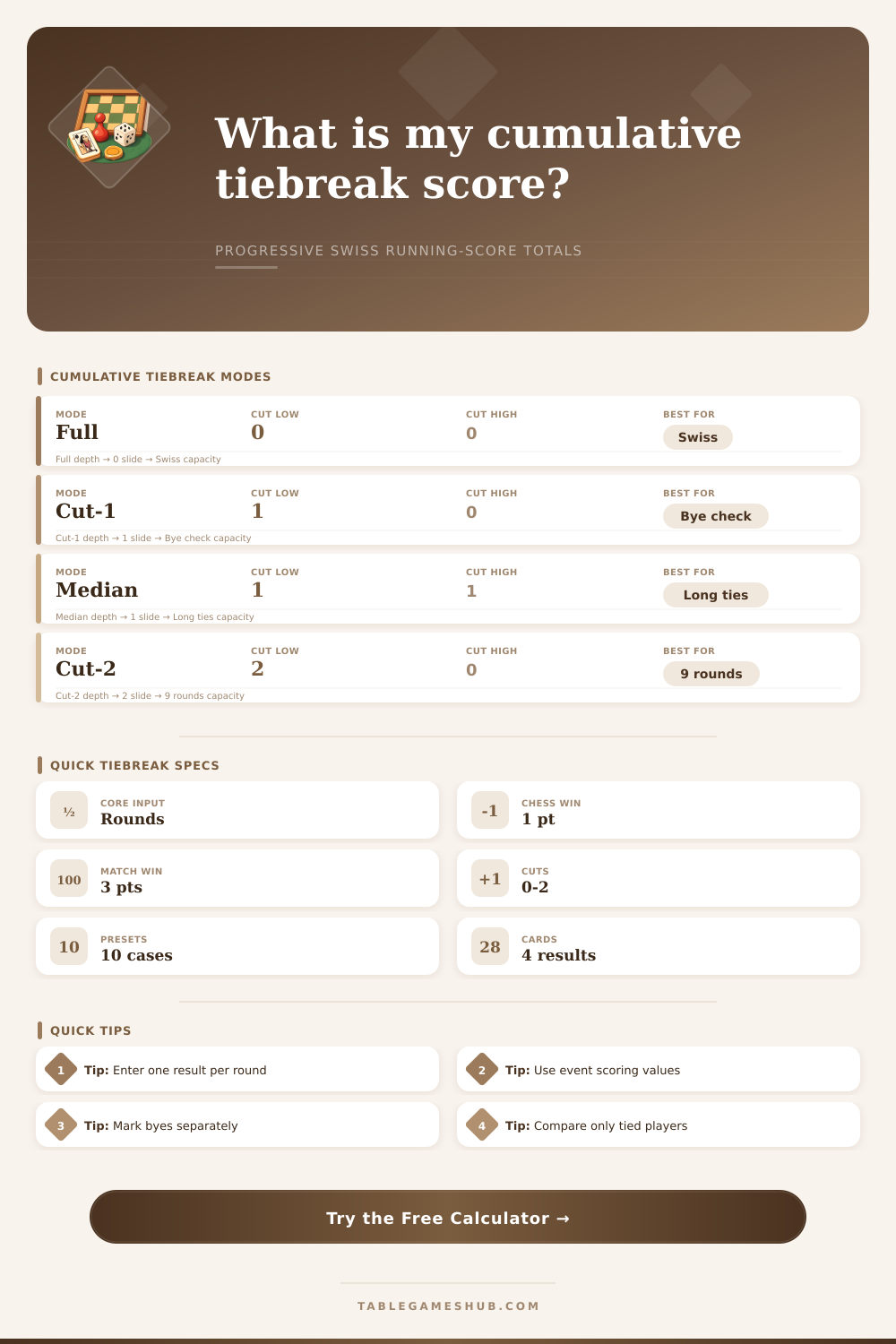
Cumulative Tiebreak Calculator
Total each player's progressive running score, apply common cut modes, and compare tied Swiss or match-play standings.
S(r) = points from rounds 1 through r
C = S(1) + S(2) + ... + S(n)
Ccut = C minus selected low or high values
CO = total listed opponent final scores
| Profile | Win | Draw | Loss | Common tabletop use |
|---|---|---|---|---|
| Chess / board game points | 1 | 0.5 | 0 | Swiss chess, abstracts, many board-game leagues |
| 3-1-0 match points | 3 | 1 | 0 | Card game rounds, team matches, league tables |
| Win-loss only | 1 | 0 | 0 | Short no-draw events and kids brackets |
| Custom scoring | Editable | Editable | Editable | House events with nonstandard point values |
| Mode | What is removed | Use when | Effect on early loss |
|---|---|---|---|
| Full cumulative | No running scores | Default progressive tiebreak | Strongly rewards fast starts |
| Cut lowest running score | One lowest S(r) | Rules soften one poor or bye round | Moderately softens early loss |
| Cut highest running score | One highest S(r) | Rules reduce top-end separation | Still rewards fast starts |
| Median cut | One lowest and one highest | Longer Swiss events need a middle total | Balances early and late results |
| Cut two lowest | Two lowest S(r) | Nine or more rounds with published cut rules | Softest for a slow start |
| Sequence | Round scores | Running totals | Final | Cumulative |
|---|---|---|---|---|
| Fast start | 1, 1, 0.5, 0, 1 | 1, 2, 2.5, 2.5, 3.5 | 3.5 | 11.5 |
| Late surge | 0, 1, 0.5, 1, 1 | 0, 1, 1.5, 2.5, 3.5 | 3.5 | 8.5 |
| Steady draws | 0.5, 0.5, 1, 0.5, 1 | 0.5, 1, 2, 2.5, 3.5 | 3.5 | 9.5 |
| Match points | 3, 1, 3, 0, 3 | 3, 4, 7, 7, 10 | 10 | 31 |
| Token | Meaning | Score source | Penalty option | Best audit use |
|---|---|---|---|---|
| B | Full-point bye | Bye value field | Score or running-score deduction | Swiss bye fairness check |
| F | Forfeit win | Bye value field | Score or running-score deduction | Opponent did not play |
| H | Half-point bye | Half-bye value field | Half or score deduction | Requested non-play round |
| Blank round | Not entered | No automatic score | No deduction unless entered | Incomplete standings draft |
In a Swiss tournament, few rounds end with a Hollywood-style finish. Instead, it tends to be a hushed mathematical puzzle in one of the halls’ corners: two competitors with the same score is facing off against each other. And while it’s not always the victor who carries the trophy home. Often, it’s the one with the most points from tiebreaks.
This is a fine detail that isn’t necessarily a measure of what you won, but when you won it. To understand that, you have to see beyond overall total. That’s your number of games taken. A tiebreak is running total version that adds up your score at the end of each round. This means wins in early rounds add to your tiebreak six additional times while a final-round win only adds once.
Why Early Wins Are More Important
In other words, starting off aggressive pays, because each point accumulates as time goes on giving a player who gets out ahead an early mathematical cushion that’s difficult to erode if they lose steam later on. Plug in your set of results into the calculator (above), and let it do the tiresome work of adding all those middle scores for you.
It all hinges on your points system, i.e., what does “points” mean in the context of your particular event? Are wins worth 1 point, draws 0.5? Or do you use a three-point system like in chess (win = 1, loss = 0, draw = 0.5)? Perhaps you’re playing a league match or card game where each win are worth three points. Whatever the case, the tool allow you to modify those numbers accordingly so that result will be true to your standings different than some theoretical ideal.
Then there’s the matter of byes. Yes, a full-point bye looks great on a scorecard, but in most situations, the rules does not penalize you for missing a round, which artificially pads your cumulative total. To keep things fair, many organizers deduct points or ignore certain running scores. This is clearly explained in page’s reference table. The table shows exactly when each type of deduction applies. This allows you to check your own standings with confidence.
Adding a further level of complication are Cut modes which tend to baffle newbies. Some tournaments has rules where the highest and/or lowest running scores is removed at each stage before adding up rest. This is intended to stop a bad beat in the first few rounds from wrecking your tournament prospects permanently. So if you lose one game in round two, you will stay on a lower number for a while but it continues to drag your overall number down. The Cut-Low option removes that sting. Essentaly it applies some statistical mercy. But not all tournaments feature a cut system.
Get these wrong and they can invalidate your entry or skew the outcome. You need to set the calculator to match tournament rules exactly. Once you isolate out the variables, it’s easy to compare players who is tied. Simply enter your sequence, then your opponent’s sequence side by side and tool will highlight difference at once. Maybe one of them had more draws but still ended up with a better cumulative, because they won early on in the schedule. This makes all the difference in a close race. It shows how the competition plays out below surface of the scores.
I think folks confuse this as a bonus for getting hot down the stretch, but instead it’s a punishment for being cold out of the gate. It rewards consistent play right out of the gates. Emotionally, it may feel good to close strong, but mathematically, you can’t make up time. And no amount of points that you earn after other players’ points have already passed will fix your arithmetic deficit created during the first half of the tournament.
Just play each round like it’s the first. Get those points early; they’re worth far more then any last-round win. When all the smoke clears and the scoreboards match, those early points will probably be what send someone away with the trophy.