Head to Head Tiebreaker Calculator
Build a mini-table for tied players, then compare direct points, win rate, score margin, and schedule completeness.
| Method | Best For | Main Formula | Watch Point |
|---|---|---|---|
| Mini-table points | Round robin and group stages | Wins x win value + draws x draw value | All tied pairs should be represented |
| Direct win percentage | Club ladders and leagues | Direct wins divided by games played | Can overstate short schedules |
| Score differential | Scrabble, Catan, point games | Direct score for minus direct score against | Use only tied-group games |
| Average points per game | Uneven schedules | Mini-table points divided by direct games | Check if rules permit averaging |
| Game Type | Typical Win | Draw or Tie | Common Next Tiebreak |
|---|---|---|---|
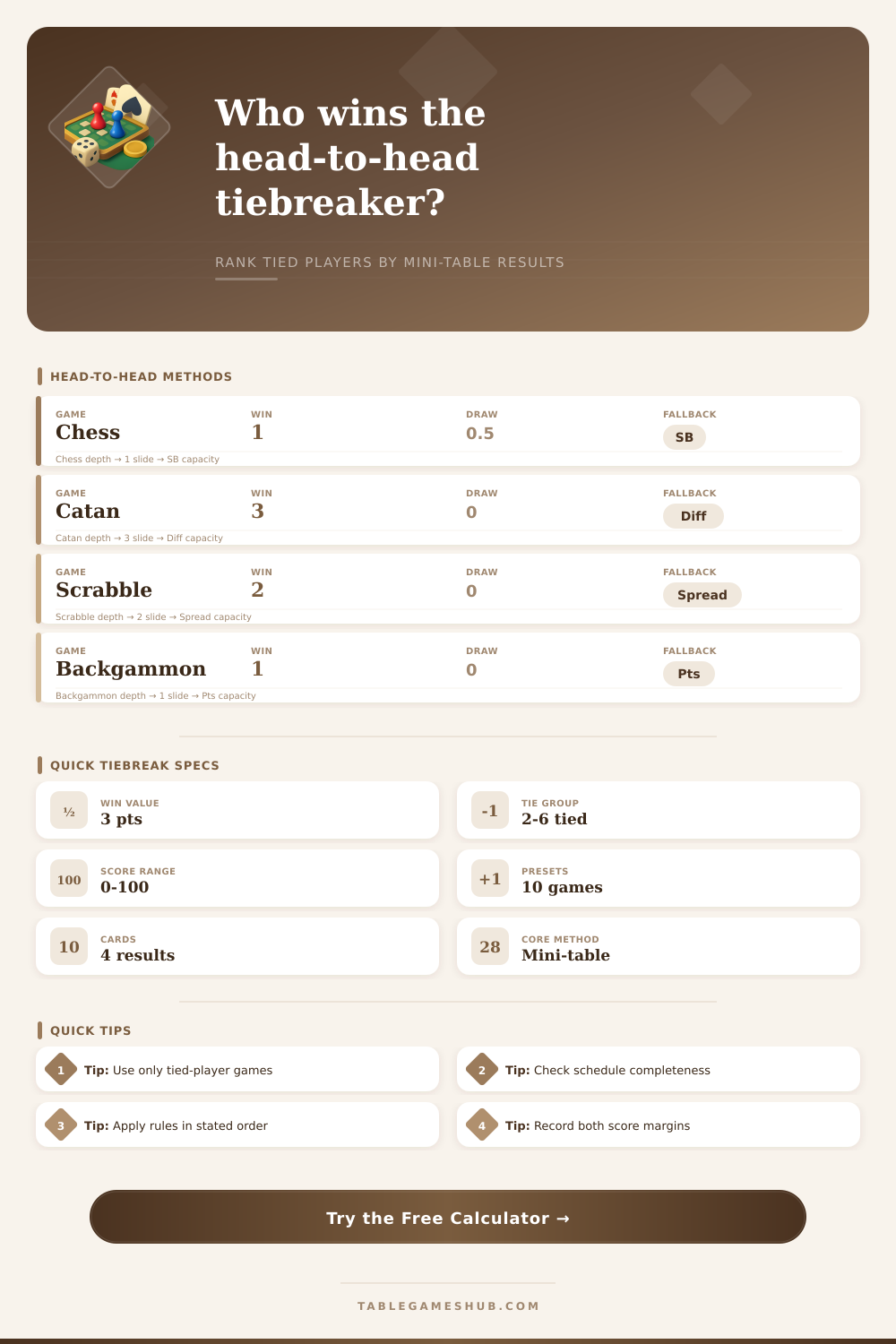
| Chess tournament | 1 point | 0.5 point | Sonneborn-Berger or Buchholz |
| Catan league | 3 match points | Rare shared points | Victory point differential |
| Scrabble event | 1 or 2 match points | Usually no draw | Point spread |
| Backgammon ladder | 1 match win | No draw | Match points or opponent strength |
| Bridge teams | VP scale result | Shared victory points | IMP balance or direct board result |
| Tied Players | Single Round Games | Double Round Games | Completeness Note |
|---|---|---|---|
| 2 tied players | 1 direct game | 2 direct games | Simple direct comparison |
| 3 tied players | 2 direct games per player | 4 direct games per player | Mini-table often decides cleanly |
| 4 tied players | 3 direct games per player | 6 direct games per player | Watch for unplayed pairings |
| 5 tied players | 4 direct games per player | 8 direct games per player | Average rules may be needed |
| Result Card | Formula | Meaning | Interpretation |
|---|---|---|---|
| Mini-table points | W x win points + D x draw points | Direct ranking score | Higher is stronger |
| Head-to-head rate | Points earned divided by possible points | Normalized direct performance | Useful for uneven schedules |
| Score differential | Score for minus score against | Direct margin | Positive margins help fallbacks |
| Schedule completeness | Played direct games divided by scheduled games | Rule eligibility check | Strict events need 100% |
It starts at game table, ends up as a spreadsheet, and finishes with clear numbers that nobody can dispute. After a nail-biting league night or round robin, there are handshakes all around, but it turns out that three of you scored exactly the same number of points. Suddenly the tension reappears, because no one’s prepared to play a sudden death playoff or coin flip to see who walks away with the trophy.
Enter head-to-head tiebreaker calculator (above) to rescue your gaming group from fights fueled by frustration. Removing the noise created by playing against easier opponents lets you focus solely on how each of the tied competitors did against one another. And once you start thinking like that, entire conversation becomes different: Who really earned the top spot? But it’s an idea that many casual tournament organizers don’t quite get.
How to Fix Tied Scores Fairly
Consider Alice, Bob, and Charlie. All three is tied for first. When you draw a mini-table with just those three, then you don’t consider any of their scores when they played against Diana or Ethan. Only Alice vs. Bob, Alice vs. Charlie, and Bob vs. Charlie matters. That isolates their own performances directy.
It doesn’t let some poor soul pile up points because he beat down on some weak players while someone else beat up on the better competition. Then the better player would sneak out ahead, which isn’t right. The calculator takes care of all of the filtering math for you. You don’t have to go back and manually rewrite your standings board.
What’s the value of a win? Every game format has its own rules. Some are subtle, like in Chess where a win is worth one point and a tie is worth a half. Others are quite blunt, such as a Catan tournament that may score games as three points per win and zero points per loss. You can plug those numbers into the tool and points on the mini-table will adjust to match what real world rewards. (If the win value is large enough to matter, then this prevents a player who ties 5 times from outscoring a player who wins 3 times but loses twice.)
If you happen to run a traditional 3-1-0 scoring system like many clubs do, the calculator will show results as being significantly more weighted toward wins than ties. The largest trap here though is assuming your schedule is complete. You can’t compare apples to apples unless everyone has played each other equally, but how would you know?
The page lists a great reference table showing how many groups there need to be in order to create a perfect mini-table. That means three guys with one game against everyone else will work out perfectly. But if Alice and Bob played each other two times, and Charlie only played them once each, then the sample size was skewed. Under most strict rules you’d need everyone to have played each other at least once for their head-to-head match to be considered valid. The tool also flags it as incomplete so that you don’t apply an unfair metric.
The direct record doesn’t always tell the story, especially when it’s uneven (or perhaps even too close for comfort). Then there should of a backup plan. For games with scores and point differentials, think Catan, Scrabble, etc… Use point differential as your metric. For each mini-table, you take away the points given up from the points scored. That better indicates who dominated the match, rather than simply tallying wins.
One person may have won more matches, but only narrowly, while another lost one match but thoroughly dominated all others. The point differential will show the spread. The calculator does this math for you automatically from whatever score inputs you enter.
When it’s all messy in the head-to-head, however, it’s tempting to jump right to the overall tournament and tally scores there, but that kind of goes against the point of the tiebreaker structure. The organizers sets up those rules so that direct competition would be valued over an easy win. If you only look at how the two tied competitors interacted with each other, then you’ll reward those that went out and rose to the occasion against their peers.
You’ll create a story that features a winner who outperformed the exact folks that was standing right next to him or her. If you don’t know where to begin, just use one of the pre-sets. These pre-sets include the most common game types like Catan and chess, load up a reasonable number, and let you see what math does with those numbers. Then tweak the inputs based on the scores that you actualy came up with and see how the rankings change.
If the win values are high, then sometimes a single draw can completely alter everything. Once you get a handle on it, it’ll help you explain results to your friends before anybody gets into a debate over who had the better roll/luck/etc. It’s all about making the decision feel like something you’ve earned, not just one that was made randomly.
If everyone agrees that the person won because they beat their competitors head-to-head in a way that proved who could handle the heat best, then people is more willing to accept it. It’s not about randomizers that make things awkward and push you toward talking about strategy and skill instead. That additional minute you spend inputting information into the calculator is worth it for the final clarity.
Arguments begin around the table, but arguments end around clear numbers nobody can argue against.