Double Round Robin Calculator
Plan a complete home-and-away, color-swap, or mirrored tabletop league with total matches, rounds, byes, table waves, schedule time, and a generated pairing preview.
◎Double Round Robin Presets
Load a common table-game league shape, then adjust table count, match length, breaks, scoring, and daily time limits.
⚙League Inputs
| Round | Leg | Main pairings | Bye |
|---|
∑Formula Cards
matches = n x (n - 1)Every pair meets twice, so the single round-robin combination count is doubled.rounds = 2 x (n' - 1)Use n' as the next even number when the field has an odd participant count.waves = ceil(floor(n / 2) / tables)Each round can require multiple waves when boards or tables are limited.time = base minutes x (1 + buffer)Base minutes include match time, wave changeovers, and breaks between rounds.📋Double Round Robin Specs
☰Reference Tables
| Participants | Total matches | Total rounds | Matches per participant |
|---|---|---|---|
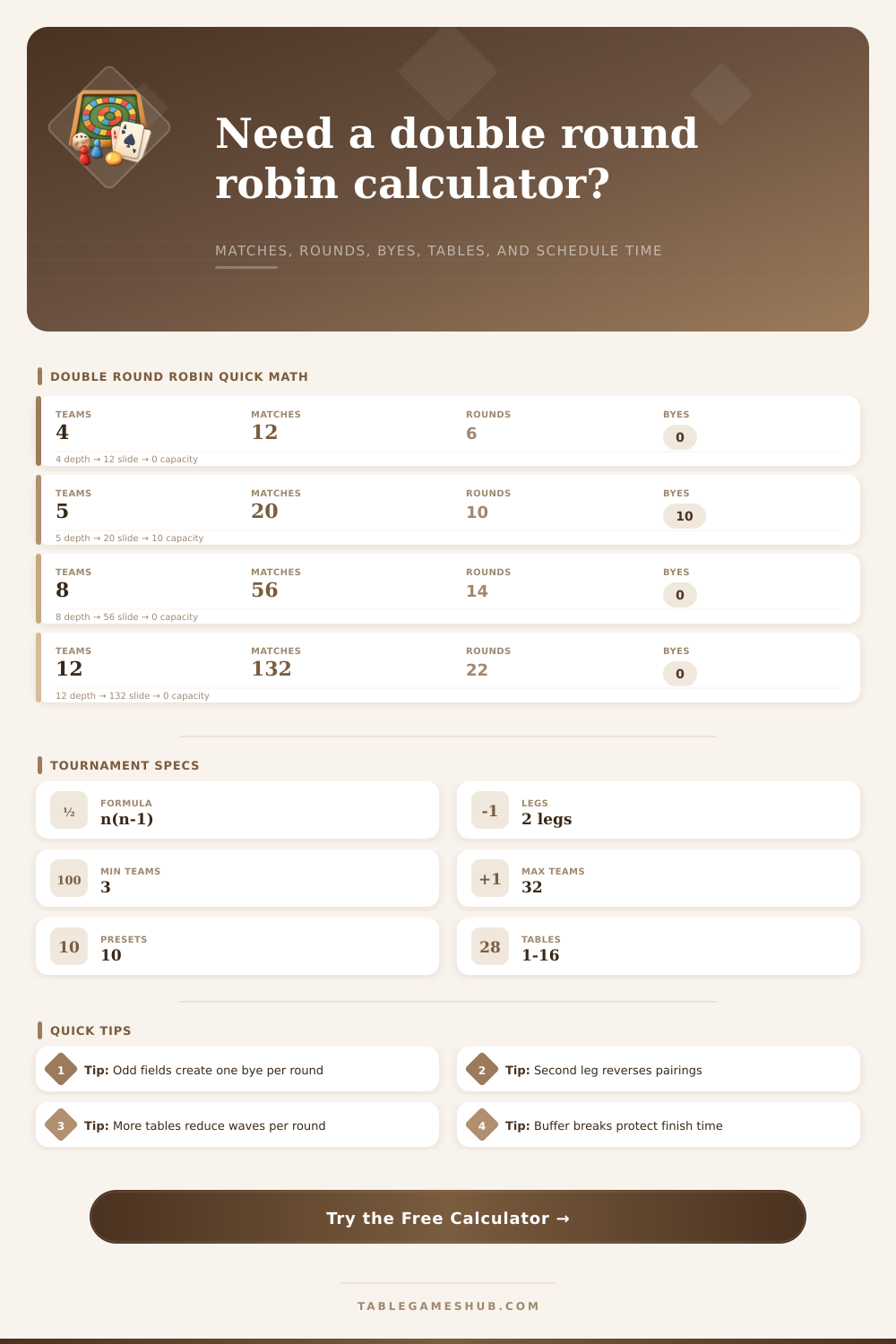
| 3 players | 6 | 6 with byes | 4 |
| 4 players | 12 | 6 | 6 |
| 6 players | 30 | 10 | 10 |
| 8 players | 56 | 14 | 14 |
| 10 players | 90 | 18 | 18 |
| 12 players | 132 | 22 | 22 |
| Field | Active matches per round | Tables | Waves per round |
|---|---|---|---|
| 5 players | 2 | 1 table | 2 waves plus one bye |
| 8 players | 4 | 2 tables | 2 waves |
| 10 players | 5 | 4 tables | 2 waves |
| 12 players | 6 | 6 tables | 1 wave |
| 16 players | 8 | 4 tables | 2 waves |
| System | Win | Draw | Useful for |
|---|---|---|---|
| 3-1-0 | 3 | 1 | Chess, Go, club board-game leagues |
| 2-1-0 | 2 | 1 | Compact match tables and older chess sheets |
| 1-0.5-0 | 1 | 0.5 | Traditional chess and head-to-head boards |
| 1-0-0 | 1 | 0 | No-draw tabletop or table tennis formats |
| Format | Best field | Time profile | Planning note |
|---|---|---|---|
| Final group | 3 to 4 players | Short but intense | Great tie-break clarity |
| Club league | 6 to 10 players | Several evenings | Easy home-and-away balance |
| Team season | 12 to 16 teams | Long season | Use rounds-per-day caps |
| Weekend marathon | 8 to 20 teams | Table limited | Watch waves and breaks |
ℹScheduling Tips
Bye tip: Odd participant counts do not change the total match formula, but they add one empty slot every round. Use the schedule preview to see who rests.
Table tip: If waves per round are above two, adding even one extra table often saves more time than shortening every match by a few minutes.
A local board game night sounds easy: we just need to set up some games. Everyone plays nice, and we’ll get it all done in time on a Tuesday evening. Nobody want to sit idle for forty-five minutes while waiting for their turn. Chaos can follow; but with a bit of clever construction, the double round robin structure prevents that.
Each player compete against each other player exactly twice, alternating who goes first or has home advantage. Luck is evened out, and there’s no doubt at the end about who won. How does this work? Turns out the mathematics to plan it isn’t easy, yet it doesn’t have to be hard. Fairness versus time, that’s always the dilemma.
How to Plan a Fair Board Game Night
With four tables, and eight players, there’s no way to run all four of those matches at once in one round. So you end up splitting them into waves. That means half the field wait while the other half plays. And then adding an extra table reduces that second wave down to nothing, which greatly reduces the overall length of your event.
Once you’ve defined what time you want and how many tables is available, the calculator will take care of those details for you. It doesn’t just spit out a theoretical “ideal” based off numbers. It’ll actualy figure out a realistic timeline from those raw numbers of participants.
The other head-scratcher comes from odd numbers of player. In this case, each round someone has to sit out because there’s no way for them to compete. That’s called a bye. It’ll allow that person some free time but it’ll reduce their playtime throughout the season compared to others in the group. Depending on who you’re with, those added breaks may become boring or even feel unfair over time.
To keep everyone involved, you might consider having a placeholder team or rotating hosting duties to fill that spot. Knowing exactly how many byes you’ll create will help determine whether it’s worth the headache going with an odd number of people or if you should of just invite another so you can balance out the board.
Beyond this, it turns out that scoring systems matters more than most folks think they do. Is your league collaborative or competitive? This comes down to the scoring system you use. If you give someone 3 points for winning and a half-point for drawing (as with Go and chess), you’re acknowledging the skill involved in stalemate and encouraging a more aggressive style of play. By setting this upfront, you avoid debates about why one player should get credit for something another doesn’t after all… Say, because they finished even in wins but won their games in different ways.
You can test out how those scores will affect standings using the tool, and change your incentives beforehand. And they undervalue how much time there is between rounds. There’s at least five minutes for players to pack everything back up, locate their next player, and get table set up again. This adds up fast over a dozen matches. Every single night, your event will be running late if you don’t account for this.
The time you build into your event for scoring and setup isn’t administrative padding, it’s the thing that preserves the actual game time. When you estimate more time on your schedule, you’re purchasing peace of mind. What’s beautiful about it is that it scales up or down as well. It could be a quick hour for a foursome. It could be a full weekend marathon for 20 teams. Doesn’t matter how big, the principles is the same.
Just keep one eye on the clock on the wall and the other on the geometry of the room. Visualize the breaks and waves before your launch. You will turn what could have been a scheduling nightmare into a smoothly running tournament. The math is surprisingly dense, but planning out events means setting your expectations as well as you can.
Planning out events means setting your expectations as well as you can. Players appreciate knowing what’s coming up next and when it will happen. That keeps them happy and on task. They don’t wonder if it is still going. Is it ever gonna happen? A good plan gives the players a structure that doesn’t feel stuffy.
There’s some wiggle room for the games to go where they want to, but it keeps it contained in an event. When done correctly, a double round robin happens without anyone realizing you did most of the work beforehand. You made space for human error, accounted for empty seats and balanced the books. What’s left?
The league concludes with a clear winner while running on schedule. Every board game player walks away knowing precisely where they ranked against the field.